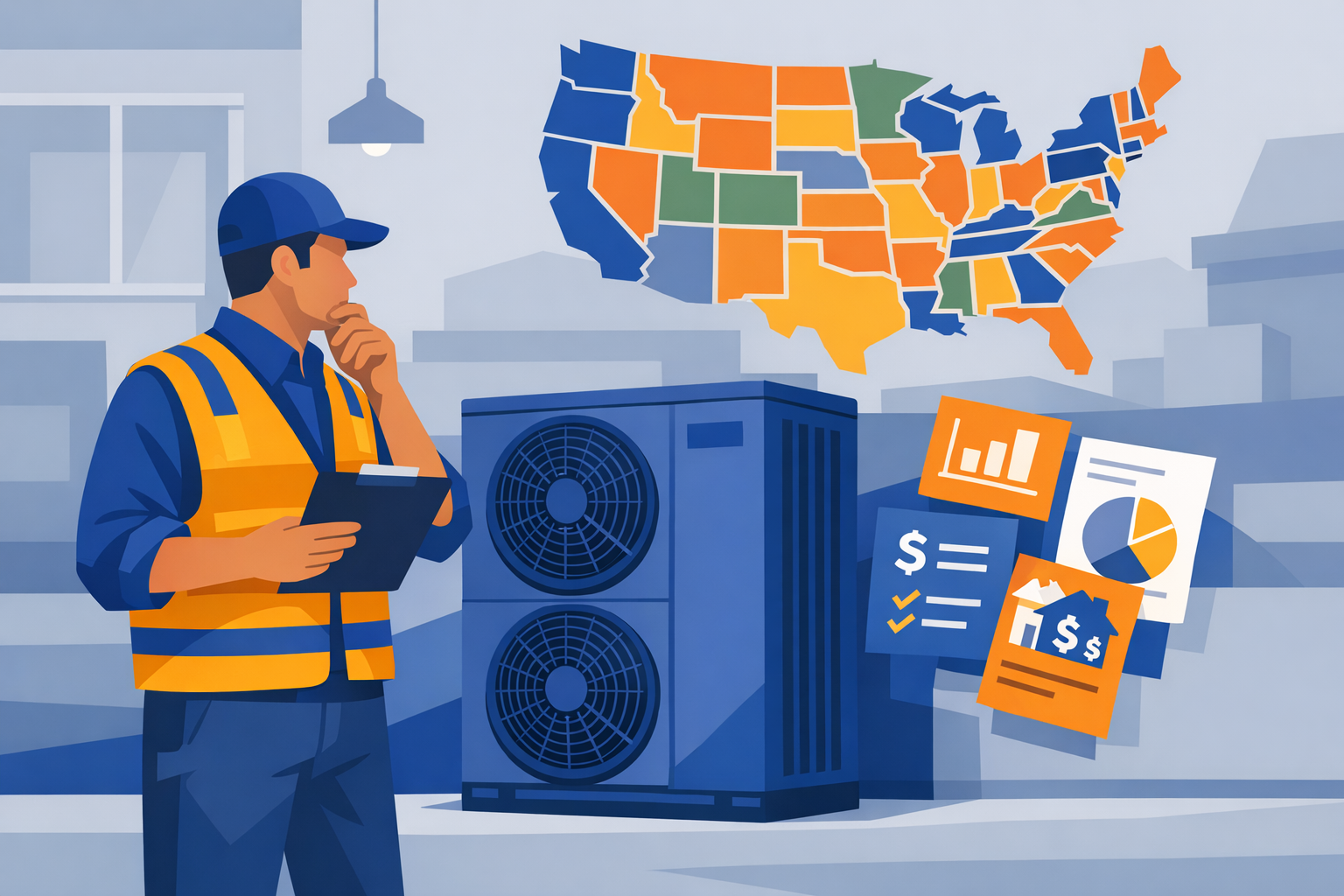
An estimated 80,000 HVAC technician positions remain unfilled across the U.S. as of 2025, yet service companies are betting that expanding their geographic footprint-not shrinking it-is the right response to a market under pressure. A convergence of climate-driven cooling demand, suburban migration, and aging commercial infrastructure is pushing firms beyond established metropolitan corridors into suburban and rural territory where competition is thin but qualified labor is even thinner.
The result is a structural reshaping of the commercial HVAC services landscape, with implications for workforce planning, pricing models, and the operational technology firms deploy to make wider coverage work.
Why Expansion Is Accelerating Now
The demand signals are unambiguous. The North America HVAC services market was valued at USD $39.41 billion in 2024 and is projected to reach USD $50.36 billion by 2030, growing at a CAGR of 4.3%. Within that trajectory, the commercial segment is expected to grow at the fastest CAGR of 7.4% from 2026 to 2033, driven by office retrofits, healthcare facility upgrades, and multifamily housing completions.
Suburban expansion is a core growth vector. Increased migration to suburban areas[1] has generated sustained demand for multi-zone systems, ductless mini-splits, and high-efficiency retrofits in larger homes-a category that typically commands higher service contract values than dense urban residential work. Residential HVAC services continue experiencing active M&A activity[2] as buyers build service-focused platforms in growing markets, particularly those with recurring maintenance agreements and established customer bases.
Regulatory tailwinds also play a role. Federal Inflation Reduction Act rebates and state-level incentives continue stimulating heat-pump adoption and homeowner retrofits, creating compliance-driven service opportunities that lift the recurring revenue mix[3] for firms that can cover the territory.
Three Strategies Reshaping the Coverage Map
Firms are pursuing regional expansion through three primary mechanisms, each with distinct capital, speed, and quality-control trade-offs:
1. Branch Openings
Establishing company-owned branches in underserved markets provides the greatest control over service standards and technician culture. The trade-off is lead time-recruiting, licensing, and equipping a new team typically takes 6-12 months before full operational readiness. Firms targeting rural markets or secondary cities with no existing local presence often choose this route when brand consistency is non-negotiable, particularly in healthcare or data center accounts where service-level agreements are contractually binding.
2. Acquisitions
Strategic buyers, including larger HVAC companies and adjacent service businesses, are pursuing acquisitions to expand geographic reach, add service capabilities, or increase customer density in existing markets. Private equity firms continue showing strong interest in HVAC platforms[4], and the core appeal is straightforward: acquiring a regional operator delivers an existing customer base, licensed technicians, and established supplier relationships in a single transaction. Recent examples include Master Trades Group's acquisition of Freedom Air & Plumbing in Florida[5] to expand Southeast coverage, and AE Industrial Partners' February 2025 investment in United Building Solutions to build a commercial HVAC platform across North Florida.
Integration risk is real, however. Standardizing service protocols, technician certification requirements, and billing systems across legacy acquisitions demands disciplined program management and frequently takes 12-18 months to stabilize.
3. Franchising
Franchising allows HVAC companies to expand brand footprint and generate ongoing royalty revenue without the capital-intensive requirements of opening company-owned locations[6]. Territory sizing for HVAC franchises typically considers population density, household counts, climate characteristics, and competitive density-with protected territories defined by ZIP codes in urban markets, counties in suburban areas, or multi-county regions in rural locations. The model suits firms seeking rapid coverage growth where recruiting local owner-operators is more feasible than deploying centrally managed labor. The trade-off is reduced control over day-to-day service execution, which can expose the master brand to quality inconsistencies.
| Strategy | Speed to Market | Capital Requirement | Brand Control | Best Suited For |
|---|---|---|---|---|
| Branch Opening | Slow (6-12 mo.) | High | Very High | Mission-critical accounts, strict SLA markets |
| Acquisition | Moderate (3-6 mo.) | High | Moderate | Rapid customer base acquisition, secondary cities |
| Franchise | Fast (1-3 mo.) | Low-Moderate | Lower | Coverage scale, rural/suburban penetration |
The Labor Shortage as Both Obstacle and Catalyst
The same shortage that makes expansion operationally difficult is also driving it strategically. HVAC employment is projected to add 23,000 roles from 2024 to 2034, but attrition will create 35,000 openings annually, leaving a persistent gap. Approximately 40% of active HVAC technicians are over 45 years old, concentrating retirement pressure in the near term.
Wages are rising accordingly[3]: median hourly wages climbed to USD $28.50 in 2025, while A2L-certified master technicians topped $40 per hour. Labor now exceeds 55% of total project cost, up from 48% in 2020. For firms expanding into new territories, this dynamic means recruiting and relocating qualified technicians often costs more than projected revenue in the first year of market entry.
Regional disparities compound the challenge. The South Atlantic region alone may see over 292,000 vacant positions[7], with the Pacific region facing comparable gaps-underscoring that labor markets are not uniform and that expansion strategies must account for local workforce availability, not just demand signals.
Firms responding effectively invest in structured apprenticeship programs tied to community college and trade school partnerships, reducing the four-year certification timeline through accelerated co-op pathways. Robust training programs can increase technician retention rates by 30-50%[8], and companies that invest in them report measurably higher profit margins. This connects directly to broader workforce planning discussed in the industry's ongoing coverage of preventive maintenance and system resilience, where technician continuity is a prerequisite for consistent service delivery.
Technology as a Force Multiplier Across Wider Footprints
Expanding service coverage without proportionally expanding headcount requires operational technology that makes each technician more productive. Two categories are proving most impactful:
Remote Monitoring and Diagnostics. Remote HVAC monitoring allows service teams to access and analyze systems based on performance data, determine whether an on-site visit is necessary, and dispatch technicians with the relevant expertise and parts already loaded[9]. This capability is particularly valuable for firms covering rural territories where drive time is a significant operational cost-eliminating unnecessary site visits and optimizing dispatch priority. Continuous remote monitoring also enables early fault detection, reducing the likelihood of emergency callouts during peak demand periods.
Intelligent Dispatch and Field Service Platforms. Modern dispatch software matches jobs to technicians based on location, skills, availability, and priority. Route optimization with built-in GPS tracking improves daily schedule density, reduces idle time, and cuts fuel costs[10]-critical considerations when technicians cover multi-county service zones rather than urban grids. Enterprise-level platforms also integrate scheduling, billing, and maintenance contract management under a single system, which is essential for firms managing newly acquired operations where data standardization is still in progress.
IoT-enabled diagnostics are also enabling outcome-based service contracts[3], with major players reporting that outcome-based agreements rose to 18% of North American bookings in 2025. This model rewards firms for system uptime rather than billable hours and is increasingly attractive to commercial facility managers seeking predictable operating budgets.
Strategic Takeaways for Service Leaders
HVAC service companies evaluating or executing regional expansion should prioritize the following:
- Audit workforce supply before committing to market entry. Regional labor market data should inform expansion sequencing-entering markets with viable training pipelines or community college HVAC programs reduces reliance on costly technician relocation.
- Structure HVAC maintenance packages as a revenue anchor. Recurring maintenance contracts in new territories stabilize cash flow during low-utilization early months and build customer retention before competitors can establish footholds.
- Integrate remote monitoring from day one in new markets. Deploying connected diagnostics at customer sites immediately upon market entry reduces unnecessary truck rolls and provides performance data that strengthens contract renewals and upsell opportunities.
- Standardize dispatch and billing systems across all locations before completing acquisitions. Operational fragmentation is the most common failure mode in HVAC roll-up strategies-firms that delay system integration consistently report higher customer churn and technician turnover in acquired markets.
- Invest in apprenticeship as a strategic capacity lever. With four-year training requirements delaying relief from the HVAC labor shortage, firms that establish structured training pipelines gain a compounding competitive advantage difficult for smaller competitors to replicate.
The commercial HVAC services market is entering a period of structural consolidation driven by demand, demographics, and the operational demands of a decarbonizing built environment. Firms that align expansion strategy with workforce reality-and leverage technology to extend the productivity of constrained technician pools-are best positioned to capture durable market share in the territories they enter.
Frequently Asked Questions
What is driving HVAC service companies to expand beyond metropolitan areas? Suburban migration, aging commercial infrastructure, and climate-driven demand for reliable cooling and heating are the primary demand-side factors. Regulatory incentives for heat pump adoption and energy-efficient retrofits generate additional service opportunities in markets that were previously underserved.
How does the HVAC labor shortage affect regional expansion? The shortage raises the cost and lead time for staffing new service territories. Firms must either recruit locally-engaging trade schools and apprenticeship programs-or relocate experienced technicians at significant expense. Remote monitoring and intelligent dispatch can partially offset labor constraints by making each technician more productive.
What are the main differences between HVAC franchise and branch expansion models? Franchise expansion is faster and requires less capital but offers less control over service quality. Branch openings are slower and more capital-intensive but allow firms to maintain strict service standards and technician culture-critical for commercial accounts with formal SLAs.
What role do HVAC maintenance packages play in regional expansion strategy? Maintenance contracts provide predictable recurring revenue that stabilizes cash flow during the early months of market entry, when utilization rates are low. They also build customer loyalty and create natural touchpoints for equipment upgrade and replacement sales as the relationship matures.
How is technology helping HVAC firms manage larger service territories? Remote monitoring platforms allow teams to diagnose faults and triage service calls without dispatching a technician, reducing unnecessary truck rolls. Intelligent dispatch software optimizes routing across wide geographic areas, while integrated ERP and field service platforms consolidate scheduling, billing, and asset management under a single system-essential for multi-location operations.