The U.S. Environmental Protection Agency's ongoing reconsideration of its 2023 Technology Transitions Rule is disrupting refrigerant procurement strategies at hospitals, data centers, and other critical facilities. Supply shortages and sharp price increases for low-GWP alternatives are compounding already uncertain compliance timelines.
Background
The Technology Transitions Rule is one of three regulatory programs EPA promulgated under the American Innovation and Manufacturing (AIM) Act of 2020. The rule mandated that newly manufactured HVAC and refrigeration systems use refrigerants with a global warming potential (GWP) of 700 or lower. Principal compliance dates began January 1, 2025, affecting new equipment manufacture and installation across residential, commercial, and industrial sectors.
On March 12, 2025, EPA announced reconsideration of the Technology Transitions Rule as one of its 31 deregulation priorities and released its reconsideration proposal on October 3, 2025. The proposed changes extend compliance deadlines five to six years while raising GWP limits across key sectors in the interim. An EPA enforcement statement released on December 22 noted that enforcement of current deadlines addressed by the proposed reconsideration is a "low priority" for the agency.
Details
The proposal's sector-specific adjustments carry direct implications for facility operators in healthcare and mission-critical infrastructure. EPA proposes extending HFC compliance deadlines in several subsectors, including residential air conditioning, retail food refrigeration, cold storage warehouses, and semiconductor manufacturing. For certain industrial chillers and refrigeration systems in the semiconductor sector, EPA proposes delaying compliance from January 1, 2026, and January 1, 2028, to January 1, 2030. For cold storage and food retail, the proposed rule raises the GWP limit for cold-storage warehouses from 150 or 300 to 700 and delays the start date for the lower GWP limits to January 1, 2032.
While the proposal eases timelines for some sectors, the transition is already generating significant cost pressure. Honeywell notified customers of a 42% surcharge for R-454B, citing rising raw material costs and anticipated tariffs-following a 15% increase in February and an additional 8% hike in March. Honeywell attributed the sharp price increase to "unprecedented demand" that domestic production alone cannot meet. In some areas, the wholesale price of R-454B has already doubled, with contractors reporting inflated quotes, tighter margins, and more customer delays.
Supply chain bottlenecks are also affecting refrigerant availability. HVAC equipment manufacturers, distributors, dealers, and building officials have been preparing for the transition to A2L refrigerants. However, supply chain issues have interfered with the rollout of new equipment and refrigerants, producing shortages of both R-454B refrigerant and A2L refrigerant cylinders.
Critical facilities such as hospitals and data centers face a distinct set of pressures. The AIM Act mandates an 85% reduction in HFC production by 2036. Common refrigerants like R-410A are banned from new equipment as of January 2025, requiring data center operators to plan refrigerant transitions aligned with both regulatory requirements and sustainability commitments. According to S&P Global's 451 Research division, utility power demand from data centers reached approximately 62 gigawatts in 2025 and is projected to nearly triple to 134 gigawatts by 2030. The data center cooling market is projected to grow from USD 11.08 billion in 2025 to USD 24.19 billion by 2032, at a CAGR of 11.8%, intensifying demand for compliant cooling technologies.
Natural refrigerants, particularly carbon dioxide (CO₂) and ammonia, are gaining attention as sustainable alternatives. CO₂ systems offer a GWP of just 1, compared to over 2,000 for many synthetic refrigerants, while ammonia systems deliver exceptional thermodynamic efficiency for large-scale cooling loads. However, many alternative refrigerants pose safety risks due to flammability or toxicity, and the vast majority of U.S. building codes do not currently permit their use or installation.
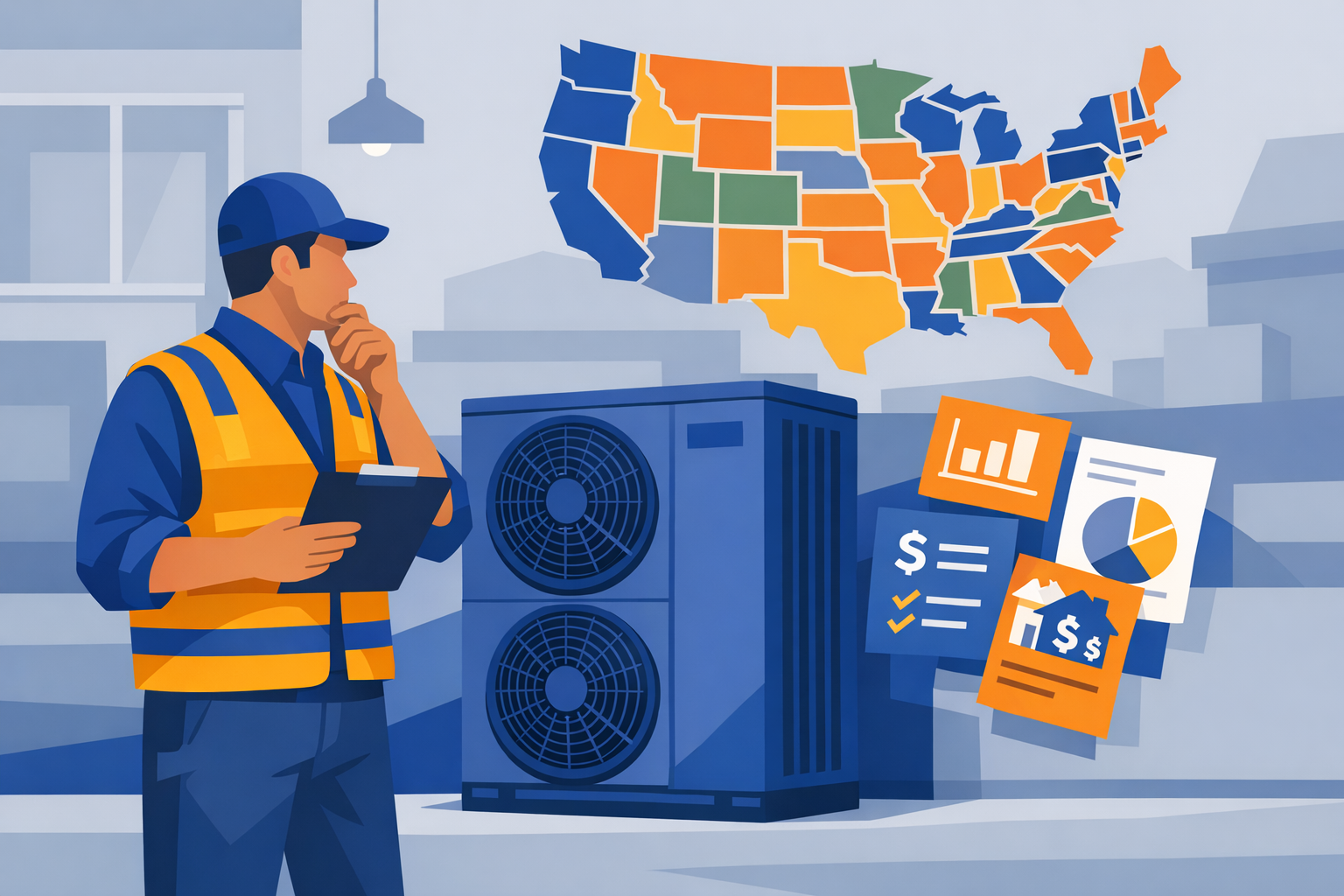
State-level divergence adds further complexity for facility engineers and contractors. Industry leaders warn that the greatest long-term challenge could come from states pursuing their own refrigerant policies and that contractors should be "extremely concerned" about diverging state regulations and the lack of federal preemption under the AIM Act. In New York State, for example, federal enforcement relief does not apply-installation of R-410A equipment is explicitly banned under state law.
Outlook
Release of the final reconsideration rule is expected later in 2026, after some of the January 1 deadlines established in the original rule have passed. HVACR contractors should anticipate a final EPA Technology Transitions Rule by late Q2 or early Q3 of 2026, though uncertainty remains in the interim. For hospitals, data centers, and their HVAC service partners, the period before finalization requires active monitoring of both federal and state regulatory developments, early procurement planning for compliant refrigerants, and technical preparation for A2L and natural refrigerant handling protocols.