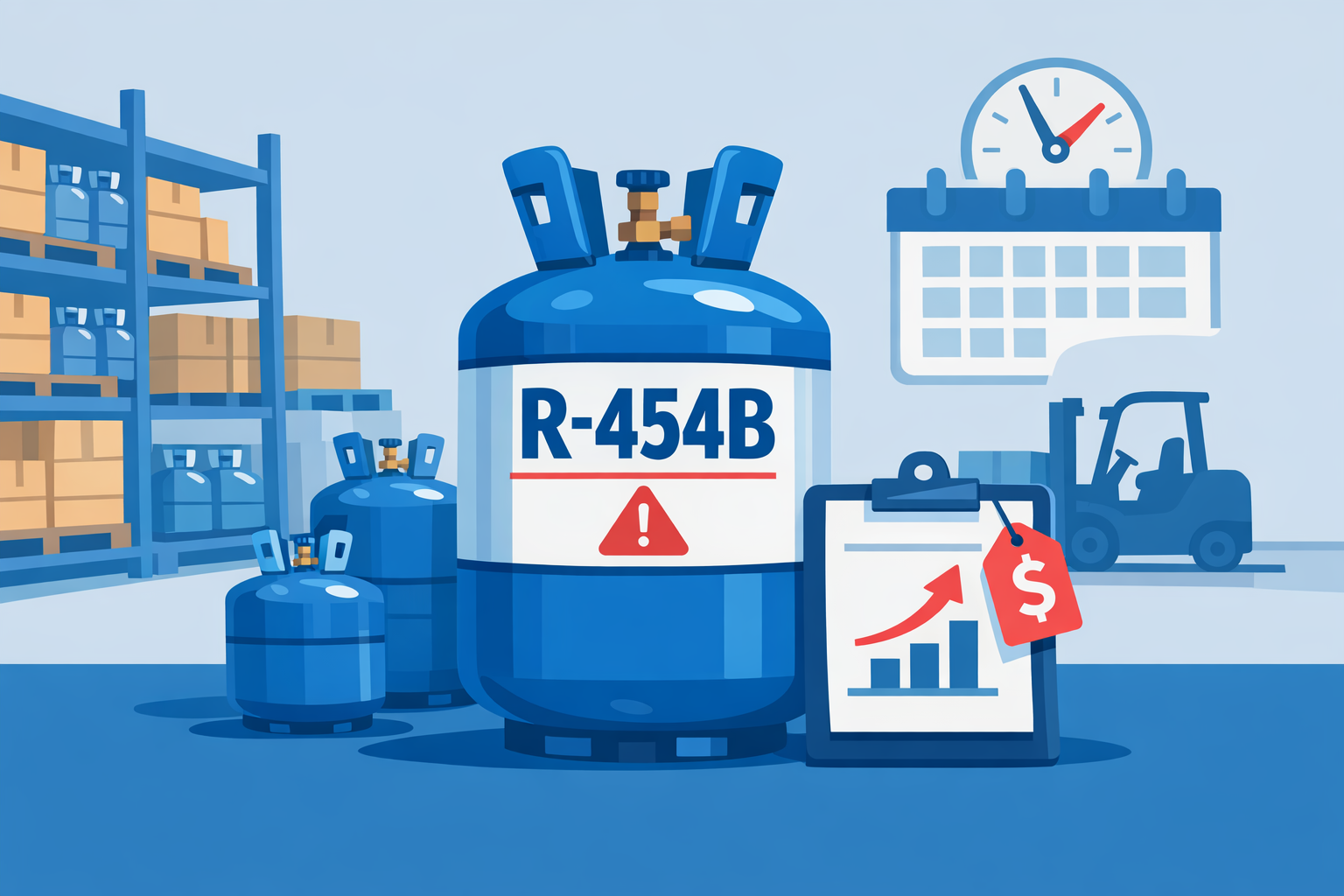
A 20-lb cylinder of R-454B that cost $344.94 in 2021 now commands $650 to $2,000 on the open market. That range alone tells the story unfolding inside HVAC distribution channels in 2025 - a story shaped by regulatory deadlines, packaging bottlenecks, panic buying, and a supply chain never fully prepared for the demand now landing on it.
For mid-sized HVAC distributors caught between manufacturers rationing allocation and contractors demanding refrigerant for installations and warranty service, the pressure is acute. The strategies employed to survive this transition period will define competitive positioning for years to come.
The Regulatory Context: AIM Act Mandates Create a Hard Clock
The foundation of the current disruption is regulatory. The American Innovation and Manufacturing (AIM) Act of 2020 authorized the EPA to phase down the production and use of hydrofluorocarbons (HFCs), establishing a clear legal timeline for the industry's departure from R-410A. Under the resulting Technology Transitions rules, manufacturers of new residential and light commercial ducted HVAC systems were required to transition to low-GWP refrigerants as of January 1, 2025, with installation deadlines following on January 1, 2026.
R-454B - a blend of 68.9% R-32 and 31.1% R-1234yf with a GWP of 466[1], representing a 78% reduction versus R-410A's 2,088 - became the primary compliance refrigerant for most major OEM product lines. The regulatory clock created compressed demand that the supply chain was not scaled to meet.
What followed was predictable in retrospect: the rapid transition did not leave enough time for manufacturers to scale R-454B production appropriately, and demand quickly outpaced available packaged supply[2].
The Cylinder Problem: Not a Refrigerant Shortage - A Packaging Crisis
The nuance confounding many distributors and their customers is that the R-454B shortage is not primarily a shortage of the refrigerant molecule itself. According to HVAC wholesalers and trade reports, there is plenty of R-454B in bulk supply - but it is sitting in tanks, unable to ship due to a shortfall of DOT 39-rated A2L cylinders required to legally transport and sell the mildly flammable gas.
Cylinder manufacturing has been unable to keep pace[3] with the transition velocity. Worthington Enterprises, a key cylinder producer, has struggled to scale production for the new DOT-certified A2L format. The result is a distribution paradox: bulk chemical plants operate at capacity while contractor supply houses run dry.
In April 2025, Honeywell announced it could no longer keep up with "unprecedented demand" for R-454B and stated it would have to import the refrigerant, causing prices to increase by over 40%. Chemours and other producers are building out infrastructure, but as Paul Johnston, executive vice president of Watsco Inc., stated during the company's Q1 earnings call: "It's strictly the container that's missing right now" - and he expects the cylinder shortage to resolve by mid-2025.
The broader market signal is clear: as of late April 2025, a 20-lb cylinder of R-454B was selling for $650-$700 in major metro markets, compared to approximately $350 for a 20-lb cylinder of R-32.
How Distributors Are Responding: Rationing, Forward-Buying, and Warehouse Reconfiguration
Mid-sized distributors lack the balance sheet depth of national HVACR wholesalers to absorb extended price volatility without operational adaptation. Responses emerging across the market reveal a bifurcation: distributors that planned ahead are managing; those that did not are rationing their way through peak cooling season.
Purchasing Limits and Allocation Controls
Gustave A. Larson Co.[4], the Wisconsin-based wholesale distributor, has imposed purchasing limits and tied refrigerant sales to equipment orders - a move designed to stretch limited stock across a broader contractor base rather than allow large buyers to deplete supply in a single transaction. Meier Supply in New York has restricted R-454B access to existing refrigerant customers and equipment dealers, capping purchases at three cylinders per invoice.
The risk of unrestricted access has already materialized in documented cases where a single contractor pre-purchased an entire month's supply, leaving other service companies without access for scheduled maintenance work.
Forward-Buying and Extended Lead Times
Distributors that insulated themselves from the worst of the shortage did so by pre-positioning stock months in advance. Meier Supply, for example, stocked enough R-410A equipment to last through mid-year - a decision that reduced pressure on its R-454B inventory while the market normalized. First Supply[5], which operates more than 50 locations across the Upper Midwest, has had to order some products up to nine months out to accommodate growth and work around supply chain constraints.
Extended lead times are now the operational norm rather than the exception. Distributors and contractors alike report unpredictable lead times and little communication from suppliers regarding when backlogged orders will be fulfilled.
Warehouse Strategy and Dual-SKU Inventory
The transition has created an unusual warehousing challenge: distributors must simultaneously manage legacy R-410A inventory - which remains legally installable through early 2026 - alongside incoming R-454B equipment and refrigerant stock. First Supply's corporate HVAC channel manager noted that the company rented extra warehouse space during the transition to accommodate R-410A equipment before rolling R-454B inventory into a newly opened central distribution center.
Industry experts from HVAC Distributor University recommend two specific tools for warehouse management during this period: a real-time tracking system with mobile visibility into stock and location, and an AI-powered demand-forecasting tool that incorporates sales trends, weather patterns, and regulatory changes to anticipate what products will be needed and when.
Pricing Dynamics: Spot Volatility, Tariff Exposure, and Margin Compression
For mid-sized distributors, the pricing environment is arguably more damaging than the supply shortage itself. Spot-price volatility makes forward contracting difficult. Trade tariffs on imported refrigerants and their components have driven up production costs and caused pricing adjustments downstream, and tariff-related pricing volatility prevents distributors from offering stable contracts to contractors.
The downstream effect: contractors face unpredictable job costing on refrigerant-intensive work - leak repairs, system commissioning, and warranty callbacks - at precisely the moment building owners are scrutinizing service costs. Some contractors have begun sourcing R-454B through secondary markets online, a practice industry professionals caution against due to the risk of receiving off-specification or contaminated product.
R-454B vs. R-32: The Parallel Path
One market signal distributors should monitor is the growing adoption of R-32 as an alternative low-GWP refrigerant. R-32, used in residential equipment by Daikin, Amana, and Goodman, is manufactured by countless companies globally and has a well-established supply chain outside North America, making it significantly more accessible than R-454B during the current shortage. Both refrigerants are AIM Act-compliant for residential applications.
The table below compares the three key refrigerants at the center of the current market:
| Metric | R-410A (Legacy) | R-454B (Transition) | R-32 (Alternative) |
|---|---|---|---|
| GWP (100-yr) | 2,088 | 466 | 675 |
| ASHRAE Safety Class | A1 (Non-flammable) | A2L (Mildly flammable) | A2L (Mildly flammable) |
| Composition | R-32 / R-125 (50/50) | R-32 / R-1234yf (69/31) | Pure R-32 |
| Avg. 20-lb cylinder price (2025) | Rising (phase-out scarcity) | $650-$2,000 | ~$350 |
| Drop-in for R-410A? | N/A | No | No |
| AIM Act compliance (residential mfg.) | Prohibited (Jan 1, 2025) | Compliant | Compliant |
| Aftermarket cylinder availability | Dwindling | Critically constrained | Readily available |
Note: Neither R-454B nor R-32 is a drop-in replacement for R-410A. Both require system-specific equipment designed for A2L refrigerants. Mixing refrigerants creates unsafe pressures, voids warranties, and is prohibited by code.
Downstream Implications: Commercial Service Networks and Maintenance Planning
The pricing and availability disruption does not stop at the distributor level. For service contractors operating commercial buildings - where unplanned downtime carries direct financial and operational consequences - refrigerant scarcity introduces a new layer of maintenance risk.
Contractors report 4-8 week delays on R-454B-equipped system repairs, particularly in high-cooling states like Florida and Texas. In commercial settings where facilities teams expect same-week response on cooling system failures, that lead time is operationally untenable.
For installers and engineers planning equipment replacements or retrofits, the reduced SKU landscape adds complexity. Fewer refrigerant options, combined with OEM equipment lead times, mean project schedules must build in greater buffer time. Building owners need clear communication about the lifecycle cost implications of transitioning to low-GWP systems - including the expectation that R-454B pricing will stabilize as cylinder supply improves and that operational costs are expected to remain comparable to or improve upon R-410A systems over time.
The Role of Reclamation Programs
One often-underutilized lever in managing refrigerant cost pressures is refrigerant reclamation. Recovered and reclaimed refrigerant from decommissioned systems - particularly legacy R-410A - can offset procurement costs for service networks with high volumes of legacy equipment. As the global refrigerant market continues its shift toward low-GWP blends, reclamation infrastructure will become an increasingly strategic asset for distributors and service organizations that develop it early.
The Regulatory Horizon: What Comes After R-454B
Distributors and contractors investing in R-454B infrastructure should note that the refrigerant regulatory landscape continues to evolve. While R-454B and R-32 have significantly lower GWPs than R-410A, many industry observers view them as transitional solutions, as global and state climate policies continue to push for even deeper emissions reductions.
Chemours has indicated its next-generation refrigerant development spans three horizons - supporting current commercial adoption, collaborating on new blend development, and developing ultra-low-GWP solutions. Orbia Fluor & Energy Materials has noted that achieving significantly lower GWP levels will likely require tradeoffs including higher flammability classifications and potential system redesigns. The AIM Act's technology-transitions program signals tighter GWP caps by approximately 2035, which may subject even current-generation A2L refrigerants to further phase-down.
For distributors, the current transition is a rehearsal, not an endpoint. Organizations that develop robust inventory analytics, flexible supplier relationships, and staff competency in A2L handling will be best positioned for the next round of regulatory-driven change.
Six Operational Priorities for Distributors Navigating the Shortage
The following measures reflect strategies already deployed by leading distributors and represent a practical framework for mid-sized operations managing the current environment:
Multi-vendor sourcing - Establish supply agreements with at least two or three refrigerant suppliers. Over-reliance on a single manufacturer has proven to be a single point of failure.
Forward-buying with lead-time discipline - Place R-454B cylinder orders 60-90 days in advance of peak cooling season. Pair early purchasing with per-invoice purchase limits to preserve supply equity across the customer base.
Real-time inventory tracking - Deploy warehouse management tools with mobile stock visibility. Augment with AI-powered demand-forecasting software that factors in weather patterns, sales trends, and regulatory milestones.
Dual-SKU warehouse capacity - With R-410A equipment legally installable through early 2026, distributors must manage parallel inventories. Temporary satellite storage can bridge the transition period.
Cost-escalation clauses in service contracts - Structure distributor and contractor agreements to include refrigerant pricing escalation provisions, protecting commercial customers from spot-price shocks on planned maintenance.
Proactive supply chain communication - Maintain close contact with manufacturers for allocation and lead-time updates. Relay accurate timelines to contractor customers to mitigate the panic buying that has materially worsened the current shortage.
Outlook: Stabilization Expected, But at a Price
Industry experts are cautiously optimistic that supply will begin stabilizing by late Q2 or early Q3 2025, as new cylinder manufacturing capacity comes online and existing plants ramp production. High-demand states including Texas, Florida, and California may continue to experience elevated prices through the summer.
The longer-term signal is equally clear: as R-410A equipment becomes scarcer and legacy refrigerant prices continue to climb, the economic case for transitioning service fleets toward low-GWP systems strengthens - even accounting for the current R-454B premium. The regulatory and market trajectories are aligned. The distributors that navigate this period most successfully will be those treating the current shortage not as a temporary disruption to weather, but as a structural signal to restructure procurement, warehouse management, and customer communication for a permanently more complex refrigerant supply chain.
For further context on how regulatory uncertainty is shaping broader HVAC procurement strategy, see Regulatory Uncertainty Drives Hybrid Cooling Strategies in the HVACR Sector.