The U.S. heat pump installation market is entering a material transition. The most widely used federal tax credit for residential heat pump installations expired on December 31, 2025, shifting the incentive burden to state-administered rebate programs that remain unevenly deployed and, in leading states, already depleted. For HVAC contractors managing project pipelines, this restructuring carries immediate implications for customer qualification, installation scheduling, and compliance documentation.
Background
Since 2022, the Inflation Reduction Act's Section 25C Energy Efficient Home Improvement Tax Credit served as the primary federal financial incentive for residential heat pump adoption. The credit, which included the federal heat pump tax credit, officially expired on December 31, 2025. The credit covered 30% of qualifying heat pump installation costs, capped at $2,000 per year. It functioned as a universal incentive with no income cap, applicable to any taxpayer with federal tax liability.
Alongside 25C, the Inflation Reduction Act created the Home Electrification and Appliance Rebate (HEEHRA) program-a point-of-sale rebate scheme administered at the state level. HEEHRA was funded with a $4.5 billion federal budget to be distributed to states through September 30, 2031. However, clean energy funding was frozen in 2025 under the Trump administration, and the HEEHRA program still has not launched in most states. Separately, with the passage of the Big Beautiful Bill in July 2025, many IRA incentives were scheduled to change. Beginning January 1, 2026, the federal tax credit for heat pump installations is no longer available due to provisions in that legislation.
Despite these federal-level changes, long-term market fundamentals remain intact. The North America residential cold climate heat pump market was valued at USD 3.25 billion in 2025 and is projected to grow to USD 7.57 billion by 2034, expanding at a CAGR of 9.85%. Heat pumps outsold gas furnaces by 32% in 2024. Yet fewer than 20% of U.S. households currently use a heat pump, indicating a substantial replacement market that incentive structures-federal or otherwise-continue to shape.
Details
The HEEHRA program represents the primary remaining federal pathway to heat pump financial support, but its reach is constrained. HEEHRA is a rebate program, not a tax credit, and continues beyond 2025 under current law. Unlike the 25C credit, HEEHRA was not repealed and remains available in 2026 and later years, subject to state implementation and funding availability. HEEHRA provides rebates of up to $8,000 for qualifying heat pump HVAC systems for households earning up to 150% of the Area Median Income.
However, state-level rollout has been uneven, and in leading markets, program funds are exhausted. As of February 24, 2026, HEEHRA rebates for single-family home retrofits are fully reserved statewide in California. The California program-one of the most advanced in the country-is available only through HEEHRA-trained, TECH Clean California-certified contractors, creating a tiered market in which contractor certification status directly determines whether a customer qualifies for point-of-sale rebate access.
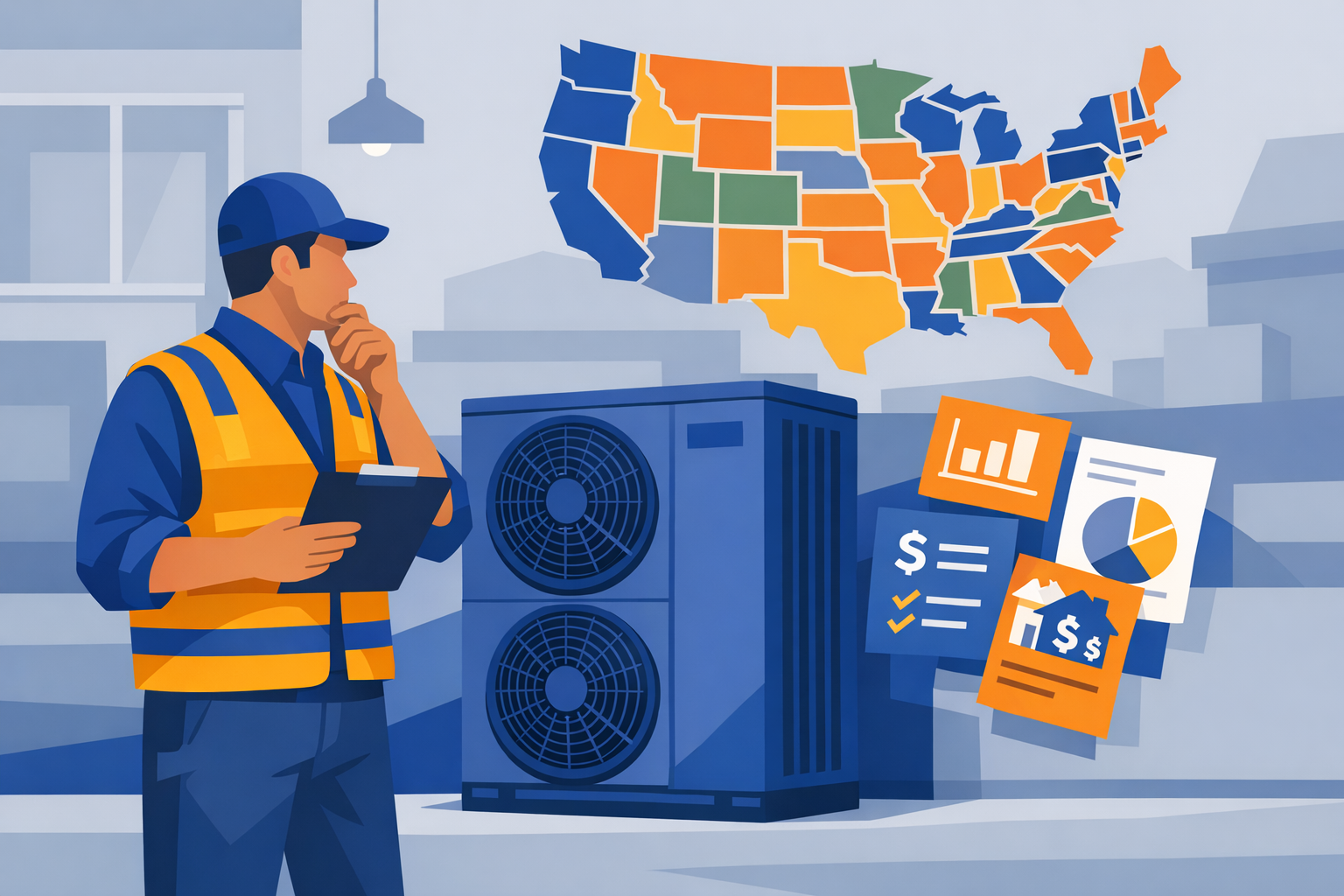
States confirmed by Rewiring America to have active HEEHRA programs as of January 2025 include Arizona, California, Colorado, Georgia, Maine, Michigan, New Mexico, North Carolina, New York, Rhode Island, Washington D.C., and Wisconsin. In states where programs have not yet launched, contractors must rely on utility-level and state-level rebate stacking. Utilities in Massachusetts and Oregon offer stacked incentives that can reach 40% to 50% of installed cost.
Equipment cost pressures compound the reduced federal subsidy environment. A 10% baseline tariff on all imports, combined with 145% on Chinese goods and 25% on Mexican products, is adding 15% to 30% to equipment costs before product reaches the supply house. Some contractors already report 22% price increases from distributors. Trane Technologies entered 2026 with a record enterprise backlog of $7.8 billion, while CEO Dave Regnery confirmed strategic surcharges are being applied to offset tariff costs. Carrier reported that residential sales dropped nearly 40% in Q4 2025, with the 2026 outlook projecting U.S. residential industry units down 10-15% year-over-year.
The skilled labor shortage remains a structural constraint on installation volumes. The North American Technician Excellence organization reports a 35% shortage of certified HVAC technicians capable of properly installing and servicing cold climate heat pump systems, with rural and northern regions experiencing even greater workforce deficits. Training program capacity has not kept pace with technological advancement and market demand; waiting lists for advanced heat pump certification courses extend six months or longer. According to Ian Shapiro, professor of practice of mechanical and aerospace engineering at Syracuse University, "the contractors are still getting used to the equipment, so there's a workforce issue."
On the compliance side, contractors operating in programs tied to federal rebates face heightened technical documentation requirements. Starting in 2025, all qualifying heat pumps must be produced by IRS-qualified manufacturers with assigned PIN numbers, making it essential to verify manufacturer certification before purchase to ensure tax credit eligibility. For HEEHRA-linked installations, beginning January 1, 2026, residential and light commercial air conditioning and heat pump systems eligible for HEEHRA rebates must contain only refrigerants with a global warming potential (GWP) of 700 or lower, per the EPA's Technology Transition Rule.
Outlook
State-administered programs are expected to become the dominant mechanism for heat pump cost support in 2026 and beyond. HEEHRA Phase II is under development in California, and several other states remain in early stages of deployment. On a long-term basis, heat pumps are projected to cover 50% of U.S. heating by 2030-2035, compared to approximately 10% in 2026. HVAC contractors operating in active rebate markets will need to maintain program-specific certifications, pre-approval workflows, and refrigerant compliance documentation to remain eligible as program administrators. Supply conditions may shift rapidly in 2026; contractors and buyers should check regularly with suppliers and remain flexible on acceptable alternatives to keep projects on schedule.