The EU's revised F-Gas Regulation (EU) 2024/573 entered into force on 11 March 2024, and its cascading ban schedule is already reshaping how HVAC service companies across Europe plan equipment inventories, train their workforce, and price contracts. For firms still calibrated to R-410A workflows, the window to adapt is narrowing faster than many anticipated.
What the Regulation Actually Demands - and When
The Global Refrigerant Market in Flux article on this publication covered the macro-level supply picture. This piece focuses on the operational and commercial implications for service businesses specifically.
Regulation (EU) 2024/573 targets a near-complete phase-out of F-gases in EU markets by 2050, with an 80% HFC reduction targeted by 2030. That endpoint sounds distant. The intermediate deadlines do not.
The ban schedule is not a single cliff - it is a cascade:
| Effective Date | Regulatory Measure | Impact on Service Operations |
|---|---|---|
| March 2024 | Regulation enters into force; F-Gas Portal registration required | Quota tracking and import/export licensing become mandatory |
| January 2025 | Virgin refrigerant with GWP >2,500 banned for servicing; commercial refrigeration ban (GWP ≥150) | R-404A top-up restricted; procurement pivot required immediately |
| January 2026 | Self-contained equipment ban; A/C and heat pump servicing restrictions begin | A2L systems become the default for new residential and self-contained commercial installs |
| September 2027 | Member States must update national F-Gas certification to include A2L handling | All existing F-Gas certificate holders face refresher training or re-evaluation |
| 2027-2030 | Cascading bans on stationary chillers and split A/C & heat pump systems | Commercial HVAC portfolio must shift to A2L (R-32, R-454B) or natural refrigerants |
| January 2030 | HFC quota drops to 24% of 2015 baseline; GWP ≤150 limit for most new refrigeration | R-410A servicing reliant solely on reclaimed gas; pricing volatility intensifies |
For firms carrying significant R-410A legacy inventory or long-term service contracts on existing installations, 2026 is the inflection point demanding immediate action - not a future planning exercise.
A2L Refrigerants: The Technical Baseline
A2L refrigerants - including R-32, R-454B, and R-1234yf - are classified under ASHRAE Standard 34 as non-toxic and mildly flammable, with a burning velocity below 10 cm per second. Their low global warming potential is the primary regulatory driver: R-454B carries a GWP of approximately 466 compared to R-410A's GWP of 2,088, representing a roughly 78% reduction in climate impact.
The mild flammability classification - the "2L" designation - is what fundamentally changes service practice. Unlike A1 refrigerants such as R-410A, A2L systems require:
- Spark-free vacuum pumps and explosion-proof recovery units
- Infrared (IR) leak detectors certified for the specific A2L compound in use
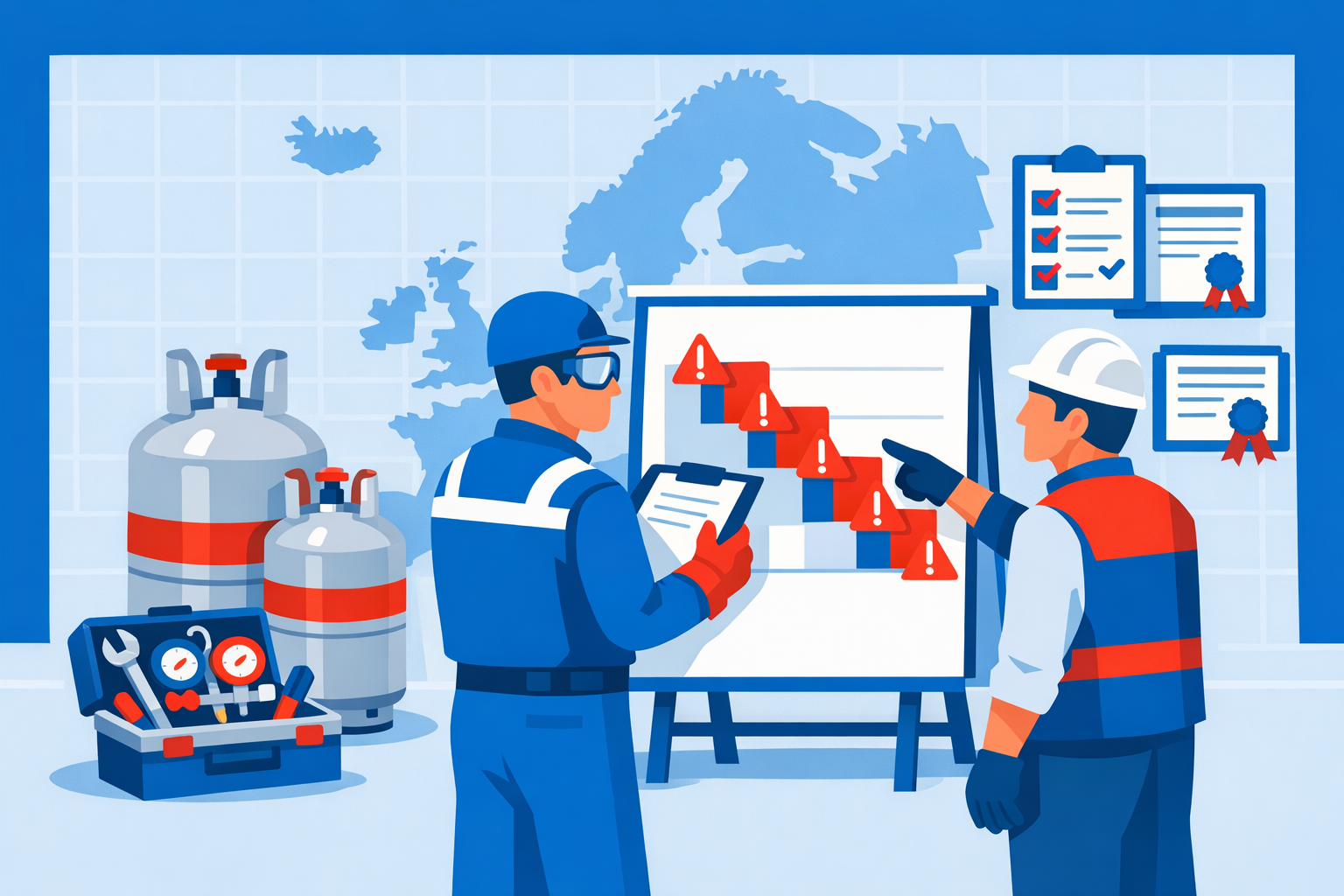
- Dedicated light-gray cylinders with red banding and left-hand-threaded valves to prevent cross-contamination with non-flammable refrigerants
- Nitrogen purging during all brazing operations to prevent flammable vapour accumulation in line sets
The safety standard governing European installations is EN 378 (Safety and Environmental Requirements for Refrigerating Systems and Heat Pumps). The 2024 revision of EN 378 expanded the A2L framework with updated charge limits and room-size calculations. Unlike the US approach - which relies on ASHRAE 15 and UL 60335-2-40 - EN 378 functions as a harmonised standard under the Machinery Directive, giving it direct regulatory authority across all EU Member States.
What It Costs: Equipment and Training
Tooling upgrades for A2L service are quantifiable. A2L-rated recovery machines, vacuum pumps, manifold sets, and leak detectors typically add €1,500 to €3,000 to a service firm's equipment budget per van or workshop.
Refrigerant costs are already diverging. In mid-2026, R-32 trades at roughly €25 to €40 per kilogram in EU wholesale markets, while R-454B sits at €40 to €60 per kilogram - the higher price of R-454B reflecting its more complex manufacturing process as a blend of R-32 and R-1234yf.
Training timelines present a more operationally complex challenge. Updating F-Gas certification to cover A2L handling requires one to two days per technician. For firms with limited headcount, removing a technician from billable work carries a direct revenue cost. Most A2L certification courses cover flammability protocols, charge limit calculations, updated EN 378 requirements, and A2L-rated tool procedures.
Country-by-Country Certification: A Cross-Border Complexity
One of the underappreciated pressures for multi-country service firms is that F-Gas credentialing remains nationally administered, despite the pan-EU regulatory framework. The Netherlands uses Stichting F-Gassen for company and technician certification; Germany requires a Sachkundenachweis issued through the IHK under ChemKlimaschutzV; and France administers the attestation de capacité. All three national schemes must now incorporate A2L handling competencies under Implementing Regulation EU 2024/2215.
Member States have until September 2027 to update their national certification frameworks, but firms should not treat that as a grace period for training. Technicians working on A2L systems today without updated credentials face liability exposure under both manufacturer warranty conditions and national F-Gas enforcement.
The UK, post-Brexit, administers its own F-Gas scheme and has not replicated the 2024 EU regulation verbatim. However, the UK's own F-Gas phase-down timeline broadly mirrors EU trajectories, and UK firms operating in EU markets must hold the relevant national certification of each Member State where they perform work.
Distributor Inventory Behaviour: Reading the Market Signals
Distributors across the EU moved aggressively to stockpile R-410A equipment ahead of the January 2025 manufacture ban, creating a temporary glut of legacy inventory. That inventory is finite. Once depleted, no replenishment pipeline exists.
The consequence for service managers: R-410A refrigerant is expected to increase sharply in price as production quotas tighten, making future servicing of legacy systems increasingly expensive - even before the 2030 quota reduction takes hold. Firms relying on legacy R-410A top-ups should begin securing reclaimed gas supply agreements now, as virgin stock becomes unavailable.
For A2L refrigerants, R-32's single-component nature makes it cheaper to produce and reclaim than R-454B - a practical consideration when specifying new installations where both refrigerants are technically compliant.
Small Firms vs. Large Integrators: An Asymmetric Transition
The A2L transition does not impose equal burdens across firm sizes. The table below illustrates the structural asymmetries:
| Factor | Small HVAC Firms (<10 technicians) | Large Integrators (10+ technicians) |
|---|---|---|
| Tool upgrade cost | High relative burden: €1,500-€3,000 per shop | Absorbable across team and multiple projects |
| Training capacity | Each technician off-site costs billable work | Dedicated training budgets; in-house sessions viable |
| Distributor access | Spot-buying at higher cost | Volume contracts and priority allocation |
| Cross-border credentialing | Logistically and financially difficult | Centralised HR can track multi-country certificates |
| Warranty compliance risk | Higher - fewer resources for documentation | In-house compliance officers manage requirements |
| Reclaimed gas strategy | Reliant on third parties | Can invest in in-house reclamation infrastructure |
Smaller firms that act early on training - securing A2L credentials before the September 2027 certification deadline creates market pressure - gain a genuine competitive advantage in local markets. Those that delay face the prospect of being unable to legally service new A2L installations at precisely the moment demand shifts toward them.
Six Steps for HVAC Service Firms to Prepare Now
1. Audit the installed base. Map every system under contract against the EU ban cascade. Flag R-410A and R-404A systems with near-term service intervals and assess reclaimed gas availability for each.
2. Enrol technicians in A2L refresher training immediately. Do not wait for the September 2027 Member State deadline. Early movers face less competition for training slots and can begin marketing A2L-capable services ahead of competitors.
3. Upgrade service tooling systematically. Prioritise the van or workshop handling the most new installations first. Verify existing gauges and nitrogen kits - most still work - before replacing equipment unnecessarily.
4. Establish a reclaimed gas supply agreement. Partner with certified reclamation facilities to secure R-410A for legacy system servicing through the 2030 quota reduction.
5. Revise service contracts and maintenance intervals. A2L systems require leak detection system checks and updated ventilation assessments. These add time - and value - to service visits. Pricing structures should reflect this.
6. Track national certification requirements for every market of operation. Firms working across borders must hold the correct country-specific credential - not just the EU-level F-Gas registration - for every technician performing A2L work in each Member State.
Outlook
The EU's A2L transition is not approaching - it is already underway. The HFC quota reduction from 31% (2024-2026) to 24% (2027-2029) and then to just 5% of the 2015 baseline by January 2030 signals a near-complete restructuring of the refrigerant market within this decade. For HVAC service companies, the practical question is no longer whether to transition, but how quickly the shift can be operationalised without disrupting service continuity or absorbing unsustainable cost shocks.
The firms best positioned to navigate this transition are those treating A2L readiness not as a compliance cost, but as a service capability and market differentiator.