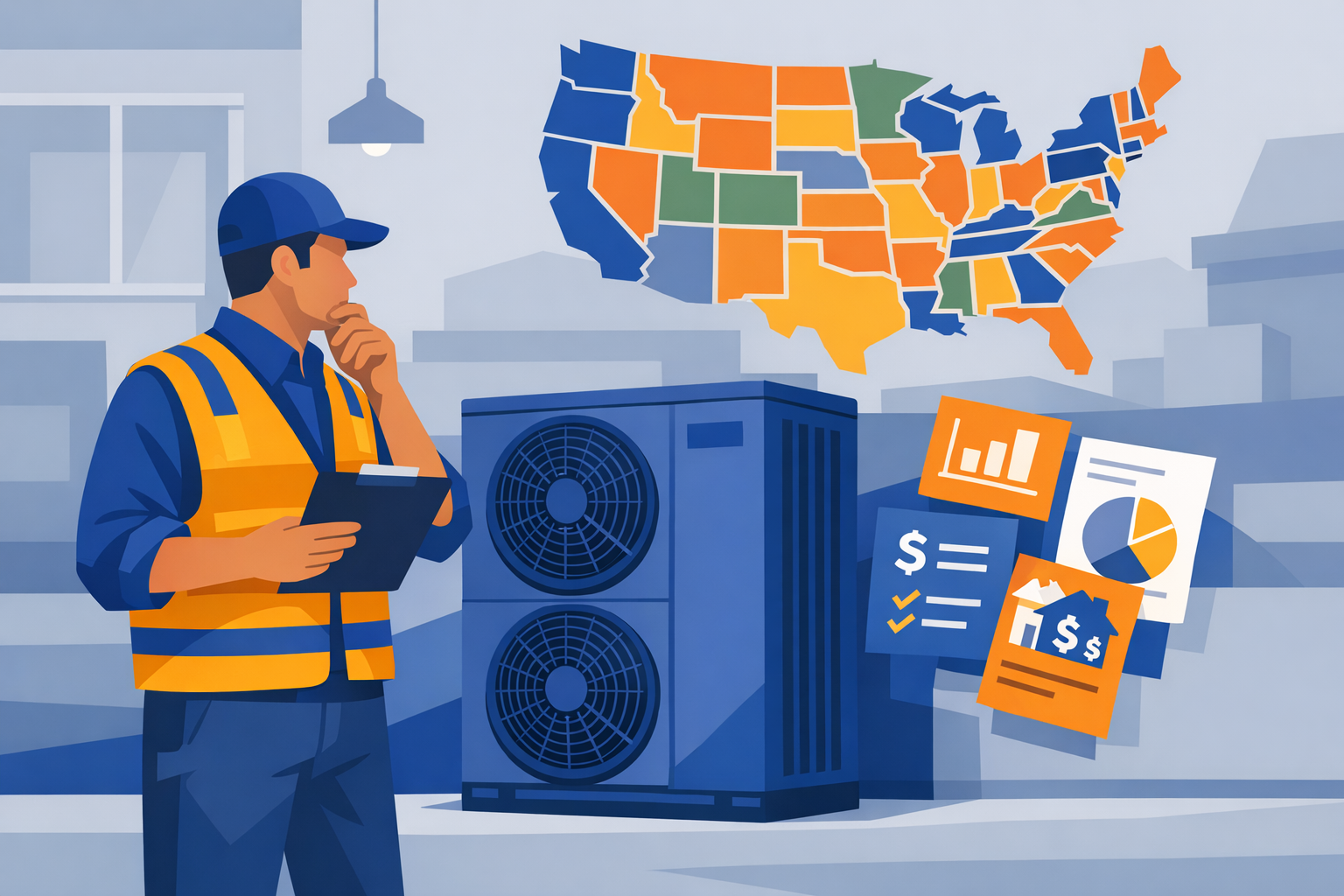
The primary federal incentive for residential heat pump installations in the United States lapsed on December 31, 2025, forcing HVAC contractors to reconfigure customer proposals, procurement timelines, and financing strategies in real time. The Section 25C Energy Efficient Home Improvement Credit - which offered homeowners up to 30% of project costs, capped at $2,000 per year for qualifying heat pumps - was eliminated ahead of its original 2032 sunset date by the One Big Beautiful Bill Act, signed into law in July 2025. The legislation collapsed the Section 25C and Section 25D deadlines to the end of 2025, eight years earlier than the Inflation Reduction Act had originally prescribed. Any air-source heat pump installed in 2026 or later is ineligible for a federal income tax credit under the expired program.
Background
The 25C credit was expanded significantly under the 2022 Inflation Reduction Act, which raised the annual cap from $500 to $2,000 for heat pumps and extended the credit window to 2032. That multi-year horizon gave HVAC contractors a stable framework for retrofit sales cycles and customer financing models. Under the IRA-enhanced version of the credit, labor installation costs were included in the 30% calculation - a meaningful factor given that labor typically accounts for 30% to 50% of a heat pump project invoice. The abrupt rollback compressed that window and removed a key selling point from contractor proposals heading into the 2026 cooling season.
U.S. heat pump sales fell by approximately 13% in 2025, according to the International Energy Agency's Global Energy Review 2026 - a decline attributed to the A2L refrigerant transition, R-410A inventory disruptions, and a slowdown in new housing construction. Industry analysts at HARDI have described current residential HVAC demand as at or near a cyclical floor. After a period in which residential cooling shipments fell more than 25% year-over-year - and at times approached 50% - Carrier CEO Dave Gitlin stated that the U.S. market exited 2025 well below its typical replacement pace.
Details
The incentive landscape has not disappeared but has grown substantially more complex for contractors to communicate to customers. Federal Section 25C tax credits are no longer available for air-source heat pump installations completed in 2026; geothermal heat pump systems retain a separate 30% federal tax credit under Section 25D through 2032. The most significant remaining federal framework is the High-Efficiency Electric Home Rebate Act (HEEHRA), which provides point-of-sale rebates administered by individual states using IRA-allocated funding. HEEHRA offers up to $8,000 toward an air-source heat pump for households below 80% of Area Median Income, and up to $4,000 for households between 80% and 150% of AMI.
State and utility programs now serve as the primary incentive pathway for market-rate customers, but rollout remains uneven. California's HEEHRA single-family rebate slots were fully reserved statewide as of February 24, 2026. Colorado's Xcel Energy utility operates under a 2024-2027 Clean Heat Plan offering rebates of up to $2,250 per heating ton for cold-climate heat pump models, while New York State maintains a renewable energy tax credit of up to 25% of installation costs, capped at $5,000. State programs frequently require pre-approved contractors and equipment meeting specific CEE tier or ENERGY STAR certification standards, adding qualification burdens for smaller HVAC firms.
On the manufacturer side, Bosch stated that "interest in heat pumps, connected solutions, and A2L-compliant equipment remains strong" despite ongoing economic uncertainty and cost pressures, according to comments reported by ACHR News. A Bosch executive noted that the rollback of government incentives had "weakened the payback period of heat pumps, slowing heat pump mix shift" on the residential side, while acknowledging continued momentum in commercial electrification. Rheem's senior vice president of U.S. Air similarly cited contractor education and upskilling as a top manufacturing priority for 2026, given the parallel demands of the A2L refrigerant transition.
For contractors, the financing gap created by the federal credit's expiration compounds existing pressure from elevated installed-system costs. Heat pump replacement projects that averaged $6,000 to $8,000 before 2019 now routinely run $12,000 to $15,000 or higher, according to HVAC industry analysis - a sticker-shock dynamic that has already pushed some homeowners toward repair over replacement. ACHR News has reported that financing is becoming an industry norm as contractors adapt to higher project values without federal credit support.
Outlook
The residential HVAC market is expected to stabilize rather than rebound in 2026, with manufacturers projecting mid-single-digit growth and analysts pointing to pent-up replacement demand as a medium-term driver. Heat pumps outsold combined warm-air furnaces in March 2026 for the third consecutive reporting period, according to AHRI shipment data, indicating that contractor investment in heat pump training and dual-fuel system sales is tracking market direction despite the incentive gap. Contractors seeking to sustain retrofit volume face a dual challenge: mastering a fragmented, state-by-state incentive structure and positioning financing tools as the primary mechanism for overcoming upfront cost barriers without the federal credit.