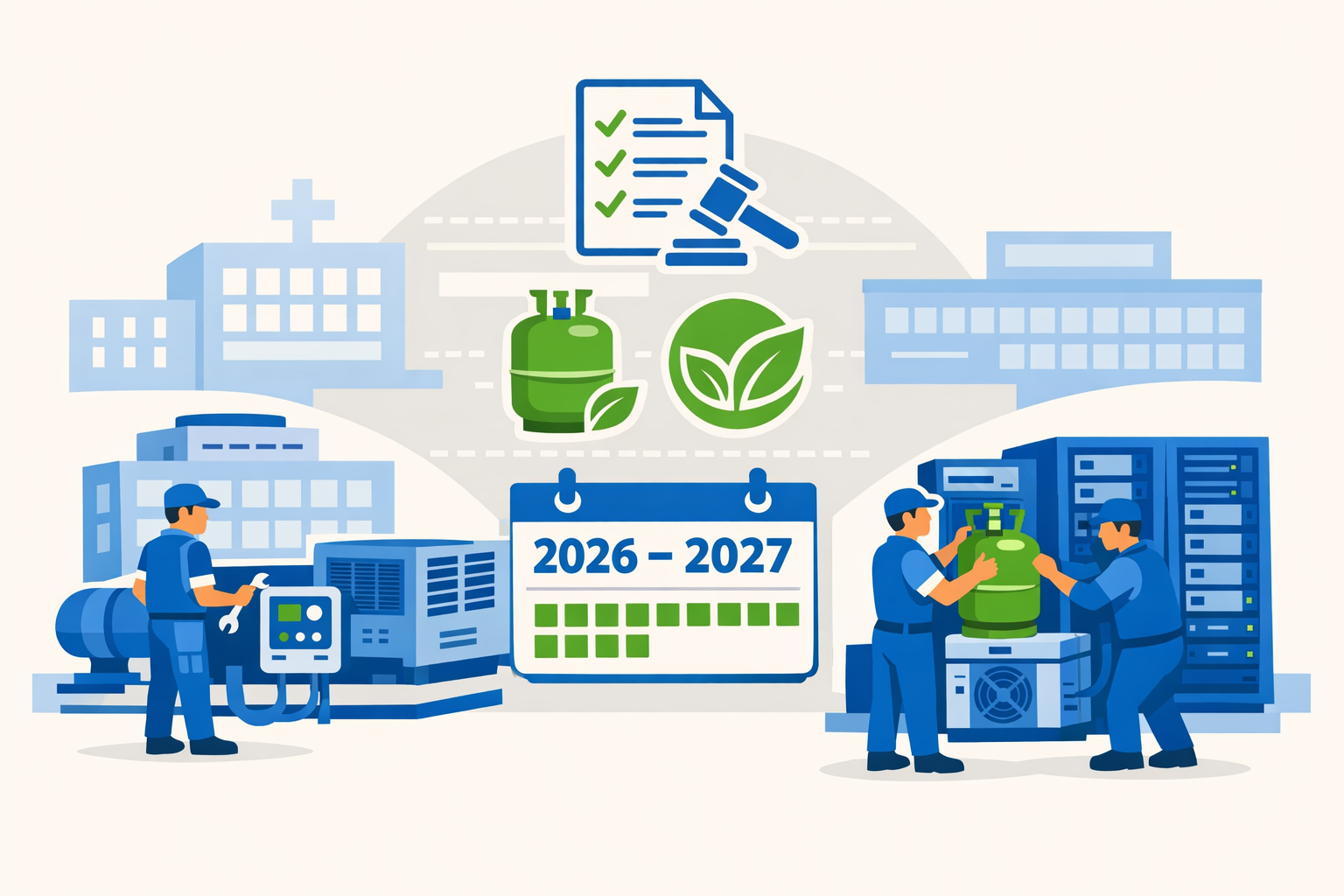
Multiple U.S. federal agencies have issued a coordinated guidance package directing critical facilities - including hospitals and data centers - toward preferred low-global-warming-potential (GWP) refrigerants ahead of cascading 2026 and 2027 mandates. The move signals tighter enforcement alignment across the healthcare and technology infrastructure sectors. The package covers implementation timelines, equipment compatibility requirements, and technician safety protocols. It arrives as two major rules under the American Innovation and Manufacturing (AIM) Act take simultaneous effect, compressing planning windows for facility operators and HVAC service providers.
Background
The regulatory framework driving this transition originates with the AIM Act, signed into law in 2020, which tasks the EPA with overseeing a phased reduction of hydrofluorocarbon (HFC) production and consumption. The AIM Act mandates an 85% reduction in HFC production and consumption by 2036 relative to historic baseline levels, structured through three parallel programs: an allowance allocation program, the Technology Transitions Rule, and the HFC Management Rule.
The Technology Transitions Rule sets GWP limits for new equipment by sector. New data center cooling equipment must use refrigerants with a GWP of less than 700 beginning January 1, 2027, according to EPA guidance. Common refrigerants currently used in data center CRAC units and IT cooling infrastructure - including R-410A (GWP 2,088) and R-134a (GWP 1,430) - exceed this threshold and are among the substances the EPA's Significant New Alternatives Policy (SNAP) identifies as restricted or prohibited for new installations.
Healthcare facilities face a parallel but distinct compliance burden. Facilities in the retail, healthcare, education, and commercial real estate sectors are expected to be most heavily impacted by the January 1, 2026, threshold reduction, according to BSI Group's environmental compliance analysis. Starting January 1, 2026, the EPA's HFC Management Rule lowers the refrigerant charge threshold triggering mandatory leak detection, repair, and reporting requirements from 50 pounds to 15 pounds for systems containing HFCs with a GWP greater than 53 - a 70% reduction in the compliance threshold. The rule applies to any appliance with a full charge of 15 pounds or more.
Details
The HFC Management Rule introduces layered operational obligations directly affecting hospital plant engineers and data center operations teams. The rule requires a leak rate calculation every time refrigerant is added to a qualifying system; if the leak rate exceeds the applicable threshold, a 30-day repair window is triggered, according to regulatory analysis by the Hunton law firm. If a verified repair cannot be completed within 30 days, the system operator must develop a retrofit or retirement plan and execute it within one year.
For large systems, automatic leak detection (ALD) systems must be installed on new refrigerant-containing appliances in the industrial process and commercial refrigeration subsectors with a charge size of 1,500 pounds or more by January 1, 2026, and on existing systems by January 1, 2027. EPA fines for non-compliance can reach $60,000 per violation per day, with California imposing separate penalties of up to $500,000 annually for missing or incorrect emissions reports, according to Fexa's compliance analysis.
The transition to low-GWP alternatives also introduces new A2L safety requirements. Preferred replacements such as R-454B and R-32 carry an A2L safety classification under ASHRAE Standard 34, denoting mild flammability with a burning velocity below 10 centimeters per second and low toxicity. Engineers must now design systems to accommodate A2L refrigerants, incorporating ventilation thresholds, room size calculations, and leak detection placement as stipulated by updated editions of ASHRAE Standards 15 and 34 and UL 60335-2-40. In data centers, room size must now factor into early planning stages because updated standards define the minimum room size for a cooling unit based on the amount of refrigerant it contains, specifically to avoid reaching flammable concentrations in the event of a leak, according to Schneider Electric's technical guidance for data center teams.
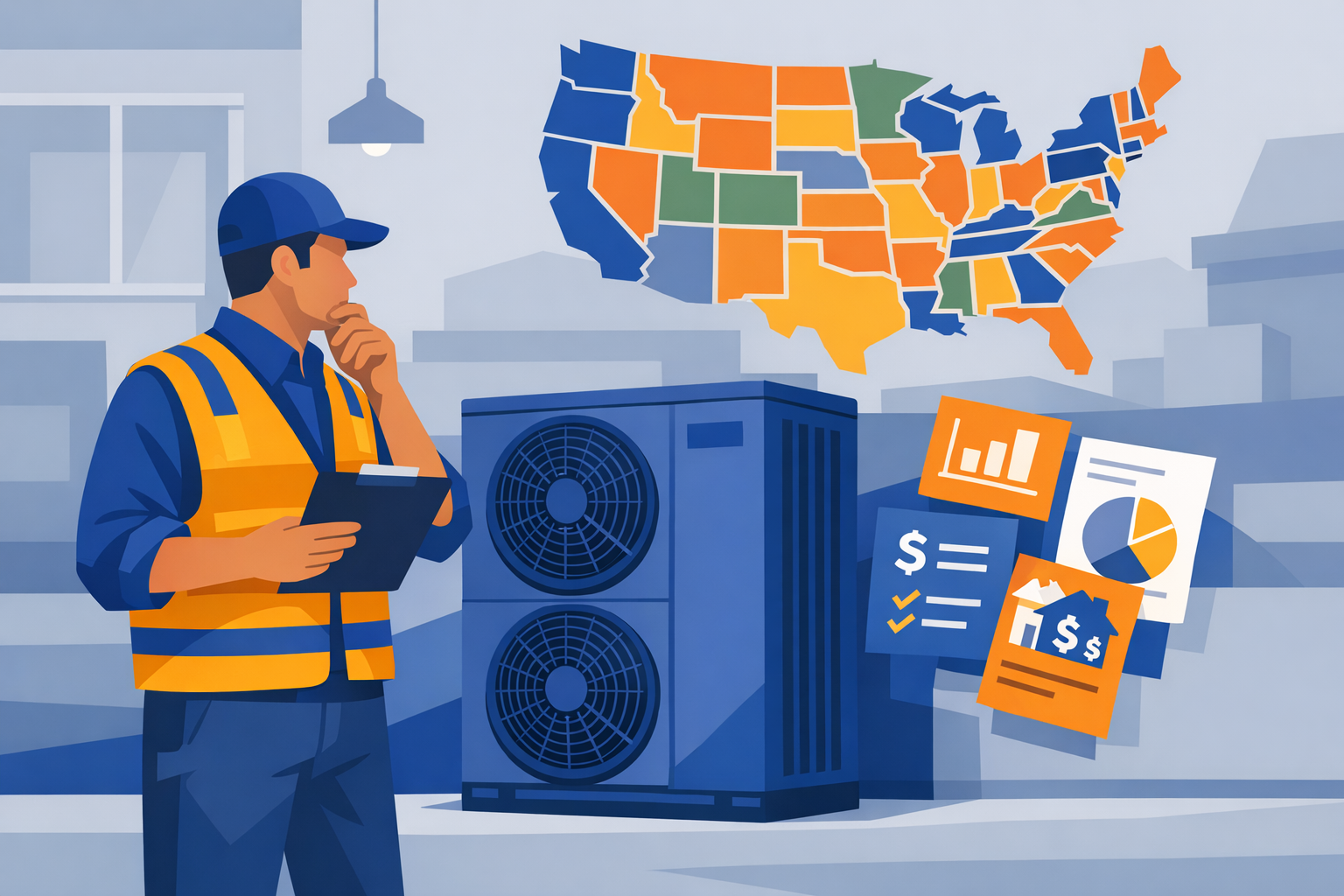
Industry groups interpret the coordinated guidance as a signal of accelerated enforcement alignment. Several states - including California, New York, Washington, and Colorado - have enacted parallel low-GWP refrigerant requirements with enforcement mechanisms independent of federal action, meaning compliance timelines remain in effect regardless of any shifts in federal enforcement posture.
EPA estimates its Technology Transitions Program will reduce greenhouse gas emissions by up to 876 million metric tons of CO₂ equivalent from 2025 through 2050, with climate benefits valued at up to $50.4 billion in 2020 dollars, according to EPA projections.
Outlook
Retrofit projects in hospitals and data centers present elevated complexity compared to standard commercial installations. Transitioning to low-GWP refrigerants in existing data center facilities presents unique challenges, as cooling equipment must be not only compatible and optimized for the new refrigerant but also capable of guaranteeing uninterrupted uptime, according to industry sources cited by ACHR News. Procurement teams and HVAC service contractors are expected to accelerate equipment assessments and technician certification programs in the near term. From January 1, 2029, servicing and repair of certain refrigeration systems must be performed exclusively using reclaimed HFC refrigerants, adding a further long-term constraint on service-market supply chains and reinforcing the case for phased retrofit planning that begins well before current deadlines.