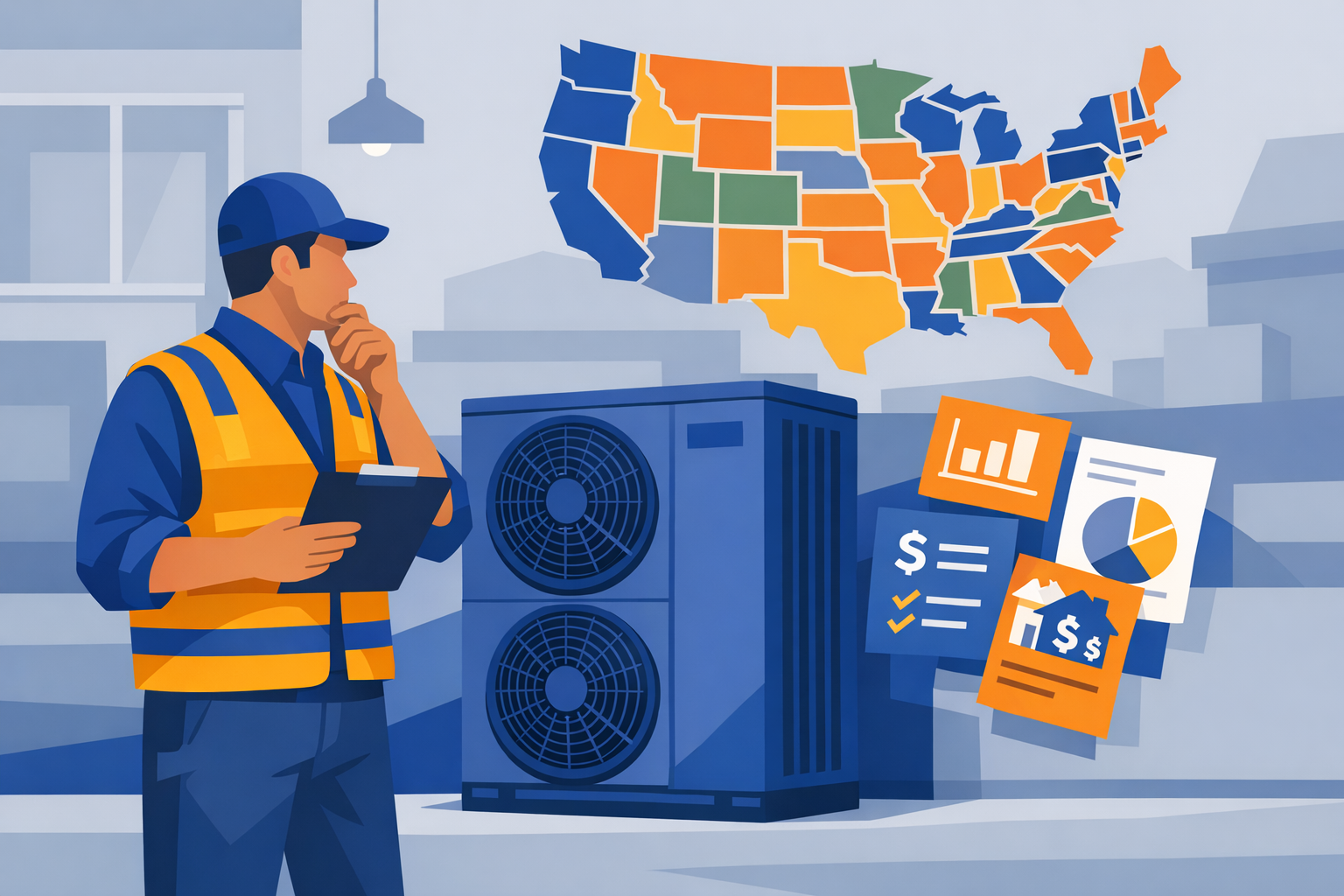
Staggered compliance deadlines, spot shortages of key refrigerant blends, and diverging international standards are forcing HVACR manufacturers, distributors, and procurement teams to restructure supplier relationships and inventory strategies as the global phaseout of high-GWP hydrofluorocarbons (HFCs) accelerates. Pressure intensified in early 2025 after the first U.S. equipment manufacture and import restrictions took effect, exposing supply chain fragilities now visible from chemical producers to field contractors.
Regulatory Background
The U.S. phaseout is anchored in the American Innovation and Manufacturing (AIM) Act of 2020, which mandates an 85% reduction in domestic HFC production and consumption by 2036. The EPA's 2023 Technology Transitions Rule operationalizes this mandate through sector-specific GWP limits. Beginning January 1, 2025, manufacturers and importers were prohibited from producing or importing new residential and light-commercial air-conditioning and heat pump equipment using refrigerants with a GWP above 700, effectively ending production of R-410A-based new systems. A second phase extends equivalent restrictions to variable refrigerant flow (VRF) systems starting January 1, 2026, with installation permitted until January 1, 2027 for components manufactured before that date.
The regulatory picture shifted significantly in 2025. On March 12, 2025, EPA Administrator Lee Zeldin announced reconsideration of the Technology Transitions Rule as one of the agency's 31 deregulation priorities. On October 3, 2025, EPA published a proposed rule that, among other measures, sought to remove the January 1, 2026, installation deadline for residential and light-commercial systems whose specified components were manufactured before January 1, 2025, citing supply chain concerns related to R-454B availability. The proposal also included adjusting the GWP threshold for remote condensing units and supermarket systems from 150-300 to 1,400 and extending compliance deadlines for certain semiconductor process chillers to January 1, 2030. The comment period closed November 21, 2025; the proposed rule has not yet been finalized.
Internationally, the EU's revised F-Gas Regulation and the Kigali Amendment's HFC phasedown schedules advance on separate timelines, creating a fragmented compliance landscape for multinationals sourcing equipment or refrigerants across regions.
Supply Chain Strains and Cost Impacts
The transition has produced acute pricing volatility for key low-GWP blends. In April 2025, Honeywell International imposed a 42% surcharge on R-454B - the primary R-410A replacement for residential systems - citing feedstock shortages, unprecedented demand, and the need to source supply internationally due to domestic production constraints compounded by trade tariffs.
Chemours reported a 40% year-on-year increase in Opteon refrigerant revenue during Q1 2025 as installers accelerated purchasing ahead of AIM Act compliance windows. Capacity investment followed: in February 2025, Chemours referenced completion of a neat Opteon capacity expansion at its Corpus Christi, Texas, facility to support demand through the 2025-2027 window. In May 2025, Arkema entered a commercial arrangement with Honeywell to sell HFO blends, including R-454B, under the Forane brand - a move analysts described as an effort to diversify supply and stabilize distribution.
Equipment cost premiums remain a material concern for procurement teams. Initial A2L-compliant systems are priced 15-40% higher than comparable HFC models, primarily due to added leak-detection electronics and limited production scale during early rollout. Independent estimates place standard new low-GWP equipment cost increases at 10-15% over legacy systems, with energy savings of $200-$500 annually partially offsetting the premium over a five-to-seven-year horizon.
Supplier due diligence requirements have intensified in parallel. According to ACHR News reporting, the shift to low-GWP refrigerants has raised the stakes on vendor oversight, making compliance documentation more important than ever for HVACR contractors. Procurement managers increasingly require suppliers to provide GWP labeling, annual reporting data, and recordkeeping consistent with EPA Technology Transitions labeling obligations, which took effect on the same date as each subsector's manufacture and import compliance deadline.
Manufacturers are evaluating production realignment, alternative domestic blending, and multi-sourcing strategies to limit disruption. For smaller distributors and independent contractors, the combination of higher unit costs, A2L handling certification requirements, and inventory reclassification is creating disproportionate compliance burdens relative to larger peers.
Outlook
The global low-GWP refrigerants market stood at approximately 204.71 kilotons in 2025 and is projected to reach 298.70 kilotons by 2030, reflecting a 7.85% compound annual growth rate driven by Kigali Amendment targets, the AIM Act, and parallel European and Asian regulations. Feedstock additions are expected to continue trailing near-term demand, sustaining upward pressure on HFO blend prices and prompting some buyers to evaluate hydrocarbon and natural refrigerant alternatives where building codes and safety standards permit.
Finalization of EPA's reconsideration proposal remains a key variable for U.S. supply chain planning. Until a final rule is issued, the January 1, 2026, installation deadline technically remains in effect, though EPA has stated that enforcement in this area is a low priority pending resolution of the rulemaking. Procurement teams operating across multiple jurisdictions should track both federal and state-level enforcement positions, as some states may apply independent compliance requirements regardless of federal enforcement posture.