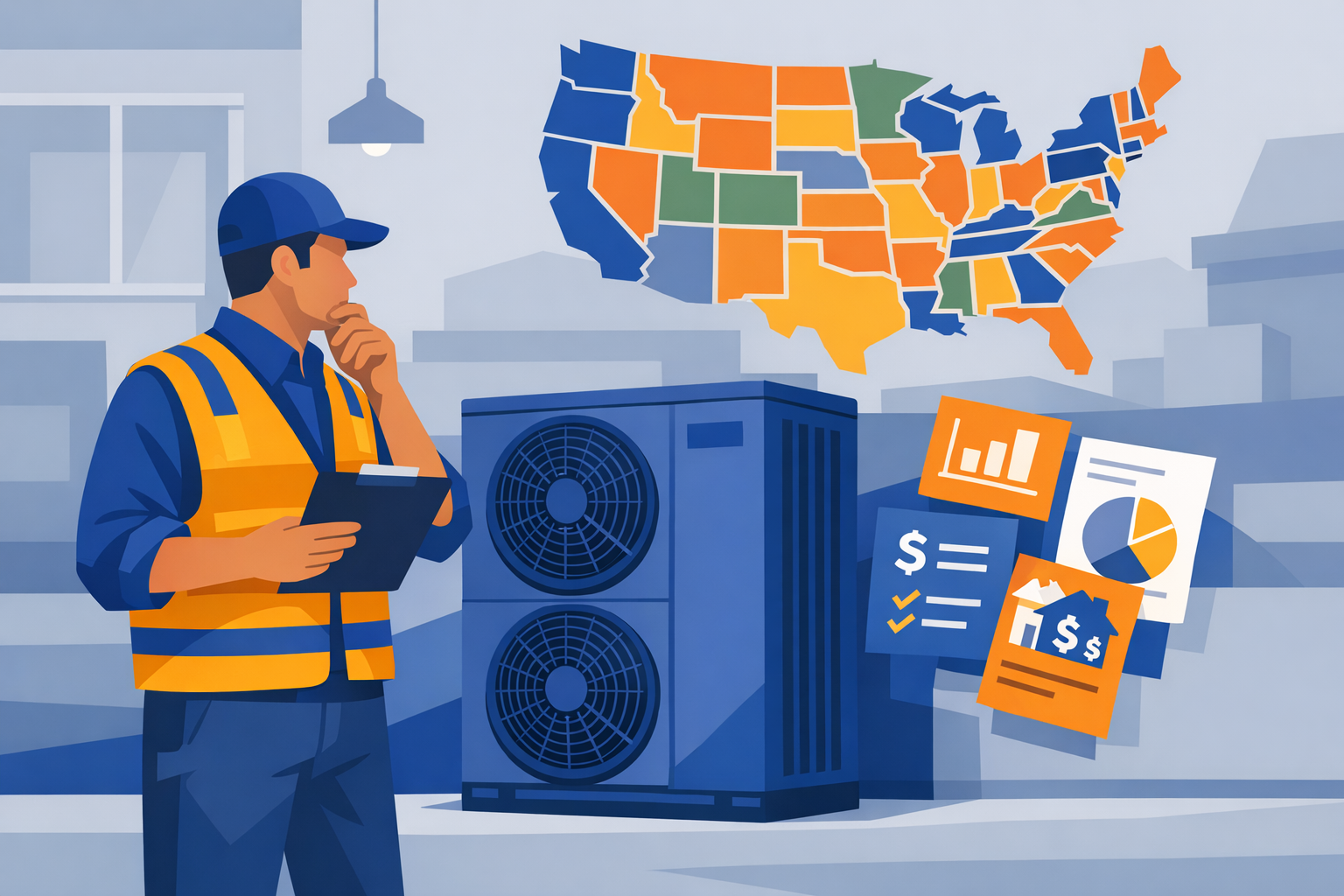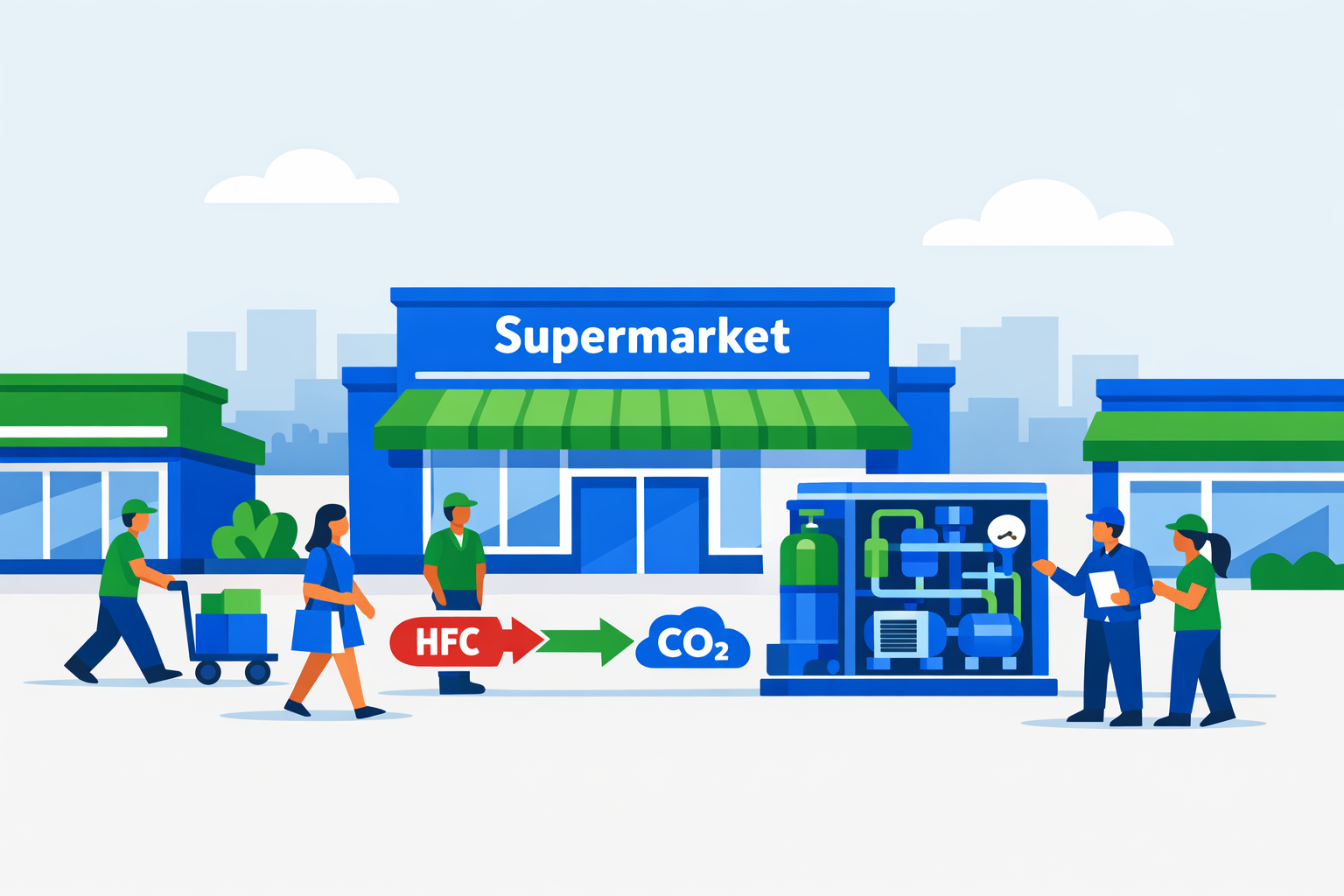
Food retailers across Europe and North America are rapidly replacing high-GWP refrigeration systems with CO2 (R744) transcritical technology as tightening regulatory deadlines and rising HFC costs compress the window for action. The transition is reshaping procurement strategies, supply chains, and installer workforce requirements across the SHK sector.
Regulatory Pressure Mounts on Both Sides of the Atlantic
The revised EU F-Gas Regulation became law on March 11, 2024, setting a complete phase-out of HFCs by 2050, with immediate restrictions already in force. From January 1, 2025, the use of fluorinated gases with a global warming potential (GWP) of 2,500 or more for the maintenance or servicing of any refrigeration equipment is prohibited. Commercial refrigerators and freezers containing HFCs with a GWP of 150 or more were banned from the EU market on January 1, 2025. Quota restrictions under the F-Gas revision have already driven HFC prices up by as much as 400% in some segments, according to Mordor Intelligence, accelerating equipment replacement schedules among grocery operators.
In the United States, the American Innovation and Manufacturing (AIM) Act directs the EPA to phase down HFC production and consumption by 85% by 2036. State-level mandates have moved ahead of federal timelines: Washington State implemented regulations restricting refrigerants with GWP above 150 in new commercial and industrial equipment starting in 2025, and California's SB 1206 prohibits the sale of virgin HFCs with GWP above 2,200 effective January 1, 2025, with the threshold dropping to 1,500 in 2030 and 750 in 2033.
Major Retailers Commit; Market Scales Rapidly
U.S. supermarket chain Kroger announced it would install CO2 (R744) transcritical units in all new stores starting in 2025, according to a presentation at the ATMOsphere America Summit 2024. ALDI committed to installing only natural refrigerants in all new and retrofit systems by 2035, across all 2,300-plus U.S. store locations. Walmart has also selected transcritical CO2 as a primary technology option for meeting its environmental targets, according to industry reporting by refindustry.com. Several national grocery chains - including Whole Foods, Publix, and Albertsons - have incorporated or indicated plans to adopt R744 systems.
Adoption rates diverge sharply by region. Europe now has approximately 90,700 food retail stores using transcritical CO2 systems as of December 2024, representing a market penetration of 30%, up from 22.9% in 2023, according to ATMOsphere's 2024 State of the Industry report. North America saw CO2 installations increase by 40% to 4,100 stores in 2024, with market penetration reaching 5.8%. The global transcritical CO2 refrigeration unit market was valued at USD 2.38 billion in 2024 and is projected to reach USD 4.31 billion by 2031 at a CAGR of 9.1%, according to Intel Market Research. Supermarkets accounted for 74.3% of total transcritical CO2 market demand in 2025, per Mordor Intelligence.
CO2 transcritical booster systems - in which both medium- and low-temperature circuits operate on R744 - are the preferred architecture for medium-to-large format stores. Innovations such as ejector technology, parallel compression, and adiabatic gas cooling have reduced energy consumption by 15-25% compared to earlier generations of CO2 systems. Supermarkets utilizing these enhanced systems report 10-30% lower lifetime operational costs versus HFC alternatives, according to Intel Market Research. An additional advantage is heat reclaim: high compressor discharge temperatures in transcritical operation enable heat recovery for domestic hot water, space heating, and fresh air preheating, offering further efficiency gains for integrated building energy management.
On cost, the upfront capital premium for CO2 systems in new-build scenarios is roughly 10-20% compared to R448A/R449A direct expansion systems for large chains, according to a NASRC retailer survey. CO2 refrigerant itself costs approximately USD 2-4 per pound, while most traditional HFC refrigerants range from USD 20-100 per pound - a gap expected to widen as AIM Act restrictions reduce HFC supply.
Retrofit Complexity and Workforce Gap Slow Existing Store Transitions
While new-build adoption accelerates, retrofitting operational store footprints presents more significant technical and logistical barriers. Transcritical CO2 systems operate at pressures of 80-140 bar, compared to 10-20 bar for HFC systems, requiring upgraded pipework, pressure-rated components, and revised safety protocols. Physical plant room constraints - including existing concrete equipment pads, electrical switchgear, and conduit layouts - frequently necessitate phased installation to maintain continuous cold chain operation during the transition.
The NASRC retailer survey identified the shortage of skilled technicians as among the most significant barriers to CO2 adoption. "We have far too few technicians for the amount of CO2 work that is out there," said one industry trainer cited by ACHR News. While many HVAC technicians are skilled with conventional refrigerants, CO2 systems involve complex transcritical cycles and require specialized tools and safety protocols. The EU's revised F-Gas Regulation adds a certification obligation: from March 2026 to March 2027, EU member states must create or adjust certification programs for personnel carrying out installation, maintenance, servicing, and leak checks on F-gas alternatives, with technical employees required to refresh training at least every seven years from March 12, 2027.
Equipment manufacturers and wholesale distributors are responding. Danfoss has deployed a mobile CO2 training unit providing hands-on system design, commissioning, and troubleshooting instruction for field technicians. Beijer Ref Academy offers structured CO2 refrigeration training programs covering compressor operation, ejector technology, parallel compression, and warm-climate applications. Several manufacturers active in the Oceania market - including Beijer Ref, Bitzer Australia, and Advansor - have launched training programs specifically for transcritical CO2 systems, a model increasingly replicated in Europe and North America.
Outlook
The NASRC projects that total CO2 systems in U.S. food retail will surpass 10,000 by 2029, significantly above the trajectory recorded in the 2024 survey, with the Southeast United States expected to see the largest regional growth despite its warmer climate. Supply chain capacity is expected to tighten as volume scales: quota cuts under the EU's 2024 F-Gas revision have already forced retailers to accelerate equipment replacement schedules, and similar pressure is anticipated in North America as AIM Act restrictions advance. For refrigeration contractors and SHK professionals, the combination of regulatory deadlines, retailer commitments, and a growing installer skills gap points to sustained demand for CO2-qualified service capacity through the end of the decade.