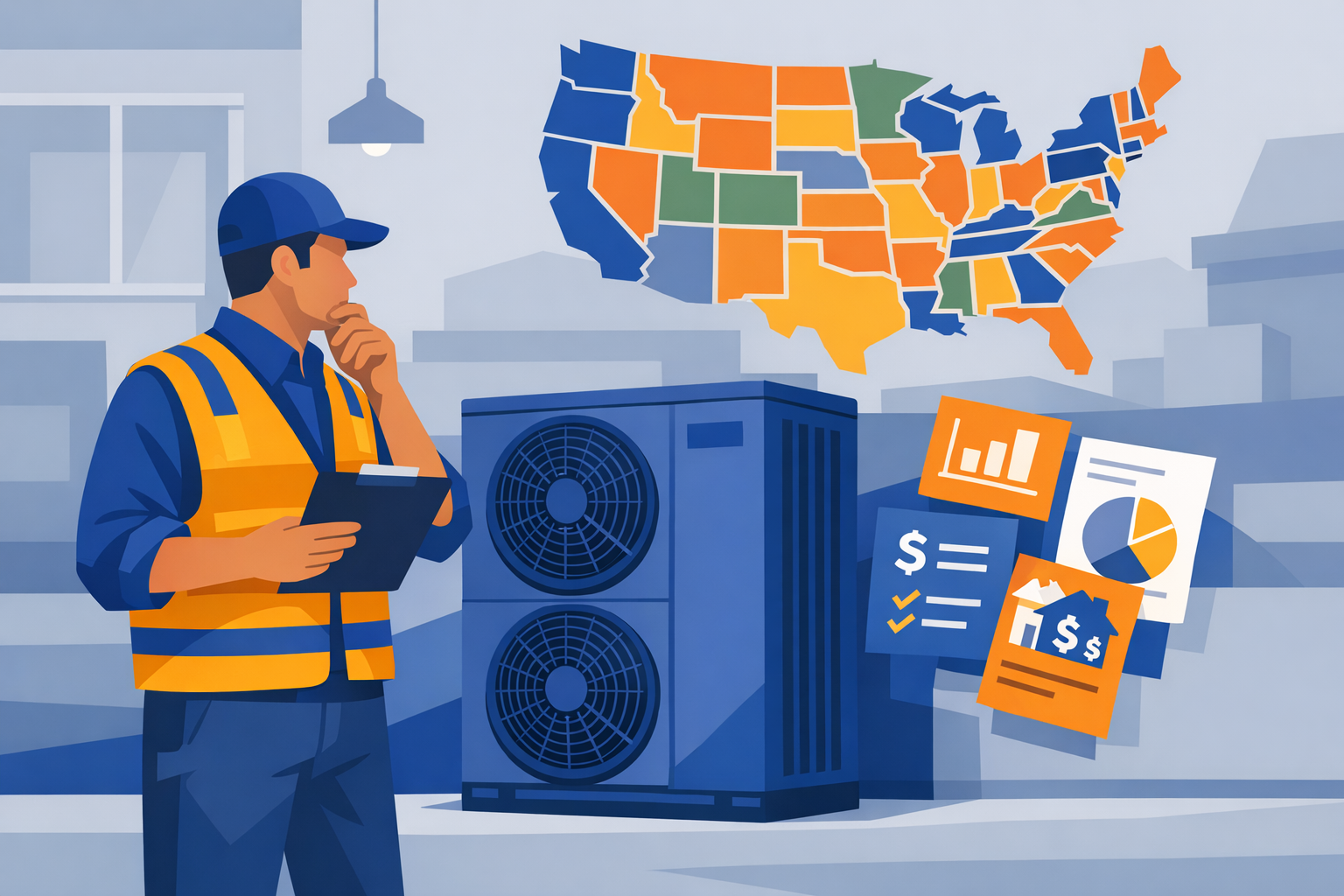
The past 12 months have seen the federal government issue interim rules, finalize extended deadlines, propose broad rollbacks, and launch an entirely new emissions management program - all within the same regulatory ecosystem. For HVAC and refrigeration professionals, the moving target is not the technology. It is the rulebook.
Understanding which obligations are already in effect, which are pending finalization, and where state mandates exceed federal minimums has become a core competency for service contractors, distributors, facility managers, and project engineers alike.
The Three-Track Federal Framework Under the AIM Act
The American Innovation and Manufacturing (AIM) Act of 2020 directed EPA to address HFCs through three parallel programs, each on its own timeline.
The AIM Act directs EPA to address HFCs in three ways: phasing down HFC production and consumption through an allowance allocation program; promulgating regulations to maximize reclamation and minimize HFC releases from equipment; and facilitating the transition to next-generation technologies through sector-based restrictions.
These three tracks - the HFC Allowance Phasedown, the Technology Transitions Rule, and the Emissions Reduction and Reclamation (ER&R) Program - overlap in practice and impose different obligations on the same equipment. Compliance requires monitoring all three simultaneously.
Track 1: Allowance Phasedown
The phasedown schedule began with a 10% reduction in 2022 and a further decrease to 60% of baseline levels in 2024. From 2029 onward, allowance reductions will reach 85% by 2034-35 and 90% by 2036. Tightening allowances compress the supply of virgin HFCs, directly affecting procurement pricing and distributor inventory management.
Track 2: Technology Transitions Rule
Beginning January 1, 2025, certain technologies may no longer use high-GWP HFCs or HFC blends. Prohibitions apply to the manufacture, distribution, sale, installation, import, and export of products containing restricted HFCs.
The rule divides industries by subcategory and applies specific low-GWP limits - 150 or 300 GWP for most refrigeration systems and 700 GWP for most HVAC systems.
The Technology Transitions Rule has been amended multiple times in response to supply chain pressure. A December 2024 final rule further extended installation deadlines for higher-GWP variable refrigerant flow (VRF) systems, permitting installations until January 1, 2027, and for certain construction projects with permits issued before October 5, 2023, until January 1, 2028.
Most recently, EPA Administrator Lee Zeldin issued a Notice of Proposed Rulemaking to reform the 2023 Technology Transitions Rule. The stated goal is balancing the AIM Act-mandated HFC phasedown with ensuring American families retain access to functioning air conditioning systems. Specifically, EPA is proposing to extend compliance deadlines on HFC use in several subsectors, including residential air conditioning, retail food refrigeration, cold storage warehouses, and semiconductor manufacturing.
Track 3: The ER&R Program - The Most Immediate Obligation for Service Contractors
On October 11, 2024, EPA published a final rule establishing the Emissions Reduction and Reclamation (ER&R) Program to manage certain HFCs and their substitutes for the purpose of maximizing reclamation and minimizing releases from certain equipment or appliances.
Beginning January 1, 2026, EPA's HFC Leak Repair and Management Rule takes effect, placing mandatory leak detection and repair requirements on owners or operators of HFC-containing appliances with a refrigerant charge of 15 pounds or greater.
This represents a significant expansion of oversight. The EPA lowered the refrigerant threshold from 50 pounds to 15 pounds for systems containing high-GWP refrigerants, bringing many previously exempt systems under federal scrutiny. Facilities in the retail, healthcare, education, and commercial real estate sectors face the heaviest impact.
The operational mechanics are precise. The rule requires a leak rate calculation every time refrigerant is added to a system. If the leak rate exceeds a specified threshold, a structured repair process is triggered - one that may compel retrofitting or retirement of the system if the repair is not completed within 30 days.
For large commercial systems, automatic leak detection (ALD) requirements add further complexity. Owners and operators of refrigerant-containing appliances in the industrial process refrigeration (IPR) and commercial refrigeration subsectors must install and use ALD systems for new and existing equipment with a refrigerant charge of 1,500 pounds or more containing an HFC with a GWP greater than 53. The final rule sets a January 1, 2026, compliance date for new refrigerant-containing appliances and January 1, 2027, for existing equipment installed after January 1, 2017.
Key Federal Compliance Deadlines
| Deadline | Rule / Program | Requirement | Sectors Affected |
|---|---|---|---|
| Jan 1, 2025 | Technology Transitions Rule | Manufacture/sale/import of high-GWP HFC equipment restricted; GWP ≤700 for most HVAC, ≤150-300 for most refrigeration | Residential & light commercial AC/HP, commercial refrigeration, chillers |
| Jan 1, 2026 | ER&R Program (HFC Management Rule) | Mandatory leak repair for systems ≥15 lbs HFC (GWP >53); reclamation standard (≤15% virgin HFC by weight); ALD required for new commercial/IPR systems ≥1,500 lbs | All commercial, industrial, healthcare HVAC/R |
| Jan 1, 2027 | Technology Transitions (VRF Rule) | Extended installation deadline for higher-GWP VRF systems (components mfr'd before Jan 1, 2026) | Variable Refrigerant Flow systems |
| Jan 1, 2027 | ER&R Program | ALD required for existing commercial/IPR systems ≥1,500 lbs (installed after Jan 1, 2017) | Commercial & industrial refrigeration |
| Jan 1, 2028 | Technology Transitions (VRF permit exemption) | Final installation deadline for VRF systems with permits issued before Oct 5, 2023 | VRF systems (permitted projects) |
| Jan 1, 2029 | ER&R Program | Mandatory use of reclaimed HFCs for servicing/repair | Supermarkets, refrigerated transport, commercial ice makers |
| 2036 | AIM Act Phasedown | HFC production/consumption reduced to 15% of baseline | All sectors |
State-Level Mandates Add Complexity - and Often Exceed Federal Rules
California, Washington, and New York have finalized comprehensive regulations governing the use of high-GWP refrigerants, leak detection and repair, and system transition timelines. State and local regulations may impose requirements that exceed federal EPA standards.
California has moved furthest. With the passage of SB 1206, California became the first state to ban the sale and distribution of virgin HFC refrigerants. Starting January 1, 2025, SB 1206 prohibits the sale of virgin and new bulk HFCs with a GWP above 2,200. The threshold drops to 1,500 in January 2030 and 750 in January 2033. Certified reclaimed HFCs are exempt from these bans and may be used for servicing existing systems.
Washington has taken a parallel path. Beginning January 1, 2025, new refrigeration equipment with a charge exceeding 50 pounds in Washington must use refrigerants with a GWP below 150. Starting in 2029, the same 150 GWP limit applies to refrigerant retrofits, effectively eliminating a gas retrofit option.
New York applies an even stricter scientific benchmark. By January 1, 2035, large supermarket chains must transition refrigeration equipment with more than 50 pounds of refrigerant to alternative systems using refrigerants with a GWP20 of 10 or less - or control leakage to a comparable emissions quantity. The use of the 20-year global warming potential metric rather than the standard 100-year measure represents a more aggressive policy stance than any current federal rule.
| State | Key Regulation | Stricter Than Federal Baseline? | Notable Provisions |
|---|---|---|---|
| California | SB 1206 / CARB Rules | Yes - virgin HFC sales ban | Virgin HFCs ≥2,200 GWP banned from sale Jan 1, 2025; drops to ≥1,500 GWP in 2030, ≥750 GWP in 2033. Reclaimed product exempt. |
| Washington | WAC 173-443 | Yes - GWP limit on new equipment | New refrigeration >50 lbs limited to ≤150 GWP since Jan 1, 2025. Retrofits subject to same limit from Jan 1, 2029. Includes HVAC applications. |
| New York | NY DEC HFC Rules | Yes - GWP20 metric used | Uses 20-year GWP horizon. Large supermarket chains must transition to GWP20 ≤10 refrigerants by Jan 1, 2035. |
| Federal (EPA) | AIM Act / Technology Transitions | Baseline | GWP ≤700 for most HVAC; GWP ≤150-300 for commercial refrigeration. |
Supply Chain Turbulence: A2L Shortages Compound Compliance Pressure
Regulatory timelines are only one dimension of the challenge. HVAC equipment manufacturers, distributors, dealers, and building officials have spent the past year preparing for the transition to A2L refrigerants. However, supply chain disruptions have interfered with the rollout of new air-conditioning equipment and refrigerants. The industry has experienced shortages of R-454B refrigerant and, more critically, A2L refrigerant cylinders.
Shortages of 20-lb cylinders for A2L refrigerants have constrained availability for HVAC installers and service contractors. These cylinders are required to properly charge HVAC systems; without them, contractors cannot complete this essential installation step.
In response to supply chain disruptions and growing concerns about A2L refrigerant availability and affordability, EPA issued a proposed rule reconsidering certain regulations under the Technology Transitions Program. For residential and light commercial air conditioning and heat pump systems, EPA proposed removing the installation compliance date entirely.
For service contractors managing existing inventories, these supply-side dynamics underscore the value of proactive stock planning over just-in-time purchasing. Distributors operating in markets like California face a dual constraint: federal GWP limits on new equipment charges and the state's escalating ban on virgin bulk HFCs. This combination is accelerating demand for reclaimed refrigerant product lines ahead of the 2029 federal mandate.
Reclamation: The Next Compliance Frontier
The mandatory use of reclaimed refrigerants - already embedded in California law and arriving federally in 2029 - is reshaping the service economy. Servicing and repair of refrigerant-containing appliances in the supermarket systems, refrigerated transport, and automatic commercial ice makers subsectors must use reclaimed HFCs after January 1, 2029.
The ER&R rule also establishes a formal reclamation quality standard. Effective January 1, 2026, no refrigerant may be sold, identified, or reported as reclaimed if it contains more than 15% virgin-regulated substance by weight. EPA requires that all containers of reclaimed refrigerants sold or distributed as of January 1, 2026, carry a permanent label certifying the contents do not exceed 15%, by weight, of virgin regulated substances.
This labeling and purity standard will materially affect how distributors source, certify, and store reclaimed product. Service contractors need verifiable supply chain documentation - not just the label - to demonstrate compliance during EPA inspections.
The broader direction is clear. "While federal regulations under the AIM Act are a key factor in the shift away from HFCs, policymakers in California, New York, and Washington are sending an even stronger signal to move to future-proof refrigerants as quickly as possible," according to Danielle Wright, executive director of the North American Sustainable Refrigeration Council.
Practical Takeaways for HVAC Professionals
The convergence of federal and state rules demands a structured compliance approach, particularly for firms operating across multiple jurisdictions.
- Audit existing equipment charge sizes. The shift from a 50-lb to a 15-lb threshold under the ER&R Program means a large number of rooftop units, small commercial refrigerators, and process coolers previously below the regulatory threshold are now covered. Facility-wide inventories are no longer optional.
- Establish leak rate tracking procedures now. Owners and operators must conduct a leak rate calculation - using the annualizing method or the rolling average method - after adding refrigerant to an appliance. Firms without systematic service record management will struggle to demonstrate compliance under an EPA audit.
- Confirm VRF project status and permit dates. Contractors with VRF installations in the pipeline should verify whether their project qualifies for the January 1, 2027, or January 1, 2028, installation deadline. Eligibility depends on when components were manufactured and whether a qualifying building permit predates October 5, 2023.
- Begin reclaimed refrigerant sourcing relationships. Organizations operating supermarket refrigeration, refrigerated transport fleets, or commercial ice makers have until January 1, 2029, to transition servicing to reclaimed HFCs - but certified reclaimer capacity is limited. Early supplier engagement reduces transition risk.
- Map state-specific requirements when operating in California, Washington, or New York. These states impose obligations beyond federal minimums, including earlier GWP limits, retrofit timelines, and - in New York's case - a stricter GWP measurement methodology.
For long-cycle capital projects such as hospital HVAC systems, data centers, and cold storage warehouses, the combination of multi-year installation timelines and shifting compliance dates makes early regulatory mapping a project design requirement - not an afterthought. Procurement managers sourcing refrigerant-specific equipment for these assets should integrate regulatory review into specification approval processes, with explicit signoff on which federal and state rules apply at both installation and long-term service.
The overarching message from the past 12 months is that refrigerant compliance is no longer a periodic task. It is an ongoing operational function - one that demands the same systematic attention as preventive maintenance scheduling, technician certification management, and equipment lifecycle planning.
For further background on how global market dynamics and supply constraints are shaping the broader low-GWP transition, see HVAC Insider's analysis in Global Refrigerant Market in Flux and the sector-specific breakdown in Regulatory Uncertainty Drives Hybrid Cooling Strategies in HVACR.