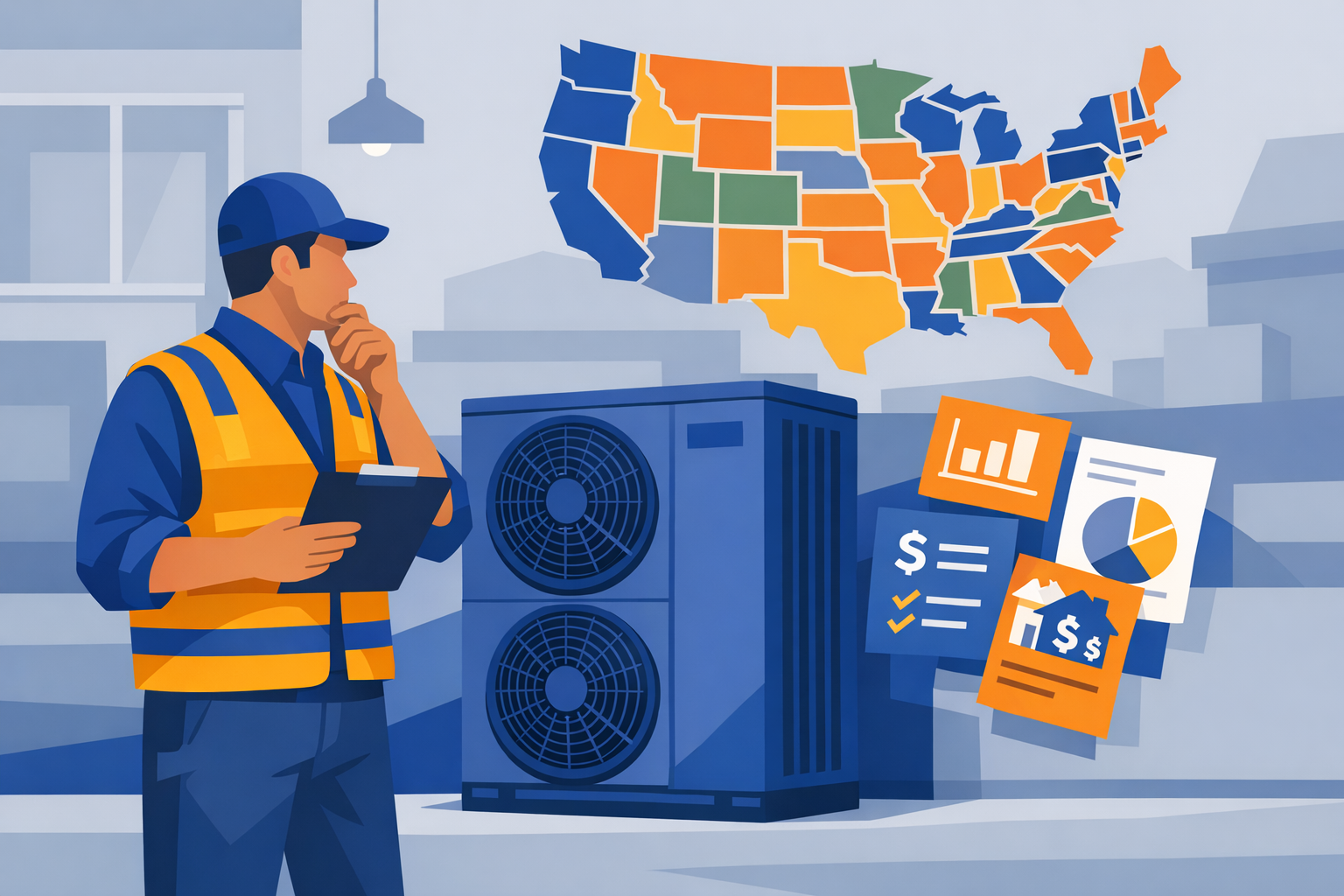
County commissioners in Washington state and Texas have accepted bids for major HVAC upgrades at justice-related public facilities. At least one project is directly tied to a statutory compliance deadline - a development that HVAC contractors and facility managers say is reshaping public-works procurement nationwide.
Background
Publicly mandated HVAC retrofits in government buildings are accelerating alongside stricter state energy codes. Washington's Clean Buildings Act (HB 1257, 2019) requires buildings larger than 220,000 square feet to meet clean building performance standards by June 2026. That deadline is already driving formal procurement actions at the county level.
The Benton County Justice Center, first constructed in 1983 and expanded to 275,058 square feet in 2001, underwent a Level 2 ASHRAE energy audit - conducted with the assistance of an energy audit consultant - and failed to meet Clean Buildings Act performance standards. Benton County subsequently solicited statements of qualifications from design-build teams to provide progressive design-build services under RCW 39.10.300-.320 for the Justice Center HVAC Upgrade Project.
In Texas, the Bell County Commissioners Court took parallel action on a structurally similar procurement. Commissioners approved a nearly $564,000 contract with Capstone Mechanical to repair and replace heating, ventilation, and air conditioning units across multiple county facilities. The project covers technology services, the engineer's office, the Belton Annex, the Temple Annex, the communication center, the Texas Department of Public Safety building, and the diversion center - with insurance proceeds from hail damage covering costs.
Washington state's Department of Enterprise Services has separately overseen a comparable undertaking at the historic Temple of Justice in Olympia. DES is replacing the HVAC system, building plumbing system, and lighting and controls throughout the building, citing aging infrastructure as vital to maintaining occupant comfort, preserving state assets, and improving energy performance in line with efficiency requirements.
Procurement and Contractor Qualification Details
High-profile public-works HVAC bids carry rigorous qualification requirements that directly affect which contractors can compete. For projects with an estimated cost of $1 million or more, each bidder must submit - by the bid deadline - a list of all licensed subcontractors for HVAC, plumbing, or electrical work, including proof of license.
The Bell County procurement also illustrated tensions inherent in public bid evaluation. The board considered selecting a construction manager at risk for the Justice Center Annex project but ultimately bypassed the top-ranked firm to save nearly $180,000.[1] The court focused on the legal concept of "best value" under Section 2269 of the state code and voted 4-1 to award the contract to Cloud Construction.
Financing structures for compliance-driven public HVAC retrofits are increasingly distinct from traditional capital-outlay methods. Energy savings performance contracting (ESPC), also called guaranteed energy savings contracting, is a budget-neutral procurement method requiring no upfront capital - projects are financed and repaid from future energy savings generated by the efficiency improvements. ESPCs have been shown to achieve deeper energy savings and employ a wider range of strategies, including full HVAC system retrofits, compared with utility-driven programs.
Basic retrofits - covering LED lighting, insulation, and HVAC improvements - can cost between $3 and $10 per square foot on average, whereas deep retrofits involving smart energy systems, renewable integration, and high-end building automation may cost $15 to $50 or more per square foot. A deep retrofit of a commercial building could cost $500,000 to $2 million but achieve 30 to 60 percent energy cost savings with a five- to ten-year payback period.
Outlook
The pipeline of compliance-driven public HVAC retrofits is expected to expand. The U.S. energy retrofit systems market is forecast to grow at a CAGR of 7.6 percent between 2025 and 2035, with rising adoption of energy-efficient building upgrades across commercial, residential, and public infrastructure accelerating momentum nationwide.
Institutional buyers - including public safety and justice facilities - prioritize mission-critical uptime, community outcomes, and budget stewardship, with procurement favoring proven solutions, performance guarantees, and compliance with funding requirements. As more state clean-building deadlines approach, procurement officers and HVAC contractors should expect statutory compliance timelines to become a primary trigger - rather than equipment failure - for public-sector retrofit contracts.