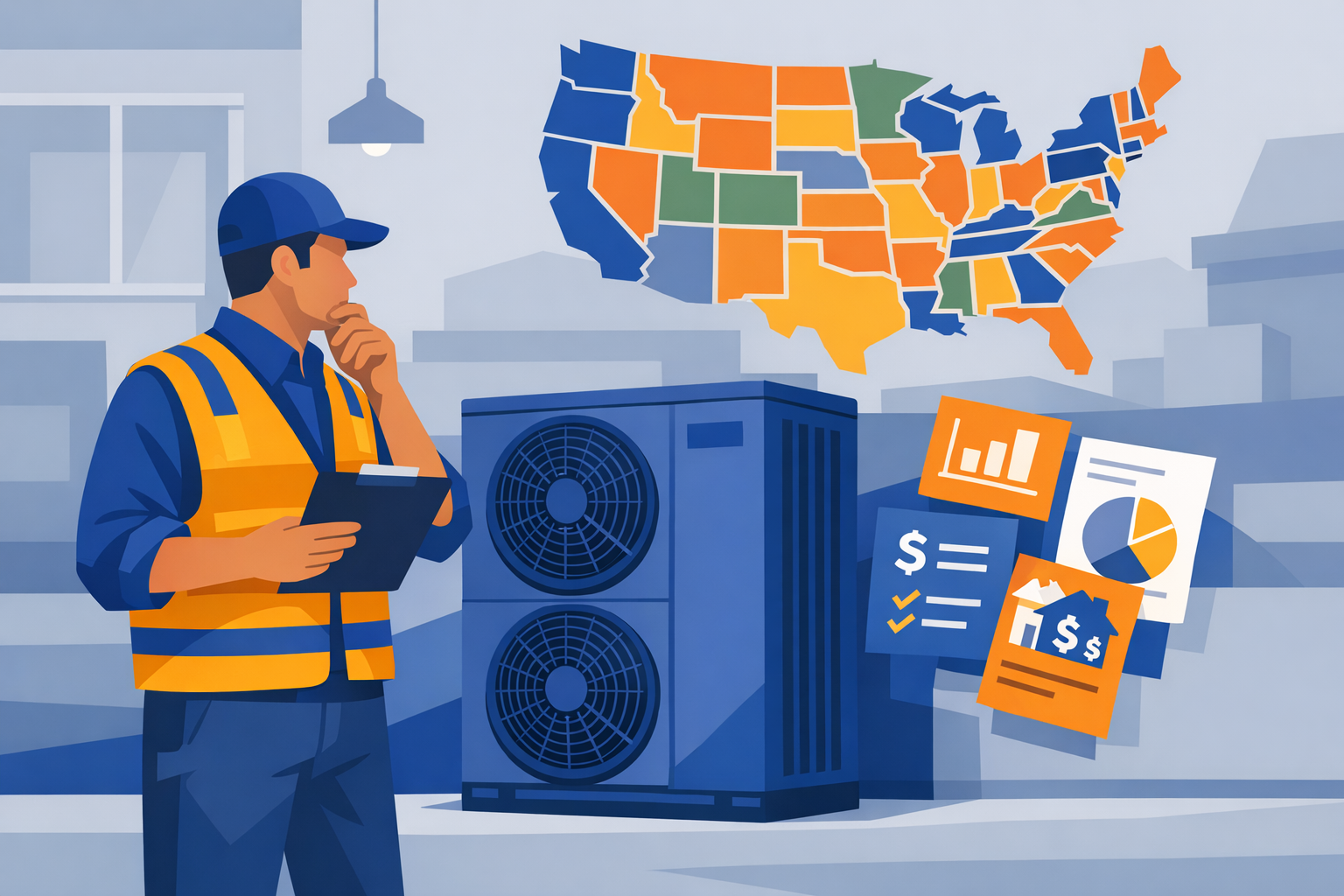
Mid-size HVAC distributors are expanding into underserved regional markets and deploying AI-driven analytics platforms to offset the operational strain of a deepening skilled-labor gap. The strategy pairs geographic growth with technology-enabled service routing and predictive maintenance tools, while structured partnerships with community colleges and trade schools aim to build a durable technician pipeline.
Background
The HVAC industry entered 2026 carrying a deficit of approximately 110,000 unfilled technician positions across the United States, according to data from SMACNA and industry analysts. Roughly 42,500 positions open annually due to retirements and market growth, and the retirement-to-replacement ratio stands at approximately five experienced technicians retiring for every two new workers entering the trade, according to fieldcamp.ai. Nearly 30 percent of current HVAC technicians are over the age of 55, according to the Air Conditioning Contractors of America (ACCA), signaling that attrition will accelerate before pipeline investments yield results.
Against this backdrop, the North American HVAC distribution market was valued at USD 65.93 billion in 2024 and is projected to grow at a 6.2 percent compound annual rate through 2030, according to Grand View Research. Distributors have identified geographic whitespace - regions where service density is thin and wait times are long - as a primary growth lever, even as too few technicians remain available to staff expanded territories.
Details
Distributors are responding on two parallel tracks: technology deployment and workforce development.
Technology deployment. Approximately 38 percent of HVAC professionals were using AI regularly in their businesses as of 2025, according to a Housecall Pro survey of more than 400 home-service professionals. Adoption is concentrating in scheduling, dispatch optimization, and predictive diagnostics. AI-powered tools can detect component wear before failures occur, and predictive maintenance scheduling has been cited as delivering up to 25 percent savings on maintenance costs compared with emergency repair models, according to fieldax.com. AI-powered scheduling and dispatch software is viewed as offering the fastest return on investment because it increases jobs handled per technician per day while reducing drive time and scheduling errors, according to industry analysts.
For distributors entering new geographies, AI-assisted route optimization is critical to making sparse technician pools viable. Intelligent scheduling that optimizes routes allows technicians to handle more service calls without burnout, according to Access Coins, a connected construction technology provider. Firms pursuing hub-and-spoke expansion models use this capability to serve low-density markets from centralized dispatch nodes.
Workforce development. Distributors and contractors are formalizing relationships with trade schools, Career and Technical Education (CTE) programs, and community colleges to create structured entry paths. Training programs are evolving to include modular, six-week intensive courses covering the latest health, safety, and air quality standards, according to Mar-Hy Distributors. Remote learning platforms that allow technicians to stay current on new systems and standards without taking time away from the field, combined with in-person sessions for hands-on skills, have become a standard hybrid model, according to ACCA. Industry distributor F.W. Webb has partnered with organizations such as Bring Back the Trades to support scholarships and workforce development initiatives, according to industry reporting.
Distribution consolidation is also reshaping market geography. Watsco completed the acquisition of Hawkins HVAC Distributors in April 2025, a supplier of HVAC equipment with locations in North Carolina and South Carolina, following earlier acquisitions of Lashley & Associates in January 2025 and Southern Ice Equipment Distributors in May 2025, according to Grand View Research. HVAC distribution roll-ups are expected to remain steady as strategic acquirers seek to increase market share in growth geographies, according to Kroll's industry analysis.
The HVAC services market stands at USD 72.48 billion in 2026 and is forecast to reach USD 98.74 billion by 2031, according to Mordor Intelligence. Commercial segments are driving a disproportionate share of demand growth, with commercial HVAC services projected to grow at a 7.5 percent CAGR through 2033, according to Grand View Research.
Outlook
Distributors that successfully link AI-enabled efficiency gains to structured workforce pipelines are expected to achieve the fastest ROI in newly entered markets, according to analysts. Apprenticeship programs will not yield fully trained personnel for at least three years, meaning near-term pressure on contractor margins will continue as labor costs account for more than half of service revenue, according to Mordor Intelligence. Broader adoption of AI tools in HVAC field-service operations is expected to continue rising through 2026 and into 2027 as platforms mature and integration with equipment-level diagnostics deepens, according to PHCC industry forecasting.