Mexico is accelerating its departure from high-GWP hydrofluorocarbons (HFCs), placing new compliance obligations on refrigeration manufacturers, importers, and service technicians across North American markets. The country's regulatory push - anchored in the Kigali Amendment and executed through SEMARNAT - is generating direct cross-border consequences for procurement, equipment standards, and workforce training.
Background
The Kigali Amendment, adopted in 2016 as an update to the Montreal Protocol, established legally binding targets for the gradual reduction of HFC production and consumption worldwide. Mexico was an active participant in the North American proposal that shaped the amendment, submitting jointly with the United States and Canada to control HFC production and consumption. Mexico ratified the Kigali Amendment on September 25, 2018, and the promulgation decree was published in the Official Gazette of the Federation on November 30, 2018.
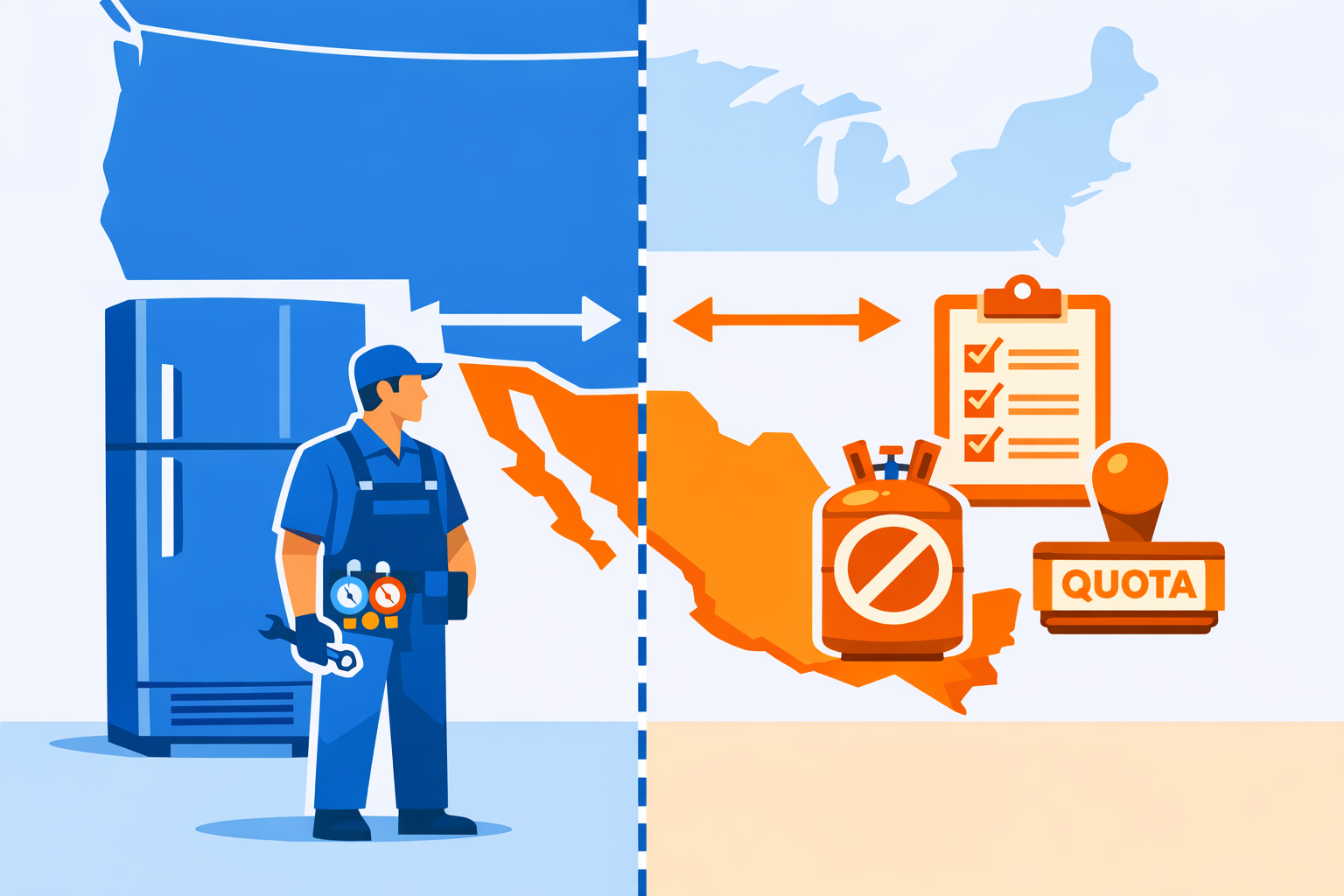
On the domestic side, Mexico has built an increasingly dense regulatory infrastructure. Implementation measures include the publication of specific customs tariffs for HFCs - pure or in blends - to ensure correct classification and control. Since July 2022, SEMARNAT has held authority to assign HFC import quotas, which took effect on January 1, 2024. Most recently, Mexico established maximum allowable consumption levels for hydrochlorofluorocarbons (HCFCs) for the 2026-2030 period; the measure was published on January 23, 2026, in the Official Gazette of the Federation.
Details
Mexico's HFC phase-down commitments follow a structured timeline with clear industry milestones. Under its Kigali roadmap, Mexico committed to freezing HFC consumption in 2024, achieving a 10% reduction by 2029, and ultimately reducing HFC consumption by 80% by 2045.
Pilot deployments are providing evidence of scale potential. Among verified achievements: demonstration projects replacing conventional refrigerants with low-GWP alternatives in cold storage rooms at a public market in Mexico City, including a commercial refrigeration system using transcritical CO₂ technology, achieved an estimated mitigation of 1,883 tonnes of CO₂ equivalent annually. According to project results, the intervention delivered a 70% reduction in total emissions through energy savings and refrigerant replacement in the upgraded systems.
Recovery infrastructure is also expanding. Mexico currently operates nine refrigerant recovery and recycling centers, along with two authorized destruction facilities using argon plasma arc and cement kiln co-processing technologies.
The regulatory divergence between Mexico and the United States adds complexity for cross-border operators. While Mexico is advancing its Kigali commitments without reversal, the U.S. EPA issued a proposed rule on September 30, 2025, to loosen requirements and compliance deadlines for air conditioning, retail food refrigeration, and other sectors. On March 12, 2025, the EPA announced reconsideration of the Technology Transitions Rule; under this proposal, the agency would adjust the GWP threshold for remote condensing units and supermarket systems from 150 or 300 to 1,400 starting January 1, 2026. This divergence means equipment certified under Mexican procurement specifications may not align with temporarily relaxed U.S. thresholds - a concern for manufacturers supplying both markets.
The final stage of Mexico's HCFC phaseout focuses on technical support for the service sector, including training programs, equipment donations, and official certification for refrigeration and air-conditioning technicians. Additional measures include training customs personnel to prevent illicit HCFC trade. Mexico has been recognized for its active role in Montreal Protocol compliance, implementing over 170 projects spanning demonstration initiatives, technical assistance, training, investments, and industrial conversion programs.
The market shift is also measurable commercially. Mexico's refrigerant market is projected to grow at a CAGR of 6.89% during 2025-2033, driven in part by the regulatory push toward low-GWP alternatives. Growing demand for air conditioning and refrigeration across residential, commercial, and industrial sectors is reinforcing this trajectory. The regulatory shift is accelerating the phase-down of high-GWP refrigerants such as R-134a and R-404A, pushing manufacturers and end users to transition toward hydrofluoroolefins (HFOs), natural refrigerants, and other low-GWP alternatives.
Outlook
Bilateral cooperation between Mexico and Canada to implement projects demonstrating efficient, sustainable solutions for eliminating high-GWP HFCs from Mexico's commercial refrigeration sector has been described as a multi-year effort. For HVAC and refrigeration professionals operating across the U.S.-Mexico border, the priority pressure points are equipment compatibility, technician certification alignment, and refrigerant import documentation under SEMARNAT's quota system. In October 2025, SEMARNAT reviewed Mexico's National Refrigerant Life-Cycle Management Plan to strengthen the network of Recovery and Recycling Centers and Collection and Destruction Centers, enhancing visibility and promoting refrigerant recovery. Tendering processes for commercial and industrial refrigeration projects in Mexico are expected to increasingly specify low-GWP compliance as a baseline requirement as 2029 reduction targets approach.