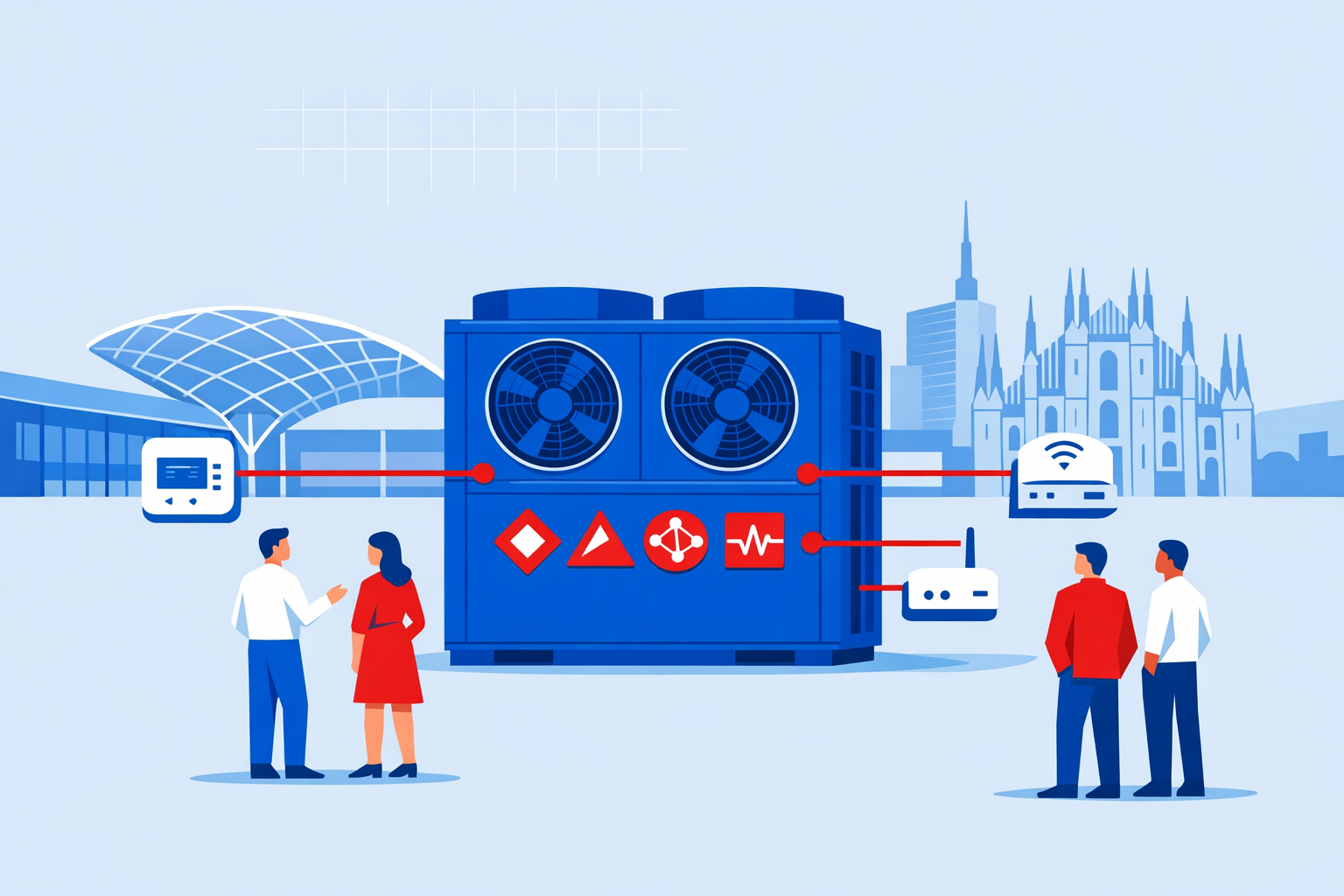
Executive summary. MCE 2026 in Milan highlights the integration of energy-efficient HVAC, IoT controls, and building automation as standard requirements. Major OEMs, including Samsung and LG, are adapting their portfolios to meet European regulatory benchmarks and an expanding landscape of interoperable building management systems. This shift drives adoption of regional product architectures, open communication protocols, and data-driven maintenance models, directly influencing system design, installation, and operational strategies.
MCE 2026 is scheduled at Fiera Milano from 24-27 March 2026, with over 1,800 exhibitors across HVAC+R, energy efficiency, renewables, and water technologies.[1] The 2026 theme, "evolving energy and integrated comfort," marks the event as a focal point for the reorganization of European HVAC and plumbing markets around interoperability and regulatory alignment.[2]
Why MCE 2026 Matters for European HVAC and Building Automation
Buildings represent about 40% of total final energy consumption in Europe, with space heating accounting for 60-80% of building energy use.[3] Globally, HVAC systems use approximately 38% of building energy, making them one of the most energy-intensive services.[4] Incremental efficiency improvements in controls and automation deliver substantial system-level impacts.
MCE 2026 centers on trends relevant for HVAC and plumbing professionals:
- Closer alignment of HVAC innovations with EU climate and energy-efficiency policy.
- Accelerated adoption of interoperable controls and building management systems using open protocols (BACnet, Modbus, KNX, Zigbee, LoRaWAN, etc.).
- Regionalized product architectures, notably in heat pumps and hydronic systems, reflecting F-gas, EPBD, and renewable energy mandates.
- Wider use of IoT platforms and cloud analytics for energy management and predictive maintenance.
These trends are evident across the event-from heat pump manufacturers to control and integration specialists.
Regulation Is Driving Regional HVAC Architectures
Recent European legislation (2023-2024) is transforming how manufacturers develop HVAC offerings and how systems are specified.
EPBD 2024: Zero-Emission Buildings as Baseline
The recast Energy Performance of Buildings Directive (EU) 2024/1275 sets a zero-emission standard for all new public buildings from 2028 and all other new buildings from 2030, aiming for a fully zero-emission building stock by 2050.[5] Zero-emission buildings (ZEB) feature minimal energy demand, on-site fossil-fuel-free operation, and extensive renewables integration.
Implications for HVAC design:
- Use of high-efficiency heat pumps and reversible systems as main HVAC sources.
- Integration of HVAC controls with on-site photovoltaics and renewables.
- Implementation of advanced control sequences within building management systems to reduce energy use and minimize peak loads.
Renewable Energy Directive and Heating/Cooling Targets
Renewables provided 26.7% of all heating and cooling demand in the EU in 2024, a record share.[6] Directive (EU) 2023/2413 (RED III) mandates Member States to increase the renewable share in heating/cooling by at least 1.1 percentage points annually (2026-2030).[6] Heat pumps and ambient-energy systems play a critical role in compliance.
2024 F-Gas Revision: Refrigerant-Driven Redesign
The revised EU F-gas Regulation (EU) 2024/573 (effective March 2024) cuts HFC quota by about 48% in 2025-26 versus 2023, and bans GWP ≥150 refrigerants in new monoblock heat pumps and small AC units below 12 kW from 2027, with full phase-out by 2032.[7] This accelerates adoption of propane (R290), CO₂, and other low-GWP refrigerants, shaping product safety, charge sizes, and installation methods.
Regulatory Drivers and Product Design Responses
| Policy / standard | Key HVAC implications | Indicative timeline |
|---|---|---|
| EPBD 2024/1275 (ZEB requirement) | Zero-emission mandate for new buildings; emphasis on integrated controls and renewables | Public new builds: 2028; all new builds: 2030 |
| Renewable Energy Directive (EU) 2023/2413 (RED III) | Annual renewable share increase for heating/cooling; prioritizes heat pumps, solar thermal, ambient sources | 2021-2025: ≥0.8 p.p./year; 2026-2030: ≥1.1 p.p./year |
| F-gas Regulation 2024/573 | Rapid HFC reduction; prohibits high-GWP refrigerants in small AC/HP; supports R290/R744 systems | Effective 2024; GWP ≥150 ban for <12 kW from 2027; phase-out 2032 |
For exhibitors, this regulatory environment drives:
- Compatibility with renewable heat sources and low-GWP refrigerants.
- Factory-set control sequences tied to EPBD and RED III performance metrics.
- Clear labeling and documentation for compliance across borders.
Interoperability and Open Protocols Move to Center Stage
Interoperability has become an essential requirement for energy-efficient HVAC and smart building projects.
Growth of Building IoT Platforms
The Building IoT platform market for commercial buildings is projected to grow from $64.1 billion in 2024 to $101 billion by 2030.[8] This expansion is driven by IT/OT convergence and demand for unified data models across building systems.
Control and gateway vendors at MCE 2026 are focusing on:
- Cloud-connected BMS and dashboards for multi-site portfolios.
- Standardized APIs and semantic frameworks for integrating HVAC data.
- Cyber-secure communication protocols (e.g., BACnet Secure Connect).
Multi-Protocol HVAC Controls
HVAC control vendors, such as CosyClimate, offer controllers supporting Wi-Fi, Zigbee, Modbus, BACnet, and LoRaWAN to facilitate integration across management and smart-home platforms.[9] Multi-protocol support reduces the need for custom gateways, streamlining cross-border projects.
Similarly, BACnet-focused providers are advancing secure integration: Suppliers like Andivi plan BACnet Secure Connect (BACnet/SC) across their ranges in 2026, supporting encrypted, certificate-based network communication.[10] This aligns with a broader European emphasis on open, secure protocols in building automation.[11]
Interoperability Layers Highlighted at MCE 2026
| Interoperability Layer | Representative Technologies | Typical Use Cases |
|---|---|---|
| Field / device layer | Modbus RTU/TCP, BACnet MS/TP, proprietary VRF buses | Chillers, AHUs, VRF/VRV, metering, valve and damper actuators |
| Automation / BMS layer | BACnet/IP, BACnet/SC, KNX, LonWorks | Room controllers, zoning, central plant control |
| IoT / cloud integration | MQTT, REST APIs, vendor clouds (SmartThings Pro, BECON Cloud) | Portfolio dashboards, analytics, updates |
| Application / data modeling | Brick schema, semantic tagging, BIoT platforms | Cross-system reporting, digital twins, diagnostics (FDD) |
System designers now must specify protocol and gateway combinations at the design stage to manage lifecycle costs and flexibility.
Samsung and LG: Integrated HVAC Control Platforms
Leading brands are positioning energy-efficient HVAC and interoperable controls as core features, not optional upgrades.
LG: BMS-Ready VRF and Heat Pump Portfolios
LG's European VRF (Multi V) and heat pump (THERMA V) lines prioritize management system compatibility. Controllers like BECON and AC Smart 5 offer multisystem coordination with open-protocol gateways.
LG's BECON and AC Smart 5 controllers enable direct integration with third-party BMS via BACnet IP and Modbus TCP, facilitating HVAC coordination with lighting and other services.[12] These platforms support energy logic libraries, load management, and diagnostics.
At MCE 2024, LG highlighted high-efficiency, low-GWP hydronic systems and heat pumps.[13] MCE 2026 continues this, focusing on integration of outdoor, indoor, and plant components in cohesive automation architectures.
Samsung: SmartThings Pro, b.IoT, and Connected Climate Solutions
Samsung advances from equipment supplier to platform provider. At ISH 2025, the firm presented the Slim Fit EHS ClimateHub, R290-based heat pumps, and extended controls such as SmartThings Pro and b.IoT Lite for commercial deployment.[14] SmartThings Pro is positioned as an enterprise energy and device management solution for European commercial buildings.[15]
Samsung's SmartThings Pro and b.IoT platforms, launched at ISH 2025 and AHR Expo 2026, feature cloud dashboards, AI-assisted controls, and multi-site HVAC oversight.[14] Samsung's controls also comprise data management servers and centralized touch controllers interfacing with BACnet and LonWorks gateways.[16]
These developments establish interoperability and energy management as built-in attributes. Integrators are now expected to design projects with systems for HVAC, lighting, and metering that function together from the planning stage.
Regionalized Product Architectures and Cross-Border Practices
Regulations and national codes are generating more region-specific product designs across Europe.
Refrigerant Choices and Safety Concepts
The F-gas phase-down and pending bans on high-GWP refrigerants are shifting OEMs to R290 and other natural refrigerants in compact units.[7] At MCE 2026, several manufacturers (e.g., Master Therm, ATREA) are introducing R290-based systems with integrated safety features and designs tuned to European conditions.[17]
Regional approaches include:
- Outdoor monoblock units with minimized refrigerant charge and sealed circuits.
- Hydronic distribution within buildings, reducing indoor refrigerant volume.
- Built-in leak detection and emergency shut-off where required by code.
Harmonizing Cross-Border Installation Practices
European OEMs increasingly offer:
- Firmware profiles pre-set for national scheduling and setpoints.
- Multi-language tools and commissioning portals.
- Design guides for cross-border issues-unit placement, acoustics, fire zones.
This standardizes installation and management across multi-country fleets while ensuring regulatory compliance.
Operational Impacts: Service Models, Maintenance, and Data
The move to interoperable, IoT-enabled HVAC controls impacts day-to-day operations.
From Scheduled to Condition-Based Maintenance
Data-rich controllers enable maintenance to transition from fixed intervals to condition-based models. Platforms such as LG's BECON/AC Smart and Samsung's SmartThings Pro/b.IoT provide analytics, alarms, and performance insights.[12]
This supports:
- Early identification of efficiency losses (e.g., coil fouling, sensor drift).
- Prioiritized service scheduling based on energy/carbon impact.
- Remote adjustments and diagnostics, reducing on-site visits.
IT/OT Convergence and Cybersecurity
Connected HVAC systems require closer integration with IT processes. BACnet/SC, VPN remote access, and role-based user management are now standard features.[10]
Key operational areas:
- Network segmentation between building systems and enterprise IT.
- Patch management for controllers/gateways.
- Managed access rights for staff, service partners, and OEMs.
Data Ownership and Standardized Metrics
Portfolio-wide dashboards reinforce use of standardized HVAC performance metrics, including:
- Normalized kWh/m² by building type and function.
- Load factors and peak demand for demand response/capacity planning.
- Comfort metrics (temperature, humidity, CO₂) conforming to EN and ISO standards.
These support regulatory compliance and internal benchmarking.[18]
Actionable Conclusions and Next Steps
Key priorities for HVAC and plumbing professionals emerging from MCE 2026:
For system designers and project engineers
- Design to regulations from concept. Factor EPBD ZEB, RED III, and F-gas criteria into system layout, refrigerant choice, and renewables integration at the earliest design stage.
- Specify protocols and interoperability. Clearly state protocol, tagging, and integration requirements in project documents.
- Plan for R290/low-GWP systems. Incorporate safety distances, ventilation, and installer qualifications in designs.
For installers and commissioning specialists
- Strengthen controls/networking proficiency. Commissioning now covers IP setup, BMS mapping, and cloud onboarding.
- Standardize templates. Use checklists for protocol, alarming, time sync, and metering to support consistent outcomes.
For facility and operations managers
- Leverage operational data. Integrate analytics and condition-based maintenance in service contracts.
- Align IT and FM roles. Define responsibilities for cybersecurity, access, and updates as HVAC systems connect to IT networks.
Frequently Asked Questions
How will the 2024 F-gas revision affect small split and monoblock heat pump selection after 2027?
From 2027, new monoblock heat pumps and small AC units under 12 kW with GWP ≥150 refrigerants are banned in the EU, with full phase-out by 2032.[7] Low-GWP refrigerants like R290 and CO₂ become standard. Expect more outdoor, factory-sealed units and updated installation standards/training.
Which communication protocols are most relevant for HVAC interoperability in commercial projects?
BACnet/IP (and growing use of BACnet/SC) leads at the BMS layer, with Modbus RTU/TCP prevalent at the device layer. KNX and LonWorks remain common for room and lighting control. MQTT and REST APIs support cloud integration.[11] Multi-protocol controllers shown at MCE 2026 facilitate integration across these communication layers.
How are platforms like SmartThings Pro and LG BECON shifting HVAC maintenance workflows?
These platforms collect detailed HVAC operational data in cloud or on-premises BMS, delivering dashboards, alarms, and reports. Features include AI-based optimization, device monitoring, and automated diagnostics.[12] Maintenance is moving to remote, prioritized, and proactive interventions.
What should be considered when specifying R290-based heat pumps in multi-unit buildings?
R290's low GWP supports regulatory compliance, but flammability requires design precautions: limit charge per circuit, maintain safety distances, ensure ventilation, and implement leak detection and shut-off as required.[7] OEM and national guidelines must inform design.
Does increased BMS and cloud connectivity heighten cybersecurity risk for HVAC systems?
Expanded connectivity expands exposure, but secure protocols (BACnet/SC), network segmentation, remote authentication, and structured patching reduce risk.[10] Cybersecurity-encrypted communications, role management, and audit logging-now features as standard in vendor solutions.