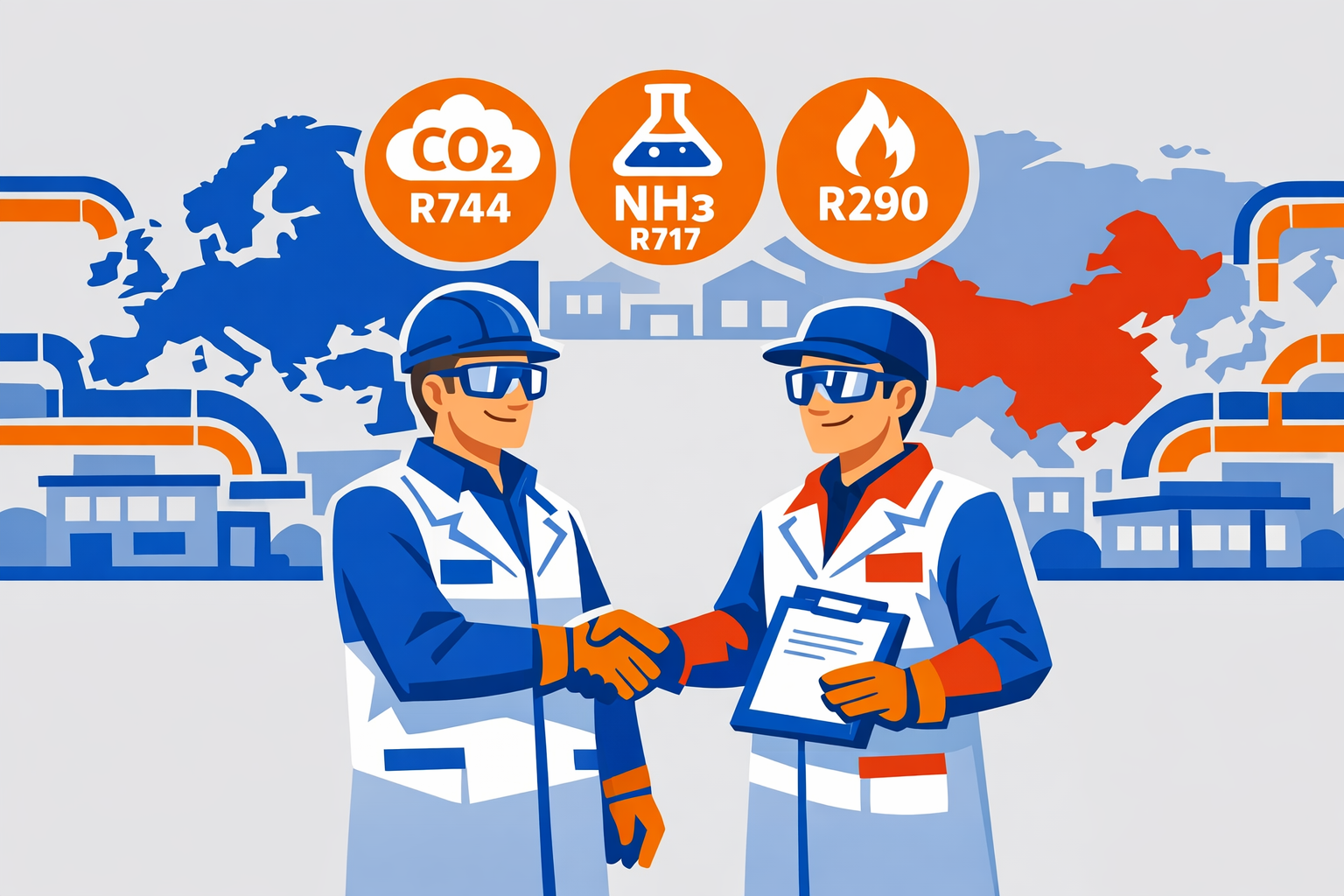
Italy and China have entered formal talks to align certification standards and training curricula for HVAC technicians working with natural refrigerants, as both nations face growing pressure to accelerate low-global-warming-potential (low-GWP) refrigerant deployment and close a widening skilled-labor gap. The initiative, disclosed at a recent international trade forum, covers CO₂ (R744), ammonia (R717), and hydrocarbon refrigerants such as propane (R290). Industry participants say the collaboration could simplify cross-border service operations, improve safety practices, and establish a common baseline for technician competency across Europe and Asia.
Background
Regulatory pressure in both regions is intensifying. The European Commission has released a proposed regulation establishing minimum certification requirements for engineers working with natural refrigerants - specifically CO₂ (R744), hydrocarbons, and ammonia (R717) - as well as F-gases, as mandated by the revised EU F-Gas Regulation. Under the revised EU F-Gas Regulation (EU) 2024/573, the European Commission is required to introduce standardized training programs across member states by March 12, 2026, with all existing technician certifications updated to comply with the new standards by March 11, 2027.
The new implementing act makes certification mandatory for technicians handling natural refrigerants and F-gases alike. It specifies six certificate types - including separate certificates for CO₂ and ammonia - covering the knowledge and skills required for each refrigerant class.
On the Chinese side, regulatory alignment with international frameworks is also advancing. China amended its Regulation on Ozone-Depleting Substances, effective March 2024, explicitly bringing HFCs under national control and aligning with the Kigali Amendment. The framework introduces HFC allowances, import-export licensing, mandatory data reporting, and lifecycle management covering leak reduction, recovery, reclamation, and destruction. China's HFC control targets a 10% reduction by 2029.
The two countries have prior cooperation on natural refrigerant technician training. Italy's Centro Studi Galileo (CSG), one of Europe's leading HVACR training institutes, previously completed a course on propane (R290) use in split-system air conditioners at Yantai Vocational College in Shandong, China, attended by 24 Chinese trainers and engineers. In November 2025, the Chinese government and the UN Environment Programme hosted a training event on good servicing practices in refrigeration, with a focus on safe handling of cold storage systems using natural refrigerants such as ammonia and ammonia-CO₂ cascade systems.
Details
The current dialogue centers on whether to pursue a global certification framework or a bilateral standard reflecting regional climate conditions, existing safety codes, and infrastructure realities. Proponents of harmonized benchmarks argue that shared competency baselines would shorten the path to widespread natural refrigerant adoption, helping manufacturers meet tightening emissions targets and governments reach regulatory deadlines more predictably. Critics caution that diverse building codes and facility types across China and Europe require modular curricula capable of national adaptation without compromising core safety and performance requirements.
Centro Studi Galileo, in cooperation with the United Nations Environment Programme, the International Institute of Refrigeration, and the leading international association of refrigeration and air conditioning, periodically organizes conferences on the latest technologies in the HVACR industry. According to CSG Director Marco Buoni, the organization's next step is global participation in UN events, with training centers already launched in Dubai and Tunisia and cooperation established in the U.S. - all aiming to replicate the European model of developing skilled technicians for new refrigerants and technologies.
The proposed collaboration includes potential joint training facilities and technician exchange programs. Discussions also cover the development of portable testing mechanisms that service firms and vendors can implement across borders. A key challenge is funding for curriculum development and instructor certification, given the specialized handling requirements of each natural refrigerant class. CO₂ systems operate at high pressures and require specialized components; ammonia demands industrial-grade safety controls; hydrocarbons require micro-charge strategies and reinforced enclosures.
The labor gap underpinning the initiative is acute on both sides. Industry data indicates that HVAC technician demand is projected to grow 13% through 2030. A severe HVAC technician shortage has left thousands of positions unfilled in 2025, driven by an aging workforce, limited awareness among younger generations, and barriers to training and certification.
Outlook
The practical timeline for any harmonized framework hinges on the pace of the EU's own certification regulation - with the European Commission's finalized implementing act on natural refrigerant and F-gas technician certification released in September 2024 - and on China's willingness to align its national standards with the resulting European baseline. China's manufacturing capacity for CO₂ technology is expanding rapidly, with Haier Carrier completing the country's first automated production line for CO₂ racks in January 2026 and CO₂ technology also being adopted for comfort heating and cooling applications. Market observers say a successful bilateral agreement on training standards could accelerate workforce development for both transcritical CO₂ supermarket systems and commercial HVAC heat pump projects, potentially serving as a model for broader international cooperation on low-GWP refrigerant deployment.