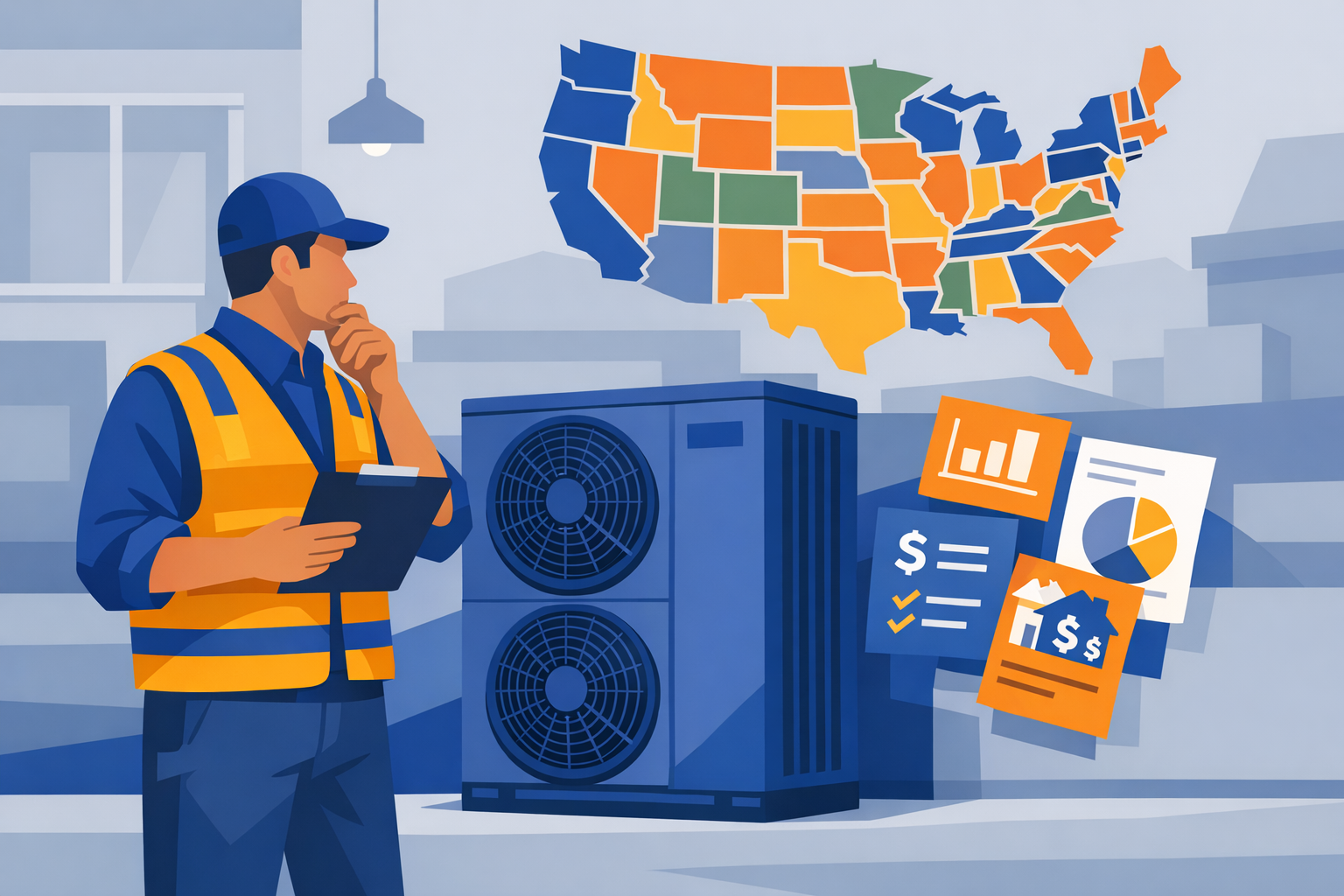
Chinese delegates visited Italy to study its technician certification model for the refrigerant transition, signaling a cross-border effort to build qualified workforce capacity for natural refrigerants on two continents simultaneously.
The visit, focused on training frameworks and Italy's refrigerant policy shift, coincides with accelerating regulatory pressure in both markets to phase out high global warming potential (GWP) substances in favor of low-GWP alternatives such as CO₂ (R744), ammonia (R717), and hydrocarbons. For HVAC and refrigeration professionals, the exchange represents an early step toward aligning certification standards across jurisdictions that together account for a substantial share of global refrigeration equipment production and installation.
Background: Parallel Regulatory Drivers
Both countries face structural pressure to transition away from fluorinated refrigerants, though through distinct policy mechanisms.
In the European Union, the revised F-gas Regulation (EU 2024/573), which entered into force in March 2024, introduced a mandatory requirement to develop training and certification programs for technicians working with natural refrigerants. The regulation establishes six types of certificates covering installation, servicing, and repair of equipment using CO₂ (R744), ammonia (R717), hydrocarbons, and synthetic refrigerants. EU Member States have one year from the implementing act to adapt their national certification programs. Italy, as a major HVAC manufacturing and installation market, is building out exactly the kind of structured credential framework the Chinese delegation came to examine.
China, meanwhile, operates under Stage II of its HCFC Phase-out Management Plan (HPMP), supported by the Multilateral Fund for the Implementation of the Montreal Protocol. In November 2025, UNEP OzonAction organized an international training workshop on "Good Servicing Practices for Cold Storage Applications and Safe Handling of Natural Refrigerants" in Guangzhou, from November 4 to 7, 2025. The workshop was jointly conducted in collaboration with China's Foreign Environmental Cooperation Center (FECO) under the Ministry of Ecology and Environment and the Chinese Association of Refrigeration (CAR). It focused on best practices for servicing cold storage systems using ammonia (NH₃) and ammonia-CO₂ cascade configurations.
On the regulatory front, China announced in April 2025 that it will ban the use of refrigerants with a GWP greater than 150 in new cars starting July 2029. Separately, China's 2026 HCFC production quotas set the allocation for HCFC-141b at zero, completing its phase-out under the Montreal Protocol schedule.
Details: Workforce Gap and Training Architecture
The alignment between Italy and China reflects a shared structural challenge: natural refrigerants such as ammonia and hydrocarbons carry specific safety, handling, and pressure requirements that differ significantly from conventional HFC systems. Without qualified technicians, equipment rollout stalls regardless of regulatory timelines.
Research published in npj Climate and Atmospheric Science underscores the scale of the problem in China. The study found that China manufactures more than 80% of the world's room air conditioners and uses roughly half of them domestically, creating a vast installed base that will require certified servicing as refrigerant transitions advance. The same study noted that the shift to low-GWP alternatives in China will require updated safety rules, improved certification systems, and extensive technician training.
As part of China's South-South cooperation efforts, the November 2025 Guangzhou training event included 20 refrigeration technicians and trainers from 13 countries across Asia, Africa, and the Pacific, demonstrating intent to leverage China's developing expertise as a platform for broader knowledge transfer.
On the European side, the EU's proposed certification framework requires that applicants pass both practical and theoretical examinations organized by an independent and impartial certification body to obtain any of the new certificate categories. The scope covers stationary refrigeration, air conditioning, heat pumps, organic Rankine cycles, and refrigerated transport units.
Italy's Centro Studi Galileo organized the 21st European Conference on the Latest Technologies in Air Conditioning and Refrigeration in Milan in June 2025, held in partnership with UNEP and the International Institute of Refrigeration (IIR), establishing Milan as a node for multilateral technical exchange on refrigerant transition topics. The IIR also participated in the MCE Mostra Convegno Expocomfort trade fair held in Milan from March 24 to 27, 2026, with sessions focused on HVAC decarbonization.
Outlook
The bilateral discussion between Chinese and Italian stakeholders remains at an early stage. No formal joint certification body or mutual recognition agreement has been publicly announced. The practical impact for manufacturers and service networks will depend on whether training content, safety benchmarks, and exam frameworks converge enough to reduce duplication for technicians operating across both markets.
For HVAC contractors, procurement managers, and training providers in Europe and Asia, the process bears monitoring: harmonized standards would lower barriers to technician mobility and could ease the qualification bottleneck that currently limits the pace of natural refrigerant deployment in commercial and industrial refrigeration.