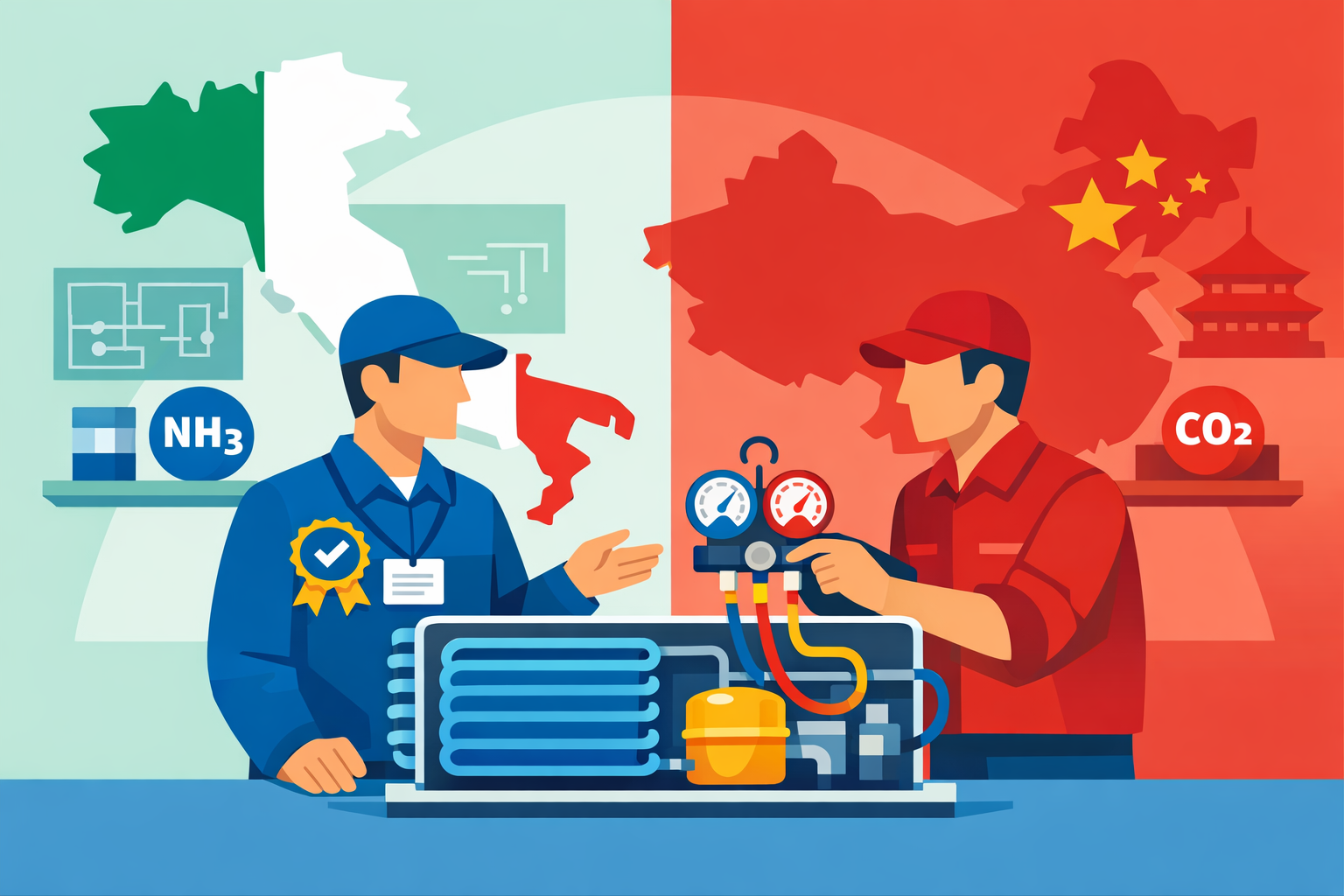
Members of the Italian and Chinese national ozone units held bilateral discussions in Rome to coordinate technician training frameworks for the refrigeration, air-conditioning, and heat pump (RACHP) sector - a move signaling growing cross-border collaboration as both jurisdictions accelerate transitions away from high-GWP fluorinated refrigerants.
Background
UNEP OzonAction organized an international training workshop titled "Good Servicing Practices for Cold Storage Applications and Safe Handling of Natural Refrigerants" in Guangzhou, China, from 4 to 7 November 2025. The event took place under Stage II of China's HCFC Phase-out Management Plan (HPMP), supported by the Multilateral Fund for the Implementation of the Montreal Protocol.
The workshop was jointly conducted by the OzonAction Compliance Assistance Programme (CAP) for South Asia, in collaboration with the Foreign Environmental Cooperation Center (FECO) of China's Ministry of Ecology and Environment and the Chinese Association of Refrigeration (CAR). Training focused on best practices for servicing cold storage systems using natural refrigerants such as ammonia (NH3) and ammonia-carbon dioxide (NH3/CO2) cascade systems. As part of China's South-South cooperation efforts, 20 refrigeration technicians and trainers from 13 countries across Asia, Africa, and the Pacific participated.
The Guangzhou workshop followed broader bilateral engagement: members of the Chinese and Italian national ozone units met in Rome to discuss training technicians to work with natural refrigerants and China's refrigerant transition in the RACHP sector.
Details
Marco Buoni, director of Italy's Centro Studi Galileo - a leading Italian HVAC&R technician training center - presented the new training requirements for technicians in the European Union. The EU's revised F-Gas Regulation requires the development of training and certification programs for technicians working with natural refrigerants. It introduces six certification categories for installing, servicing, and repairing equipment using CO2 (R744), ammonia (R717), hydrocarbons, and synthetic refrigerants.
Centro Studi Galileo is among the most recognized training centers in Italy and is well established across Europe and internationally for training in refrigeration, air conditioning, and renewable energies. Around 3,000 companies participate in its programs, which operate across more than 15 locations throughout Italy and the United Kingdom.
China's own policy trajectory underscores the urgency of the training push. China announced in April 2025 that it will ban the use of refrigerants with a GWP greater than 150 in new cars starting July 2029 - the first GWP restriction applied to mobile air-conditioning in the country. R134a remains the most widely used refrigerant for passenger cars and trucks sold in China, with emissions from the refrigerant in the MAC sector reaching 20 million metric tons of CO2 annually, according to the International Council on Clean Transportation.
China has released its national implementation plan for the Montreal Protocol for 2025-2030, detailing measures to phase down ozone-depleting substances and HFCs. The plan mandates a gradual reduction of HCFCs, targeting a 97.5% cut in production by 2030 from baseline levels. To improve end-of-life management, it requires registration of maintenance and refrigerant recovery units, promotes technician training and certification, and encourages regeneration and traceability of recovered refrigerants.
Deployment of natural refrigerant systems within China is also accelerating. As of December 2025, an estimated 25 commercial stores and 10 industrial sites in China were operating transcritical CO2 refrigeration systems, according to an ATMOsphere report on commercial and industrial refrigeration. In January 2026, Haier Carrier announced it had completed China's first automated production line for CO2 racks, which it said would increase production eightfold.
A shortage of trained natural refrigerant technicians in both established and emerging markets remains a barrier to adopting CO2- and propane-based refrigeration systems. Proper technician training for installing and servicing such systems is essential to accelerating deployment. CO2 presents challenges related to high operating pressures and emerging technologies such as ejectors, while propane raises flammability concerns.
Outlook
The revised EU F-Gas Regulation, which became law in March 2024, requires member states to establish certification programs for technicians working with natural refrigerants. With China simultaneously mandating technician training and certification under its 2025-2030 Montreal Protocol implementation plan, the bilateral dialogue between Italian and Chinese authorities positions both jurisdictions to exchange structured curricula, safety protocols, and examination standards. For HVAC&R manufacturers, importers, and service providers operating across European and Asian markets, harmonized training benchmarks could reduce barriers to deploying natural refrigerant equipment globally.