A UNEP OzonAction-brokered initiative is bringing Italian and Chinese institutions into direct collaboration on natural refrigerant technician training, creating a practical model for cross-border certification alignment as both Europe and China accelerate phase-outs of high-GWP refrigerants.
Background
In May 2026, UNEP OzonAction organized an International Training of Trainers (ToT) Programme for RAC Certification Trainers and Assessors in Casale Monferrato, Italy, hosted by the Italian Association of Refrigeration Technicians (ATF). The programme, conducted under UNEP's Compliance Assistance Programme (CAP), drew participants from six South Asian countries, including China. The five-day event focused on RAC best practices, safe handling of fluorinated gases, and the transition to low-GWP natural refrigerants, with financial support from the Multilateral Fund for the Implementation of the Montreal Protocol.
The Italian training followed a related event in China. In November 2025, UNEP OzonAction organized a workshop titled "Good Servicing Practices for Cold Storage Applications and Safe Handling of Natural Refrigerants" in Guangzhou, conducted under Stage II of China's HCFC Phase-out Management Plan (HPMP) and supported by the Multilateral Fund. The Guangzhou workshop was jointly conducted by the OzonAction Compliance Assistance Programme for South Asia, in collaboration with China's Foreign Environmental Cooperation Center (FECO) under the Ministry of Ecology and Environment, and the Chinese Association of Refrigeration (CAR). Training focused on best practices in servicing cold storage systems using ammonia (NH3) and ammonia-carbon dioxide (NH3/CO2) cascade systems.
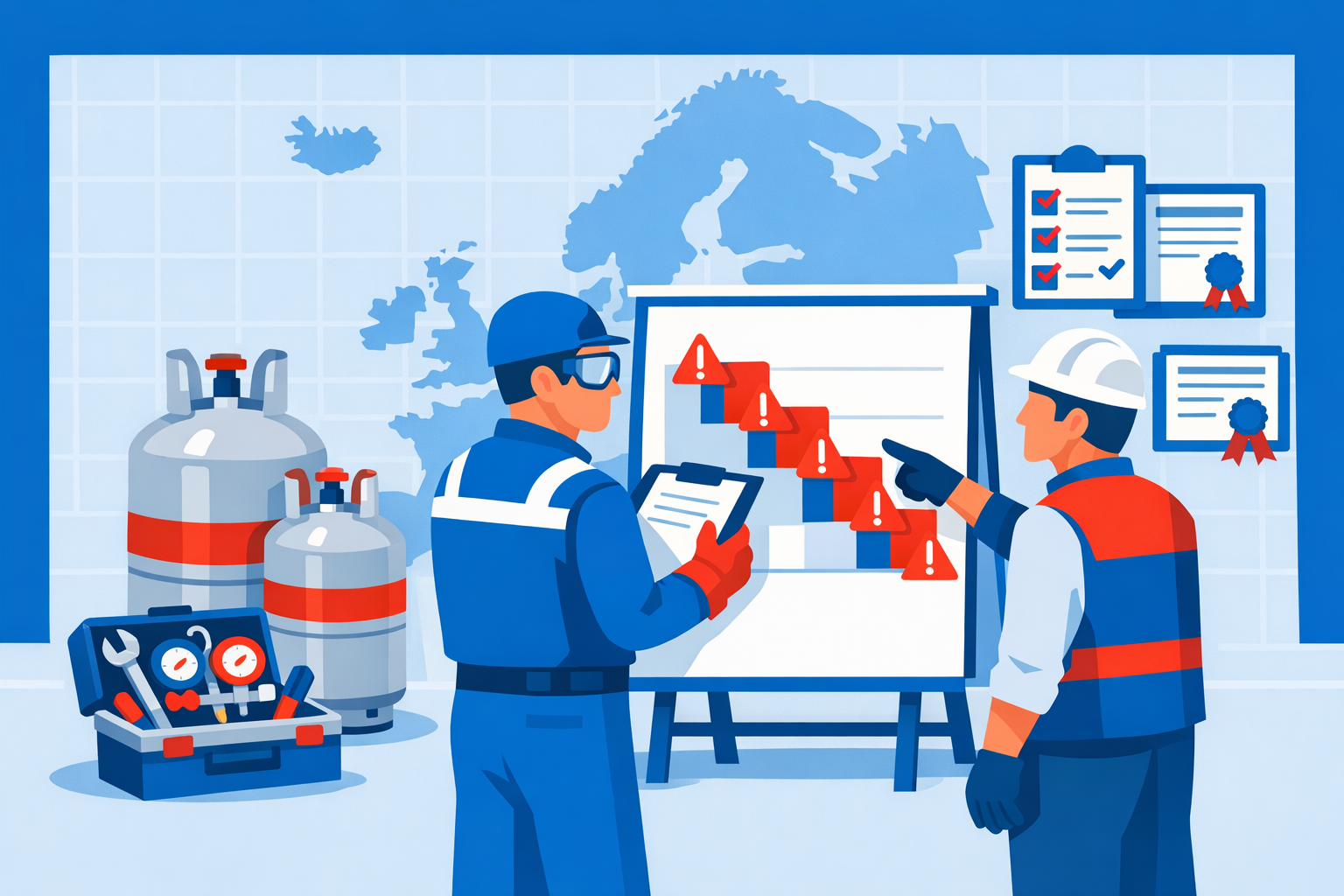
These activities sit within a broader regulatory context. The EU's revised F-Gas Regulation (EU) 2024/573 requires member states to establish minimum requirements for certification programs covering technicians working with natural refrigerants - specifically CO2 (R744), ammonia (R717), and hydrocarbons - as well as F-gases. The European Commission published implementing rules introducing six types of certificates, including separate certifications for CO2, ammonia, hydrocarbons, and combined categories. All existing EU technician certifications must be updated to comply with the new standards by March 11, 2027.
Details
At the close of the Italian ToT programme, participants could sit the EU F-Gas Certification examination. Ten of eleven participants passed both theoretical and practical examinations, earning official EU F-Gas certificates that strengthen their standing as trainers and assessors in their home countries. The programme also addressed what organizers described as persistent capacity gaps in delivering competency-based certification systems across developing countries.
China's participation in Italian-hosted certification training aligns with its own accelerating domestic policy commitments. China's National Plan for Implementation of the Montreal Protocol (2025-2030), issued in April 2025 by the Ministry of Ecology and Environment and four other ministries, sets targets of a 67.5% cut in HCFC production and a 73.2% cut in consumption from baseline by 2025, reaching 97.5% reduction by 2030. The plan prohibits production of household refrigerators and freezers using HFC refrigerants as of January 1, 2026, and bans refrigerants with GWP above 750 in most new room air conditioners and small commercial systems by 2029. China's national plan also mandates technician training and certification programs and promotes registration of maintenance and refrigerant recovery units.
On the European side, regulatory pressure on training institutions is compounding. Under Regulation (EU) 2024/573, technicians handling alternative refrigerants such as hydrocarbons, CO2, or ammonia - not just F-gases - now require certification for the first time. CO2 (R-744) is gaining ground in commercial refrigeration, while ammonia (R-717) remains the preferred choice for industrial applications, and hydrocarbons such as propane (R-290) are increasingly used in heat pumps and smaller refrigeration systems.
The cross-border training model pursued by UNEP OzonAction reflects recognition that national certification ecosystems alone cannot keep pace with simultaneous transition demands in both regions. The programme specifically addressed capacity gaps faced by Article 5 countries in delivering high-quality training and implementing competency-based certification systems. At the 2026 Ozone2Climate (O2C) Technology Roadshow and Industry Roundtable, held in April 2026 at the Capital International Exhibition and Convention Centre in Beijing, UNEP OzonAction cooperated with China's government and the China Refrigeration and Air-Conditioning Industry Association (CRAA) to review progress under the Kigali Amendment and discuss strategies to accelerate the shift to sustainable cooling technologies.
Outlook
The alignment of Italian training infrastructure with Chinese regulatory priorities creates a potential template for standardized competency mapping that training bodies in North America and other regions could reference. ASHRAE and UNEP approved a new two-year Life Cycle Refrigerant Management (LCRM) work plan at the 2026 ASHRAE Winter Conference in Las Vegas, reinforcing their partnership to advance sustainable refrigerant practices worldwide. For HVAC and refrigeration service firms operating across European and Asian markets, the practical implication is growing pressure to audit technician qualification portfolios against evolving, jurisdiction-specific certification frameworks - particularly for ammonia, CO2, and hydrocarbon systems - within near-term compliance windows.