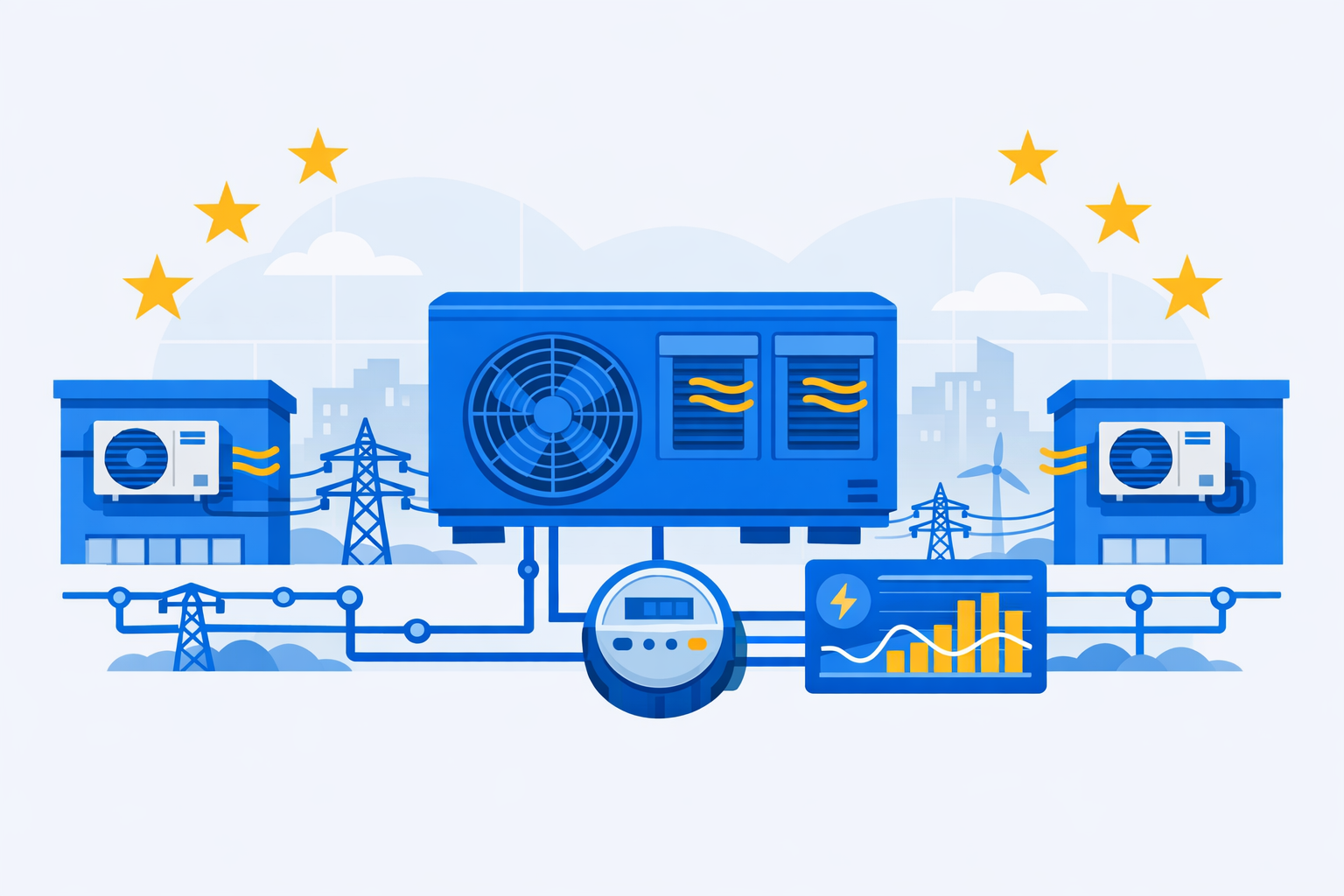
HVAC systems are increasingly utilized as distributed energy resources (DERs), supporting grid reliability and renewable integration. European Union grid regulations now promote demand-side flexibility: day-ahead electricity markets operate in 15-minute intervals, and the Agency for the Cooperation of Energy Regulators (ACER) requires national flexibility assessments by July 2026. A Network Code on Demand Response will permit DERs to participate directly in wholesale markets. ACER's EU-wide reforms, including 15-minute trading and the forthcoming demand response code, target improved real-time flexibility and expanded market access for distributed resources. Member states face a July 2026 deadline for flexibility assessments and must set indicative targets by January 2027.[1]
Background
Germany has adopted regulatory measures via the Energy Industry Act (EnWG §14a) to promote flexible operation of controllable assets such as heat pumps and EV chargers. These measures introduce time-based grid fees and mandate connection rights for eligible smart devices. Beginning April 2025, German distribution system operators are required to offer variable grid fees for assets like heat pumps and EV chargers. Tariff bands will average 2.6 ct/kWh (low), 8.6 ct/kWh (standard), and 12.5 ct/kWh (high) nationwide. EnWG §14a also guarantees connection rights for heat pumps, which may be throttled according to agreed grid management rules.[2]
These policies address current challenges: Germany recorded over 560 hours of negative electricity prices through October 2025-almost 8 percent of all hours-primarily due to high solar generation without adequate load flexibility.[3] Projections indicate Germany could face capacity shortfalls for approximately eight hours in 2026, increasing to 18 hours by 2028, emphasizing the need for demand-side contributions to grid stability.[4]
Details
Pilot projects and research demonstrate how HVAC systems can function as DERs. In the EU and Germany, trials examine interoperability standards for explicit demand response in buildings, leveraging smart meter infrastructure and established communication protocols to enable consistent load management across devices.[5] One German pilot within the DRIMPAC framework coordinates electricity, gas, and district heating in municipal buildings in Trier, optimizing flexibility across energy carriers while maintaining occupant comfort.[6]
Technically, recent academic work explores optimization strategies for air-conditioning load management under uncertain conditions. Robust models use probabilistic methods to aggregate fixed-frequency air conditioners for demand response, accounting for temperature uncertainty and balancing aggregator profit with occupant comfort.[7] Advanced simulation tools now also support human-in-the-loop operation, allowing building operators to adjust zone setpoints in real-time and analyze HVAC flexibility scenarios via detailed dashboards.[8]
Outlook
With EU market reforms underway and Germany advancing national flexibility measures, HVAC systems' role as DERs is set to expand. Forthcoming flexibility assessments, new tariffs, and smart meter deployment will enable wider HVAC participation in retail and wholesale energy markets. These changes aim to enhance grid stability amid increasing renewable penetration and offer building operators new opportunities for cost savings.