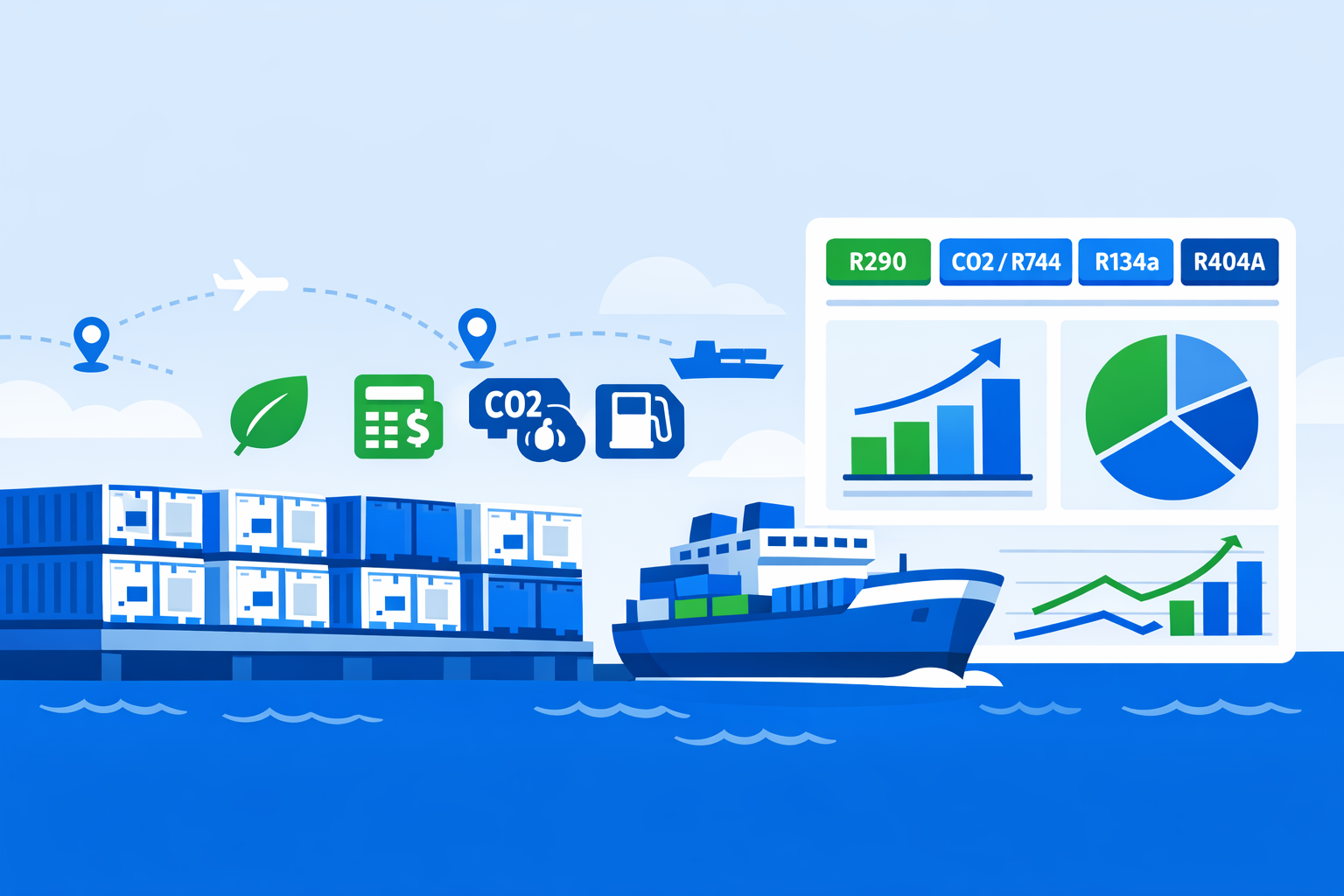
The Greener Reefer Transition Alliance, led by Germany's GIZ (Deutsche Gesellschaft für Internationale Zusammenarbeit), has released a free online tool that enables fleet operators and logistics managers to calculate and compare total operating costs and greenhouse gas emissions of different refrigerants used in maritime reefer containers across real-world trade routes.
Background
Refrigerated maritime containers - known as reefers - form the backbone of global trade in temperature-sensitive goods, yet their reliance on high-GWP refrigerants containing "forever chemicals" and energy-intensive cooling systems poses a significant environmental challenge. While reefers account for only 15% of the global container fleet, they generate a disproportionately high share of emissions due to HFC refrigerants such as R134a and R404A, which carry GWPs of 1,530 and 4,728, respectively.
In 2018 alone, refrigerant leaks from reefers produced 3.74 million tonnes of CO₂-equivalent emissions. The sector faces mounting regulatory pressure: as of January 1, 2025, intermodal containers sold for domestic use in the United States must use refrigerants with a GWP below 700, as mandated by the EPA under the American Innovation and Manufacturing (AIM) Act. The EU F-Gas Regulation, the Kigali Amendment, and IMO climate goals are simultaneously accelerating demand for sustainable reefer technologies.
The refrigerated container market - valued at approximately $4.5 billion in 2024 - is expected to nearly double to $9 billion by 2033, driven by growth in retail, healthcare logistics, and fresh food supply chains.
Tool Details and Simulation Outputs
The Greener Reefer Transition Alliance, a collaborative industry initiative led by GIZ, has introduced an emissions and cost simulator comparing refrigerants used in maritime reefers across real-world trade routes. The free Reefers Emissions & Cost Savings Simulator allows users to input variables including route, cargo, carbon pricing, and refrigerant and fuel costs. It enables shippers, logistics operators, and policymakers to quantify the benefits of natural refrigerants - propane (R290) and CO₂ (R744) - against synthetics including R134a, R1234yf, R404A, R513A, and R452A.
Users select the vessel IMO number, product, container size, cargo load, route, and market prices. The simulator factors in the product's storage requirements, the route's ambient temperature, the vessel's technical specifications, the refrigerant charge, and the leak rate. It then quantifies each refrigerant's environmental impact, including direct and indirect greenhouse gas emissions, TFA (trifluoroacetic acid) emissions, and carbon abatement - defined as the avoided cost per kilogram of CO₂e.
The tool was developed in collaboration with the Centre for Shipping and Global Logistics (CSGL) at Kühne Logistics University (KLU), with support from the International Climate Initiative and the German Federal Ministry for the Environment, Nature Conservation, Nuclear Safety and Consumer Protection.
In a demonstration scenario, Gordon Wilmsmeier, Director of the Hapag-Lloyd CSGL at KLU, modeled shipping bananas from Guayaquil, Ecuador, to Hamburg, Germany, aboard the vessel Polar Ecuador (IMO 9786774), applying average intercontinental shipping parameters. Propane (R290) emerged as the most cost-effective option. Compared to R290, annual costs per container were roughly $50 (€43) higher for CO₂, $350 (€300) higher for R134a and R1234yf, $450 (€390) for R513A, $1,000 (€870) for R404A, and $1,200 (€1,000) for R452A.
"Natural refrigerants can turn decarbonization into a strong business case," said Gordon Wilmsmeier, Director of the Hapag-Lloyd Center for Shipping and Global Logistics at Kühne Logistics University.
The model translates technical performance into monetary values, providing a cost breakdown for each refrigerant.[1] The simulator quantifies each refrigerant's environmental impact, including greenhouse gas emissions (direct and indirect), TFA emissions, and carbon abatement costs.[2] TFA is a persistent environmental contaminant classified as an ultra-short-chain PFAS substance.
Outlook
To accelerate the transition to natural refrigerants in maritime shipping, GIZ is supporting R290 reefer development and CO₂ reefer training. In collaboration with GIZ, Thermo King, a brand of Trane Technologies, will test a direct-expansion R290 proof-of-concept reefer in June with a Costa Rican fruit producer. Modeling published separately by GIZ and the Kühne Climate Center shows that 50% adoption of R290 in new reefers by 2050 could significantly reduce GHG and PFAS emissions. Energy efficiency improvements through better insulation and control systems are projected to cut indirect emissions by up to 20%.