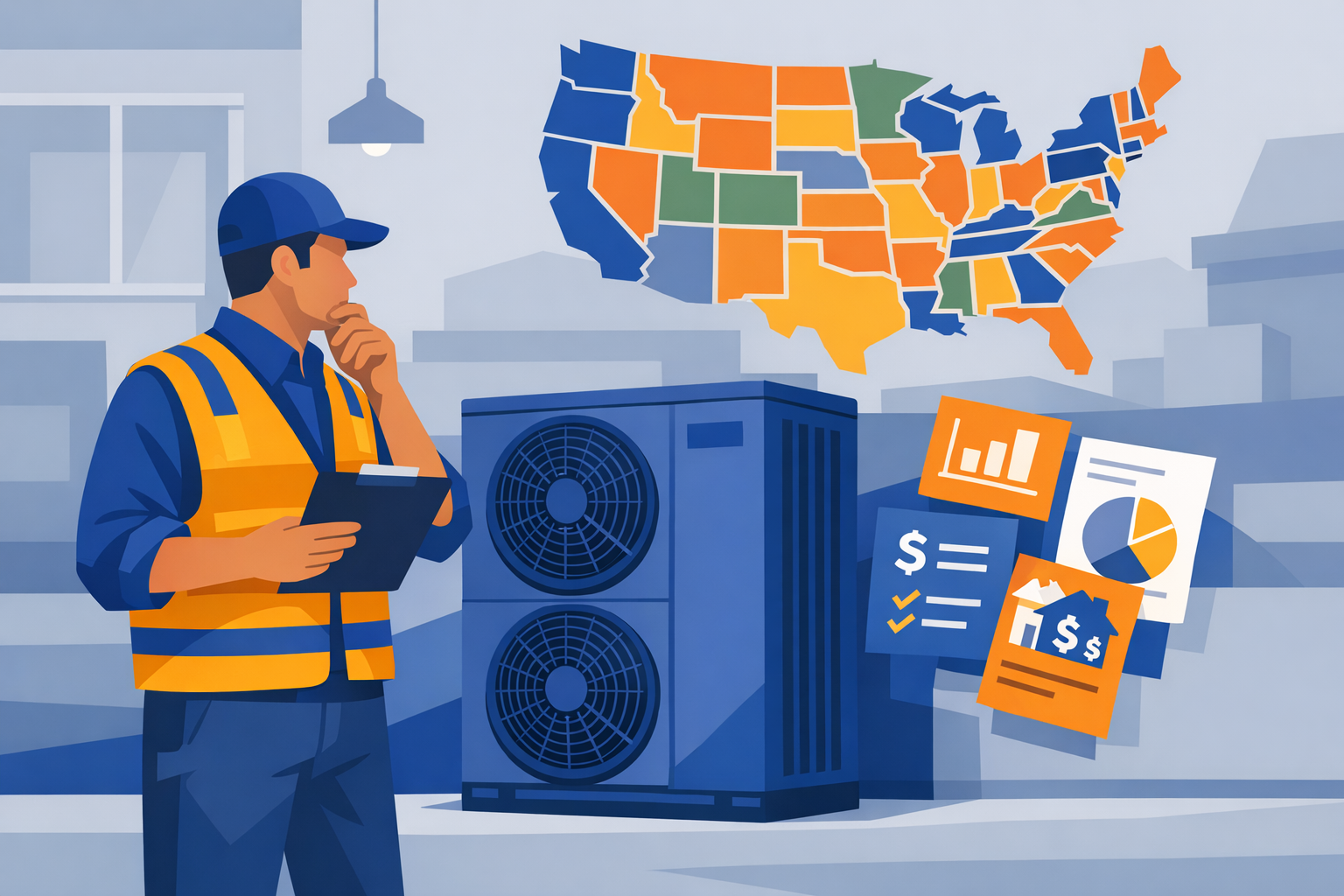
Clean technology companies Palmetto and Quilt are deploying separate but complementary strategies-subscription leasing and partner-driven hardware expansion-to reduce the financial and logistical barriers that have kept heat pump adoption concentrated in affluent, incentive-rich markets.
Background
Residential space heating accounts for a substantial share of U.S. home energy emissions, and HVAC electrification has become central to state and federal decarbonization strategies. The Inflation Reduction Act (IRA) created two major funding streams: the Section 25C Energy Efficient Home Improvement Credit, offering homeowners a 30% federal tax credit on heat pump installations up to $2,000 per year, and the High-Efficiency Electric Home Rebate Act (HEEHRA), a $4.5 billion rebate program targeting low- to moderate-income households with up to $8,000 in point-of-sale rebates for heat pump installations. Despite this federal framework, program rollout has been uneven. California's HEEHRA single-family rebates became fully reserved statewide as of February 24, 2026, with all unapproved reservation requests placed on a waitlist. Federal heat pump subsidies expired in 2025, though many utilities, states, and local governments continue to offer incentives. According to the Database of State Incentives for Renewables and Efficiency (DSIRE), 49 states and Washington, D.C. currently offer state- or utility-level heat pump incentives; Alaska is the only state with no related listings as of May 2026.
Details
On the hardware side, Redwood City-based Quilt closed a $20 million Series B funding round in December 2025, bringing total capital raised to $64 million. The new funding targets geographic expansion, with nearly 1,000 units installed across 16 U.S. states and five Canadian provinces, according to CEO Paul Lambert. In February 2026, Quilt announced a partnership with Southern Home Services, a residential trade service consolidator. Southern Home Services brands began offering Quilt systems in nine markets across Florida, Georgia, South Carolina, and Texas-one of the largest single expansions in Quilt's history. The deal extended coverage to 21 U.S. states and six Canadian provinces, served by more than 90 certified installation partners. Chief Revenue Officer Mark Schmidt described the company's 2026 expansion strategy as "partner-driven," with plans to prioritize the Midwest and South alongside deeper coastal penetration. Quilt is also broadening its hardware and software product suite, including remote diagnostics tools designed to accelerate installations and reduce repeat service visits.
On the financing side, Palmetto launched its Comfort Plan subscription program in October 2025, targeting the same affordability barrier from a different angle. The program enables homeowners to access energy-efficient HVAC systems without upfront cost, replacing traditional capital outlay with a predictable monthly fee covering equipment, installation, and service.[1] The company stated that families no longer need $15,000 upfront to replace a failing HVAC system or upgrade to a more efficient heat pump.[2] The plan also serves HVAC dealers, who gain access to new customer segments, and rental property owners, for whom it eliminates capital expenditure requirements.
Awareness and installer capacity remain structural constraints. Nationally, 92% of homeowners self-report awareness of heat pumps, but 55% do not know what heat pumps do or that they outperform conventional systems in efficiency-a gap that installer partners are being tasked with closing. The International Energy Agency has identified deployment barriers on both the demand side (cost and market hurdles) and the supply side (manufacturing constraints and a shortage of trained installers). Research on heat pump equity similarly notes that adoption barriers include high upfront costs, credit and liquidity limitations, low technology familiarity, and low awareness of available policy incentives.
Outlook
Quilt's latest investment is expected to accelerate commercial expansion across the United States and drive continued software and product innovation, with the company targeting more than 1,000 cumulative installed units in the near term. The sustainability of the broader market push will depend on whether state-administered rebate programs can be replenished and whether installer workforce capacity keeps pace with demand. Ensuring that lower-income households are not left behind remains a central challenge for state leaders driving building decarbonization, according to Matt Casale, director of state mobilization at the Building Decarbonization Coalition.