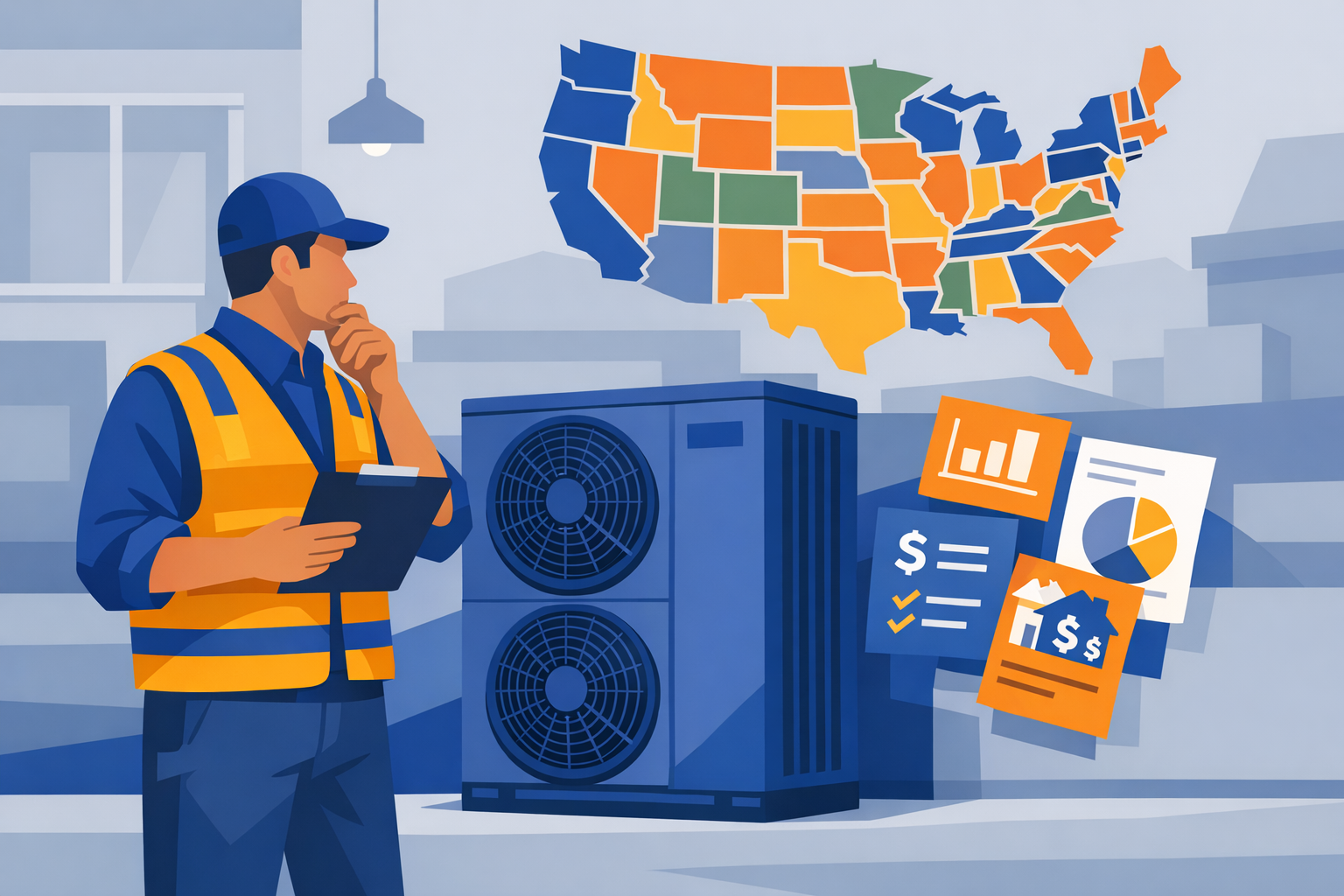
Regulatory uncertainty surrounding the EPA's proposed rollback of its 2023 Technology Transitions Rule is compelling HVAC contractors, equipment distributors, and service firms across the United States to revise retrofit schedules, recalibrate training investments, and rethink supply-chain commitments made under the original compliance framework.
On March 12, 2025, the EPA announced reconsideration of the Technology Transitions Rule as one of its 31 deregulation priorities, then released a formal reconsideration proposal on October 3, 2025. The comment period closed on November 21, 2025. A final rule addressing petitions for reconsideration was published in the Federal Register on May 26, 2026.
Background
The rollback effort targets the 2023 Technology Transitions Rule, enacted under the American Innovation and Manufacturing (AIM) Act - legislation President Trump signed in December 2020. That rule established sector-specific limits on hydrofluorocarbon (HFC) refrigerants and prohibited the manufacture, installation, or import of equipment using certain higher-GWP refrigerants.
Under the AIM Act, the number of HFC production and consumption allowances is set to decrease to 15 percent of historic baseline levels by 2036. Beginning January 1, 2025, the Technology Transitions Rule restricted the manufacture, sale, distribution, import, and export of HFC-containing appliances in certain residential, commercial, and industrial sectors, applying GWP limits specific to each sector. Separately, the HFC Leak Repair and Management Rule took effect January 1, 2026, imposing mandatory leak detection and repair requirements on any HVAC or refrigeration system carrying a refrigerant charge of 15 pounds or greater, down from the prior threshold of 50 pounds.
The EPA described the proposed rollback as a response to appeals from industry associations seeking relief from cost pressures and supply-chain challenges tied to a rapid transition.
Details
The proposed amendments vary significantly by sector. For retail food refrigeration - including remote condensing units and supermarket systems - the EPA proposed raising the permissible GWP threshold from 150 or 300 to 1,400 starting January 1, 2026, with an eventual reversion to the original stricter limit by January 1, 2032, according to the reconsideration proposal. To address supply-chain concerns around R-454B availability, the EPA also proposed removing the installation deadline for residential and light commercial air conditioning and heat pump systems, provided that specified components were manufactured or imported before January 1, 2025. For industrial chillers and refrigeration systems in the semiconductor manufacturing sector, the EPA proposed delaying the compliance date from January 1, 2026, and January 1, 2028, respectively, to January 1, 2030.
For HVAC service firms, shifting deadlines compound an already costly transition to A2L refrigerants such as R-454B and R-32. Because A2L refrigerants are mildly flammable, technicians require specialized training to handle them safely. The EPA has outlined new certification requirements covering safety procedures, handling, and leak detection. Technicians must earn qualifications beyond the standard EPA Section 608 credential; the EPA and ACCA offer specialized A2L certification courses focused on leak detection and safe handling, though the universal 608 remains a baseline requirement.
Those training costs are material for small and mid-size firms. The 2025 refrigerant transition has reshaped HVAC project costs broadly, with contractors reporting 15 to 50 percent higher project prices attributable to safety upgrades, training requirements, and limited A2L component supply. Manufacturers have raised base equipment prices approximately 10 to 18 percent, and contractors are incorporating additional time for new installation procedures, inspections, and documentation. Those increases are flowing through to end customers: full system replacements commonly run $5,000 to $22,000, with the A2L transition adding an estimated $1,500 to $11,000 on top of pre-2025 pricing for comparable installations.
The rollback also introduces distinct risks at the state level. The Air Conditioning Contractors of America (ACCA) has expressed concern that federal rollbacks will produce a worsening patchwork of state refrigerant regulations. While AIM Act regulations are federal, many provisions around A2L refrigerants are enforced at the state and local level. Some states move faster than others in adopting updated mechanical and fire code requirements, creating a fragmented compliance landscape for multi-state operators.
One potential partial offset for small contractors exists in Congress. The Employer-Directed Skills Act, introduced in the House, proposes reimbursing employers for up to 50 percent of qualifying workforce training costs. H.R. 4049 was introduced to the House Committee on Education and Workforce in June 2025 by Rep. Elise Stefanik and later brought to the Senate, though it has not yet been voted upon. ACCA has voiced support for the bill.
Outlook
Contractors who aligned procurement and staffing plans with the original rule face another round of adjustments - restocking parts, updating technician training programs, managing customer pricing expectations, and tracking state-level rules that may diverge from the EPA's revised federal position. Some industry observers have raised concerns that prolonged use of higher-GWP refrigerants under the rollback could consume available HFC allowances and accelerate a future transition to more highly flammable alternatives. The Bureau of Labor Statistics projects nine percent employment growth for HVAC technicians through 2033, faster than the national average - a trajectory that underscores why training capacity and certification timelines remain central to the sector's ability to absorb further regulatory change.