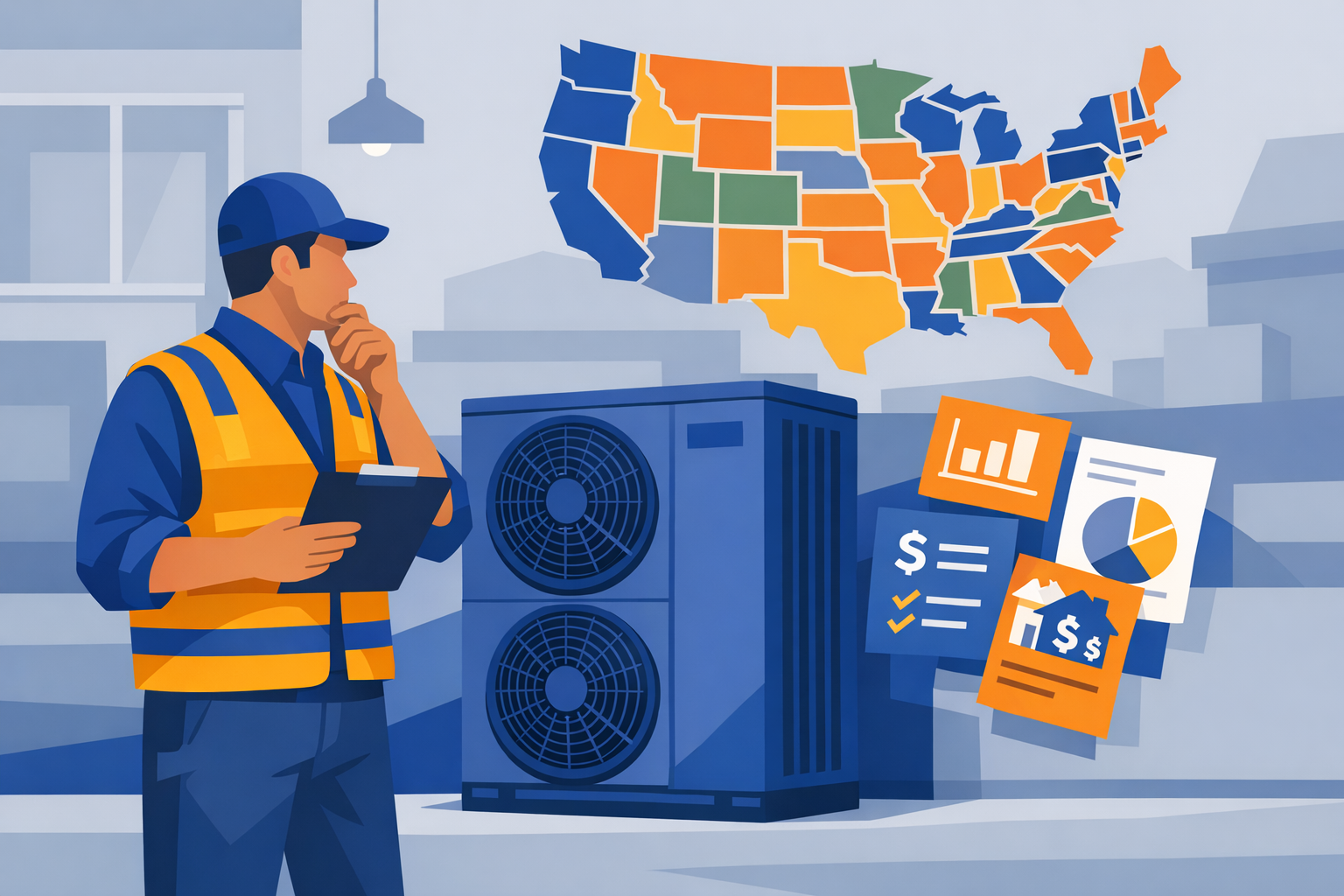
The expiration of the federal Section 25C energy efficiency tax credit on December 31, 2025, has removed the primary financial incentive for residential heat pump installations nationwide, compounding pressure on HVAC contractors, manufacturers, and state program administrators already navigating a volatile market. Enacted under the Inflation Reduction Act and originally set to run through 2032, the 25C credit was curtailed to December 31, 2025, by Public Law 119-21 - the "One Big Beautiful Bill" - signed in July 2025. The move eliminates a credit that covered 30% of qualifying air-source heat pump installation costs, capped at $2,000 per year, according to the IRS.
Background
The Section 25C Energy Efficient Home Improvement Credit had served since 2023 as one of the federal government's principal tools for driving residential heat pump adoption. For homeowners, the credit offset a meaningful share of upfront costs - in 2024 alone, more than 2.3 million families claimed over $2 billion in energy-efficient home improvement credits, averaging $880 per family, according to installer data. The IRA had originally extended 25C and the companion geothermal credit under Section 25D through 2032. The new legislation collapsed both programs to the same December 31, 2025, deadline.
The federal Home Electrification and Appliance Rebates (HEAR) program - the other major IRA-funded mechanism, launched with a $4.5 billion national budget distributed to states through September 2031 - was designed to offer point-of-sale rebates of up to $8,000 for low-income households and up to $4,000 for moderate-income households, according to EnergySage. However, the rollout has been uneven. Clean energy funding was frozen under the Trump administration in 2025, and as of May 6, 2026, the HEAR program for heat pumps is active in only twelve states and jurisdictions: Arizona, California, Colorado, Georgia, Indiana, Maine, Michigan, New York, North Carolina, Wisconsin, and Washington, D.C., according to the National Association of State Energy Officials (NASEO) Residential Energy Efficiency Task Force.
For a related look at how California is responding to these shifts through its updated building code, see earlier coverage: California Tightens HVACR Rules in 2026 Energy Code.
Details
The patchy HEAR rollout is already producing localized funding exhaustion. In Colorado, the HEAR Single-Family Program for Region 1 - covering the Front Range counties including Denver, Boulder, and El Paso - closed to new applications on April 28, 2026, with project proposals submitted after that date denied, according to contractor communications from program administrator CLEAResult. In Oregon, the state was awarded over $113 million in HOMES/HEAR funding, but neither program was accepting applications as of March 2026, pending Department of Energy approval, according to the Oregon Department of Energy. New Hampshire's HEAR program, approved by the state's Governor and Council in March 2026, is not expected to launch until mid-summer 2026, per the New Hampshire Department of Energy.
The vacuum left by 25C is shifting the incentive burden directly to state and utility programs, many of which carry finite funding pools. Wisconsin's $149 million IRA allocation is a fixed pool with no replenishment mechanism, according to Focus on Energy program documentation. Oregon's state-funded Energy Trust of Oregon rebates - ranging from $800 to $1,000 for most homeowners - are ratepayer-funded rather than federally appropriated and have remained stable but cannot fully replace the withdrawn federal credit for higher-income households ineligible for HEAR.
The expiration has already influenced purchasing decisions. According to ACHR News, one HVAC manufacturer executive noted that "as these incentives have disappeared, it's weakened the payback period of heat pumps, slowing heat pump mix shift" in the residential sector. Carrier reported Q1 2026 residential sales down 12%, driven by unit volume from distributors to dealers down 8%, with field inventories down 35% year over year, according to the company's Q1 2026 earnings report. AHRI shipment data published in May 2026 showed heat pump shipments rose nearly 10% from March 2025 to March 2026, indicating residual structural demand despite the incentive withdrawal - though year-to-date 2026 combined air conditioner and heat pump unit totals of 1.9 million represent a 6.8% decline from the same period in 2025, per AHRI.
Contractors are absorbing the disruption in different ways. According to ACHR News, market analysts report that affordability constraints and elevated equipment prices - system replacement costs have nearly doubled since 2019, with what once cost $6,000 to $8,000 now running $12,000 to $15,000 or higher - are pushing service firms toward maintenance-agreement revenue and repair-before-replace strategies. The HVAC workforce shortage poses an additional constraint: the industry currently faces more than 110,000 unfilled positions, with a 5:2 retirement-to-replacement ratio, according to industry trend data compiled for 2026.
Despite the federal rollback, heat pumps outsold fossil fuel furnaces for the fourth consecutive year in 2025, according to the Building Decarbonization Coalition's Q1 2026 Momentum report, suggesting the underlying structural shift remains intact. In 2024, U.S. heat pump sales outpaced gas furnace sales by 32%, with 4.1 million units shipped, according to AHRI-referenced industry figures.
Outlook
State and utility programs are expected to bear the primary support load through 2026 and into 2027, though funding adequacy varies sharply by geography. States without active HEAR programs - the majority of the country - leave contractors and consumers with limited alternatives beyond utility-level rebates and manufacturer promotions. The Home Energy Rebates (HER) program survived the One Big Beautiful Bill and remains available to state energy offices, according to Evergreen Action's policy analysis, but the Trump administration's Department of Energy has been slow to approve state program applications. Manufacturers expect stabilization by mid-2026; Rheem's U.S. Air division cited improving housing activity, easing interest rates, and stronger consumer confidence as factors supporting a gradual residential rebound, according to ACHR News. Whether that rebound extends to heat pump-specific retrofit work will depend in part on whether pending state HEAR programs receive federal approval before end-of-year installation windows close.