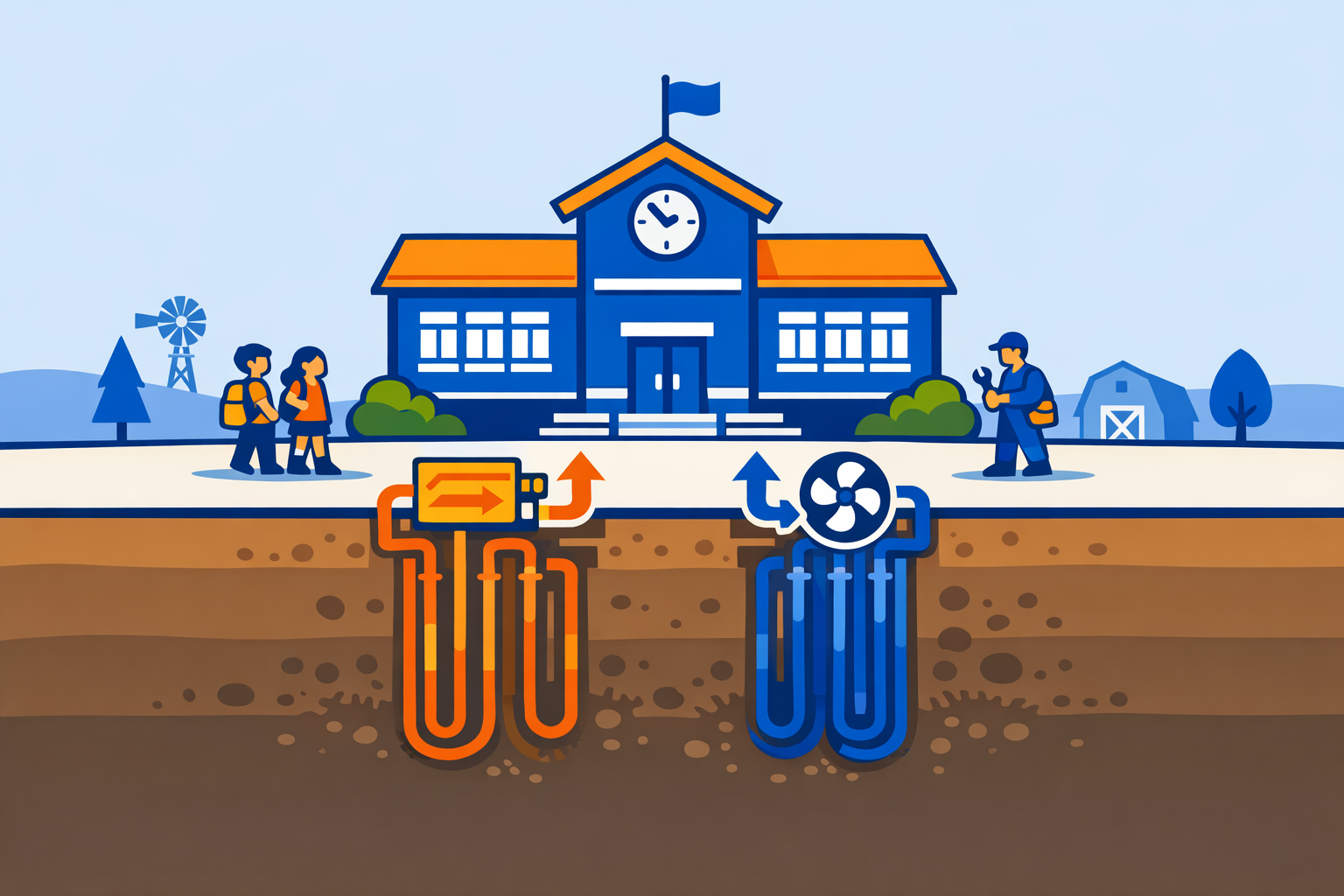
A convergence of federal grant programs and updated tax incentives is accelerating the deployment of geothermal heat pump (GHP) systems in rural K-12 school districts, reducing long-term HVAC operating costs while creating new demands for qualified installers and certified maintenance personnel.
Background
Research indicates that approximately 41 percent of U.S. school districts need to update or replace HVAC systems in at least half of their schools, representing roughly 36,000 schools nationwide. Most of those systems burn fossil fuels, undermining both indoor air quality and energy budgets. Rural districts face compounded challenges: tighter operating budgets, aging infrastructure, and limited access to the financing mechanisms available to urban systems.
The legislative groundwork for the current wave of geothermal investment was laid by the Bipartisan Infrastructure Law (BIL) and the Inflation Reduction Act (IRA) of 2022. The IRA introduced an "elective pay" mechanism - commonly called direct pay - that allows tax-exempt public entities, including school districts, to receive cash reimbursements equivalent to applicable clean energy tax credits. Under the IRA's Section 48 Investment Tax Credit, public and non-profit organizations can qualify for up to 40 percent direct reimbursement for the installation of geothermal HVAC systems, provided the project meets prevailing wage and apprenticeship requirements or has a net output of less than one megawatt. GHP systems retain eligibility for the Section 48 credit through 2032, while most other renewable technologies have transitioned to the technology-neutral Section 48E framework.
Supplementing the IRA, the USDA's Rural Energy for America Program (REAP) provides an additional pathway for rural communities. The IRA provided REAP with over $2 billion for renewable energy and energy-efficiency grants through 2031, with the maximum grant size increased to $1 million for renewable energy systems. Geothermal installations qualify under REAP as renewable energy systems.
Federal School Grant Programs Lead Adoption
The DOE's Renew America's Schools Program, funded through the BIL, has become the primary direct-grant vehicle. In 2024, the program directed $190 million to support school districts across the country in implementing energy upgrades, with the 2024 prize round selecting 16 applicants to invest in 320 school facilities across 25 states, directly benefitting over 123,000 students and 9,100 teachers. The 2025 Renew America's Schools Prize will invest an anticipated $90 million, with a specific focus on local educational agencies that qualify as disadvantaged and/or rural. Eligible improvements include new HVAC systems and renewable energy technologies. Phase 2 and Phase 3 cooperative agreement awards range from $7.5 million to $15 million per applicant.
State programs are amplifying the federal push. In Maine, Efficiency Maine is collaborating with HVAC contractors to deliver heat pump retrofits to rural and aging schools, funded by $8 million from the governor. Construction firm Kraus-Anderson reported that in early 2024, it was actively working with 10 project teams to pursue federal school energy funding opportunities, with expected project awards ranging from $400,000 to over $12 million.
Real-world deployments confirm the financial case. Dorchester County Public Schools in Maryland, one of the state's most underserved districts, was awarded $1.6 million from the Maryland Energy Administration's Decarbonizing Public Schools program in August 2024 to advance energy efficiency and geothermal upgrades. In Michigan, East Lansing Public Schools' Donley Elementary incorporated a geothermal heating and cooling system paired with an onsite solar array, achieving an operating Energy Use Intensity of 28.1 kBtu/sf-yr.
Financial and Workforce Considerations
Despite favorable grant structures, districts face a well-documented first-cost barrier. Initial installation costs for ground-source heat pump systems are typically twice that of conventional HVAC systems, with average payback periods of 7.5 to 9.2 years depending on the baseline system being replaced. Soil conditions, bore-field depth requirements, and available land area on constrained rural school sites introduce additional site-specific cost variability. A DOE-cited analysis found that the combination of IRA noncompetitive incentives can effectively reduce the up-front cost of geothermal heat pump installations for schools by up to 50 percent.
Lifecycle performance data support the investment. Geothermal heat pumps can reach efficiencies of 300 to 500 percent, as measured by the U.S. Department of Energy, meaning 3 to 5 units of heating or cooling energy are produced per unit of electricity consumed. Indoor equipment components last 20 to 25 years, while ground loop infrastructure can exceed 50 years, substantially outpacing conventional equipment replacement cycles.
Workforce availability poses a near-term constraint on deployment pace. The DOE's Office of Geothermal is addressing this through the GHP PATHs (Partnerships to Accelerate Training and Hiring for Geothermal Heat Pumps) Prize, which targets regional training partnerships to strengthen the geothermal installer and service base. Districts commissioning new GHP systems must also account for ongoing service requirements - including certified loop-field maintenance, refrigerant handling, and building automation integration - competencies not uniformly present among rural HVAC service contractors.
Outlook
The 2025 Renew America's Schools Prize application cycle and the ongoing USDA REAP quarterly competitions represent active funding windows for districts planning near-term projects. GHP systems remain eligible for the IRA Section 48 Investment Tax Credit through 2032, giving districts a multi-year planning horizon. HVAC contractors, ground-loop drillers, and geothermal system designers operating in rural markets should anticipate sustained procurement activity as districts move from feasibility assessments to construction. Workforce certification requirements are expected to tighten as project volumes increase. For an overview of related school HVAC capital planning frameworks, see Public Infrastructure Upgrades in Education: How Capital Planning Drives Energy-Efficient School HVAC and Switchgear Modernization.