EPA's proposed revisions to its 2023 Technology Transitions Rule under the AIM Act have drawn significant feedback from HVACR stakeholders regarding compliance costs, implementation timelines, and strategies for low-global warming potential (GWP) innovation. Released on September 30, 2025, the draft rule adjusts GWP thresholds and delays enforcement dates for several refrigeration subsectors, generating nearly 2,300 public comments from manufacturers, distributors, and service professionals.[1]
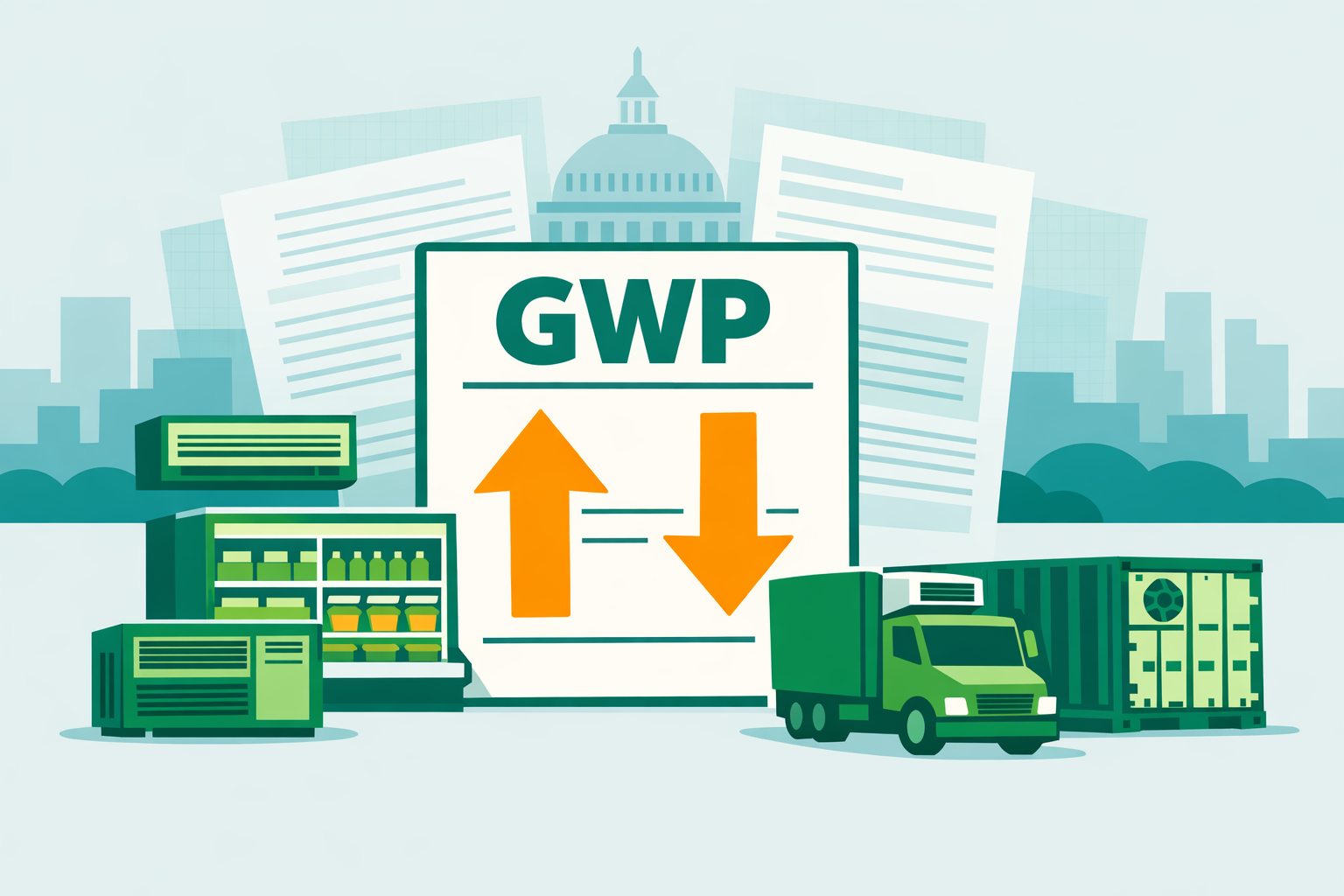
In this proposal, EPA would raise the GWP limit for remote condensing units and supermarket refrigeration systems to 1,400 starting January 1, 2026. The threshold would revert to the original 150 or 300 limit in 2032. For cold storage warehouses, the proposed GWP threshold would increase to 700 beginning January 1, 2026, declining to 150 or 300 from 2032. The proposed rule removes installation deadlines for residential and light commercial AC and heat pump systems manufactured or imported before January 1, 2025, allowing indefinite installation.[2]
Background
The AIM Act empowers EPA to phase down high-GWP hydrofluorocarbons (HFCs) using an allowance program, set sector-specific GWP limits, and regulate refrigerant management. The original 2023 Technology Transitions Rule introduced these limits, with principal phase-in dates starting January 1, 2025, to accelerate adoption of lower-GWP refrigerants.[3] The latest proposal addresses industry concerns about supply chain constraints, retrofit feasibility, and increased compliance costs.[4]
Details
For refrigerated transport, the proposal would move the lower-bound exclusion threshold from -50 °C to -35 °C and shift compliance measurement from refrigerant/fluid temperature to box temperature, directly impacting intermodal container requirements.[5] Stakeholders have noted that delaying stricter GWP limits could disadvantage early adopters of low-GWP technologies.[5] HVACR associations, including ACCA, have called for eliminating installation deadlines to avoid stranded R-410A inventory and inconsistent state-level regulations.[1] Some warn that postponing supermarket compliance could increase consumption of low-GWP refrigerant allocations, raising safety and efficiency concerns.[4]
Outlook
EPA is reviewing public comments and plans to finalize the rule by the end of 2025 or early 2026. While the extended timelines may reduce short-term compliance pressure and support wider research and development, they also introduce uncertainty for retrofit planning and procurement across refrigerated transport, school systems, and commercial HVAC sectors.