Executive summary. EPA's HFC regulations are entering a pivotal revision phase, with proposed modifications to the Technology Transitions Rule and new leak-management mandates set for 2026. Testimony from the late 2025 public hearing exposed a clear split between those advocating for strict low-GWP timelines and stakeholders seeking transitional flexibility. The EPA's decisions will affect refrigerant selection, retrofit schedules, and training across transport refrigeration, commercial HVAC, and large building portfolios.
The Regulatory Baseline: AIM Act, Technology Transitions, and HFC Management
The American Innovation and Manufacturing (AIM) Act directs EPA to phase down HFC production and consumption to 15 percent of historic baseline levels by 2036.[1] This directive is implemented through three primary programs:
- HFC Allowance Allocation (production and import caps)
- Technology Transitions (sector-specific GWP limits for new equipment)
- Emissions Reduction and Reclamation (ER&R) / HFC Management (leak repair, reclamation, cylinder controls)
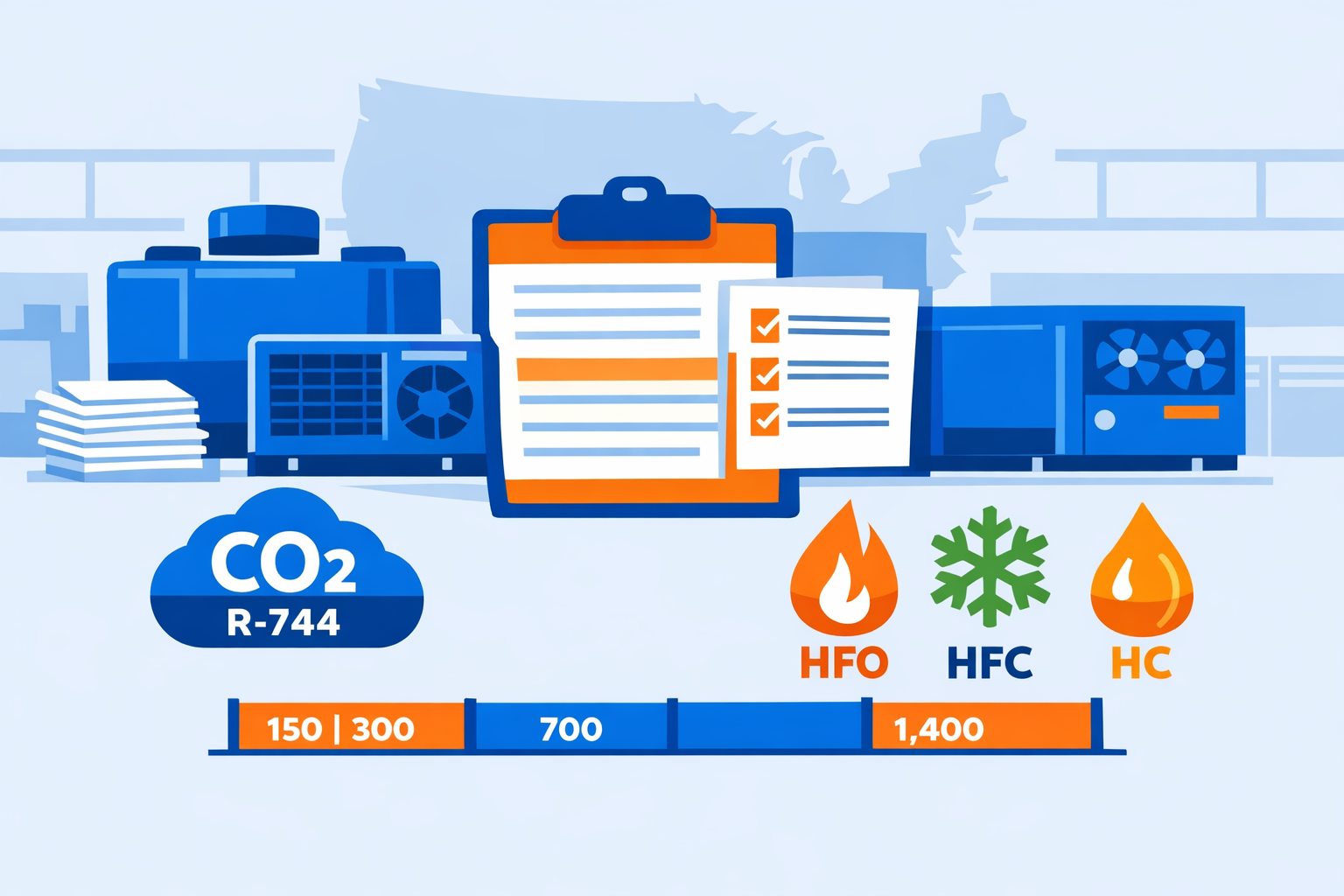
Effective January 1, 2025, the Technology Transitions Rule restricts manufacture, sale, import, and export of appliances using high-GWP HFCs in specified sectors based on subsector GWP limits.[1] Most new commercial refrigeration must meet 150 or 300 GWP thresholds; stationary HVAC systems are capped at 700 GWP, with compliance dates staggered between 2025 and 2028.[2]
EPA finalized the ER&R rule under AIM Act subsection (h). Starting January 1, 2026, appliances with a full charge of 15 pounds or more of an HFC, or an HFC substitute with GWP above 53, face mandatory leak detection and repair requirements.[3] This shifts the threshold from prior ozone-layer rules, which generally applied to systems with 50 pounds or more.
What Is in Force vs. What Is Under Reconsideration
By early 2026, two layers of EPA requirements are relevant:
- In force:
- Technology Transitions Final Rule (October 2023): sets GWP caps and HFC bans for new equipment.
- ER&R / HFC Management Final Rule (October 2024): mandates leak repair, automatic leak detection for systems ≥1,500 lb, quality standards for reclaimed refrigerant, and tracking.[3]
- Proposed / under reconsideration:
- October 3, 2025 proposal to reconsider aspects of the Technology Transitions Rule, including GWP limits and compliance dates for retail food refrigeration, cold storage, certain industrial process systems, and refrigerated transport.[4]
A public hearing was held October 20, 2025, and the comment period closed November 21, 2025.[4] Until publication of a final reconsideration rule, original Technology Transitions deadlines remain, despite EPA's reduced enforcement priorities and issuance of targeted No Action Assurance (NAA) letters for certain equipment.[4]
Design, procurement, and asset-management planning should continue with the original compliance dates, while monitoring for possible changes.
Refrigerated Transport: Intermodal, Road, and Marine Systems
The Technology Transitions Rule treats refrigerated transport as a distinct subsector, resulting in new specification requirements.
Current federal requirements
EPA's restrictions for refrigerated transport:[2]
- New refrigerated intermodal containers with refrigerant entering the evaporator at or above -50 °C must meet a 700 GWP cap from January 1, 2025.
- New road and marine refrigeration systems using legacy blends (R-404A, R-402A/B, R-410B, R-507A) have been prohibited since January 1, 2025.
- Products operating below -50 °C are currently "not covered" by these GWP restrictions but are still subject to other AIM Act provisions or, in some cases, NAA conditions while EPA reviews ultra-low-temperature applications.[4]
These measures are significant as many fleets previously relied on high-GWP blends for trailers and marine units. R-744 (CO₂) has a GWP of 1; R-404A's GWP is about 3,922 (100-year basis). Replacing R-404A in new equipment substantially reduces direct climate impact per kilogram.[5]
Low-GWP options in the transport segment
Available options for transport include:[6]
- CO₂ (R-744) systems for marine containers and pilot trailers
- HFO/HFC A2L blends (R-452A, R-455A) for road units and some marine applications
- Hydrocarbons (R-290) for small, self-contained units meeting safety standards
Operators are deploying these refrigerants, often combined with improved insulation and digital controls to reduce both direct (leakage) and indirect (energy) emissions.[7]
The 700 GWP cap for intermodal containers rules out new R-404A systems but allows some mid-GWP A2L blends. Bans on named fluids are moving OEMs toward blends like R-452A or natural refrigerants such as CO₂ and hydrocarbons.
Commercial HVAC and Building Portfolios
Technology Transitions and ER&R rules are reshaping commercial HVAC and building portfolios. Public debate has centered on supermarket and cold-storage equipment, but implications are broader.
Key thresholds are:[2]
- Stationary residential and light-commercial AC and heat pumps: 700 GWP limit for new systems from January 1, 2026.
- Variable refrigerant flow (VRF) systems: 700 GWP limit for new systems from January 1, 2027 (with limited flexibility for permitted projects before October 5, 2023).
- Chillers and comfort-cooling: 700 GWP limits between 2025 and 2028, depending on application.
ER&R rules apply from January 1, 2026. Leak-repair provisions cover appliances containing 15 pounds or more of HFCs or substitutes with GWP over 53. Automatic leak detection is required for new and existing appliances at or above 1,500 pounds in commercial and industrial applications.[3] This expands compliance to many more rooftop units, split systems, and medium-sized racks compared to ozone-focused rules.
Facility and portfolio managers must consider refrigerant choice for new equipment and leak performance of the existing base to avoid regulatory risk.
The October 20, 2025 Hearing: What Stakeholders Signaled
EPA's October 2025 hearing drew input from manufacturers, trade groups, NGOs, and operators. Most witnesses opposed five- and six-year delays for supermarket and cold-storage GWP limits to 2032, but views split on interim flexibility and subsector specifics.[8]
NGOs: Protect the original low-GWP schedule
Organizations like NRDC and Environmental Investigation Agency argued that the 2023 schedule reflected extensive industry input and available alternatives. They warned that delays would slow HFC phasedown, increase cumulative emissions, and undermine program cost-effectiveness.[8]
NGOs noted that natural refrigerants (CO₂, ammonia) are widely deployed in cold storage and retail, while mid-GWP HFO/HFC blends may face PFAS-related regulatory risks. They advocate for stringent 150/300 GWP limits to avoid locking in higher-GWP blends.[8]
Manufacturers of low-GWP systems: Do not dilute the signal
Original-equipment manufacturers with natural-refrigerant portfolios support existing compliance dates, which align with their product development. Hillphoenix emphasized that current timelines have driven investments in CO₂ and hydrocarbon systems, testing, and technician training. Delays could undermine these investments and increase demand for high-GWP refrigerants as allowance caps tighten.[8]
The IIAR opposed raising cold-storage limits to 700 GWP until 2032, citing the availability of ammonia systems for over 90% of US cold-storage. Some manufacturers expressed support for targeted relief, including dropping the 2026 installation deadline for pre-2025 residential and light-commercial AC and heat pump equipment.[8]
Retailers, grocers, and distributors: More time, but clarity is critical
Supermarket and food retailer groups, including FMI, supported delay of deadlines due to transition costs, equipment availability, and potential price impacts.[8] Distributors, represented by HARDI, warned that shifting deadlines create stranded inventory risk and uncertainty once procurement actions are in motion. Manufacturers reported "market confusion" arising from pending proposals close to compliance dates.[8]
What the Reconsideration Proposal Would Change
The proposal centers on select subsectors, with three key elements for refrigeration and HVAC:[4]
- Retail food - remote condensing units and supermarkets
- Interim GWP limit of 1,400 from 2026 (condensing units) and 2027 (supermarkets)
- Return to 150/300 GWP limits January 1, 2032
- Cold-storage warehouses
- Interim GWP limit of 700 for new systems from January 1, 2026
- Return to 150/300 GWP limits January 1, 2032
- HVAC subsectors
- Removal of the January 1, 2026 installation deadline for pre-2025 residential and light-commercial AC and heat pumps
- Extensions for some industrial process refrigeration and semiconductor chillers to 2030
Table 1 compares key timelines for affected refrigeration subsectors.
Table 1 - Original vs. proposed Technology Transitions timelines (if reconsideration is finalized as drafted)
| Subsector | Original limit & date (2023 rule) | Proposed interim limit & date | Proposed final limit & date |
|---|---|---|---|
| Retail food - remote condensing units | 150/300 GWP from Jan 1, 2026 | 1,400 GWP from Jan 1, 2026 | 150/300 GWP from Jan 1, 2032 |
| Retail food - supermarkets (racks) | 150/300 GWP from Jan 1, 2027 | 1,400 GWP from Jan 1, 2027 | 150/300 GWP from Jan 1, 2032 |
| Cold-storage warehouses | 150/300 GWP from Jan 1, 2026 | 700 GWP from Jan 1, 2026 | 150/300 GWP from Jan 1, 2032 |
| Select industrial process / semiconductors | 150/300/700 GWP with dates in 2026 or 2028 | Compliance deferred to Jan 1, 2030 | 150/300/700 GWP (unchanged) |
Sources: EPA Technology Transitions final rule tables; October 3, 2025 reconsideration proposal; industry summaries.[2]
The reconsideration does not roll back the underlying HFC phasedown or ER&R leak-management requirements. HFC allowance reductions and 2026 leak-repair obligations remain in effect regardless of GWP limit adjustments.[1]
Aligning Rule Trajectories with Low-GWP Transition Plans
Retrofits and fleet renewal for refrigerated transport
For road and marine transport, new equipment using high-GWP blends like R-404A and R-507A no longer meets Technology Transitions criteria.[2] Fleets procuring such equipment risk non-compliance.
With the 700 GWP limit for new intermodal containers, CO₂ systems and lower-GWP A2Ls are favored in newbuild reefers. ER&R leak-repair thresholds for appliances containing 15 pounds or more of refrigerant drive improved maintenance and reduced leakage, even before full replacement.[9]
This results in three main strategies for transport refrigeration portfolios:
- Tighten maintenance and track charge for existing high-GWP units
- Specify lower-GWP blends or natural refrigerants in new procurements to avoid future retrofits
- Closely monitor EPA adjustments for ultra-low-temperature containers (-50 to -35 °C)[4]
Supermarkets, cold storage, and natural-refrigerant growth
Retailers and engineers have planned for the original 150/300 GWP supermarket and cold-storage dates. Kroger's 2024 ESG report states all new stores will use CO₂ starting in 2025, matching anticipated low-GWP mandates.[8] OEMs report strong demand for CO₂ systems; R-744 sales are rising.[8]
If interim GWP limits are finalized, many will install mid-GWP blends (R-448A/R-449A) through the late 2020s, facing a second required transition by 2032. Stakeholders opposing delays advocate for a single transition to CO₂, ammonia, hydrocarbons, or ultra-low-GWP HFOs, minimizing stranded assets.[8]
Building portfolios and ER&R leak-management obligations
The ER&R rule alters risk for both refrigeration and HVAC assets in multi-site portfolios. Facilities with numerous 15-49 pound systems now fall under federal leak-repair requirements. Repeated violations can trigger mandatory retrofit or retirement.[10]
Key priorities for large portfolios:
- Short term (2026-2027): inventory refrigerants, verify charge sizes, implement ER&R leak-rate processes
- Medium term (through 2030): direct capital to replace high-GWP, high-leak systems in regulated subsectors
- Long term (post-2030): plan for possible second-stage conversions if interim GWP limits revert by 2032
Actionable Conclusions and Next Steps for HVACR Stakeholders
Even as revisions are pending, several implications are clear for HVAC and refrigeration professionals:
- Rely on original Technology Transitions deadlines pending a final rule. EPA guidance confirms current dates remain effective for compliance decisions.[4]
- Integrate ER&R leak-management into maintenance. Leak tracking for >15 lb systems and ALD for large racks are enforceable; lack of preparation increases future compliance risk.[3]
- Select low-GWP refrigerants for new equipment where possible. CO₂, ammonia, hydrocarbons, and ultra-low-GWP HFOs reduce the likelihood of a second forced transition when GWP caps are tightened.
- Monitor specialized and ultra-low-temperature applications. Sectors like containers below -35 °C and semiconductor chillers may see further regulatory updates; stay alert to EPA dockets and NAAs.
- Coordinate procurement, engineering, and operations. Standardizing on fewer low-GWP refrigerants and technologies-plus aligned training and parts-streamlines compliance as rules evolve.
These steps ensure resilience amid the current regulatory baseline and coming federal revisions.
Frequently Asked Questions
What is the status of EPA's Technology Transitions reconsideration in early 2026?
EPA published its reconsideration proposal on October 3, 2025, held a hearing October 20, 2025, and accepted comments through November 21, 2025.[4] As of March 2026, the October 2023 Technology Transitions Final Rule is still in force.
EPA has de-emphasized enforcement in some areas and issued NAAs for specific equipment, including certain transport containers and semiconductor systems.[4] Stakeholders must distinguish binding requirements from those temporarily under deferred enforcement.
How do the refrigerant rules affect existing transport refrigeration units?
Technology Transitions restrictions apply to new transport refrigeration systems-not those already in service.[2] Existing units with high-GWP refrigerants such as R-404A may continue operating and be serviced per AIM Act and ER&R.
However, new road and marine units cannot use banned blends, and intermodal containers ≤-50 °C must meet the 700 GWP cap.[2] From January 1, 2026, transport appliances with a charge of 15 pounds or more and GWP above 53 must comply with ER&R leak-repair rules, potentially triggering retrofit if persistent leaks are not resolved.[9]
What is the difference between Technology Transitions GWP limits and ER&R leak-repair rules?
Technology Transitions is product- and system-based: it sets which refrigerants may be used in new equipment, enforced via GWP caps or bans per subsector. For example, new supermarkets must meet 150/300 GWP, intermodal containers above -50 °C must not exceed 700 GWP.[2]
ER&R is operations-based: requiring leak repair, reclamation, and cylinder management for all covered appliances above charge thresholds, regardless of refrigerant or unit age. Leak-rate calculations, repair deadlines, and retrofit/retirement are part of ER&R policy.[3] Both rules must be integrated in upgrade and maintenance planning.
Which low-GWP refrigerants are most relevant today for transport and commercial refrigeration?
CO₂ (R-744) is emerging as a long-term option for marine containers and increasingly for trailers. A2L blends such as R-452A and R-455A are replacing R-404A in many road units.[11] In commercial refrigeration, natural refrigerants such as ammonia, CO₂, and hydrocarbons now dominate new installations, with HFO-based blends (GWP 100-300, e.g., R-455A, R-1234ze) adopted where natural refrigerants are less viable. PFAS regulation may affect the future of some blends.[12] Federal and state guidelines continue to push toward ultra-low-GWP options.
How should companies plan when both federal rules and state regulations are evolving?
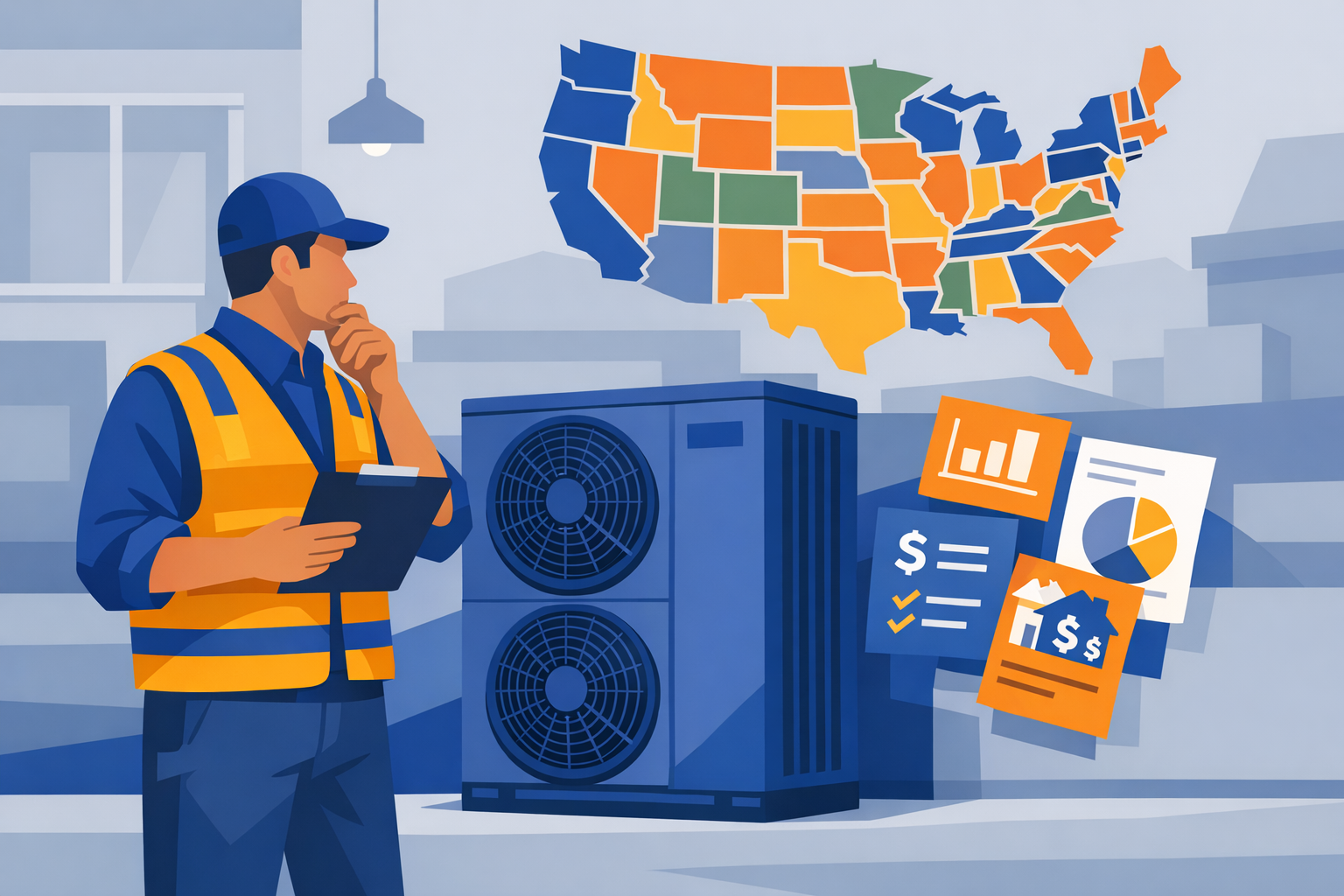
States like California, New York, and others enforce HFC limits that sometimes exceed federal requirements.[8] Hearing testimony warned that weaker federal rules could accelerate divergent state mandates, increasing compliance complexity and cost.
Many retailers and suppliers are standardizing new installations around the strictest known targets-often 150/300 GWP or below-to prevent obsolescence and streamline training and operations as state and federal regulations evolve.[8]