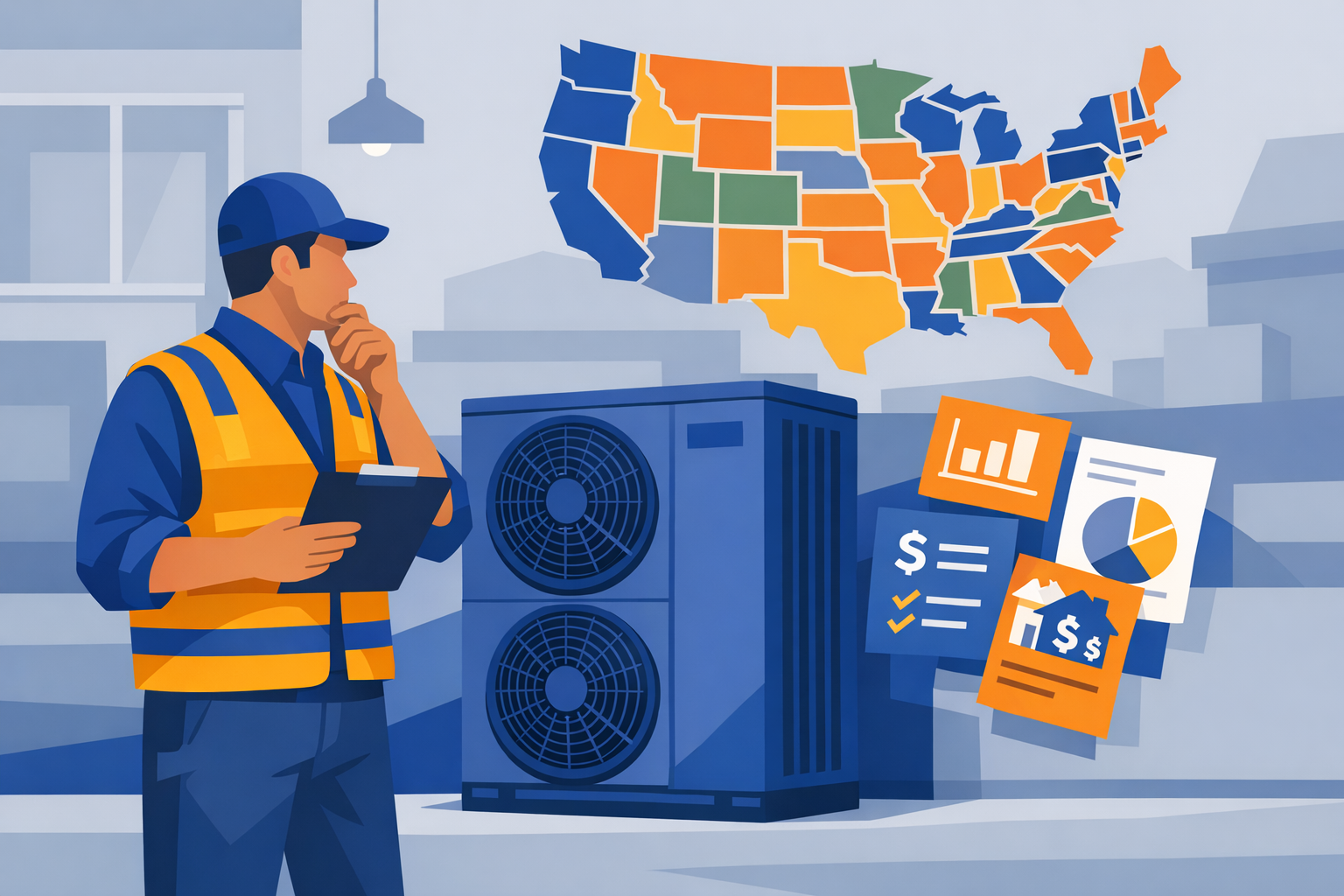
Executive summary. In early 2026, EPA confirmed that enforcement of certain January 1, 2026 compliance dates under the Technology Transitions rule is a low enforcement priority while the rule is under reconsideration. Those deadlines remain legally in force, but EPA has stated it intends to focus resources on new dates to be set through the reconsideration, reserving the option to act where needed to protect human health and the environment[1]. For the HVACR industry, this creates a broader planning window for low-GWP refrigerant transitions but also a complex risk landscape shaped by the ongoing HFC phasedown, state regulations, and emerging leak-reduction requirements.
Regulatory context: AIM Act, Technology Transitions rule, and 2026 milestones
The American Innovation and Manufacturing (AIM) Act, enacted on December 27, 2020, authorizes EPA to phase down hydrofluorocarbons (HFCs) and manage the transition to lower-GWP alternatives; under this law, U.S. HFC production and consumption allowances drop from about 90% of baseline in 2023 to 60% in 2024, 30% in 2029, and 15% in 2034-2036[2].
To support this phasedown, EPA's final Technology Transitions rule, signed on October 5, 2023, restricts the use of higher-GWP HFCs in new aerosol, foam, refrigeration, air-conditioning, and heat pump (RACHP) products and systems, using sector-specific GWP limits with compliance dates between January 1, 2025 and January 1, 2028[2]. The rule distinguishes between factory-built products and field-assembled systems and targets new manufacture/import and installation, not continued operation of existing equipment[2].
EPA analysis underscores the scope: the agency estimates the Technology Transitions rule will avoid up to 876 million metric tons of CO₂-equivalent emissions through 2050, with climate benefits valued up to $50.4 billion and additional cost savings of up to $4.5 billion for businesses and consumers[2].
Key January 1, 2026 compliance dates relevant to HVACR
Several Technology Transitions provisions converge on January 1, 2026, especially for refrigeration and certain AC applications:
- Residential and light-commercial AC and heat pumps (sell-through of legacy stock)
- Industrial process refrigeration (IPR) chillers
- Industrial process refrigeration (non-chiller) high-temperature applications
- Cold storage warehouses
- Self-contained commercial ice machines
Selected examples are summarized below.
| Subsector / application (new equipment) | Limit or restricted refrigerants | Key 2026 date and scope |
|---|---|---|
| Residential & light-commercial AC/heat pumps (factory-built products) | 700 GWP limit for new stationary AC/HP products (e.g., window units, portables) | Manufacture/import limit began Jan 1, 2025; a separate interim rule allows installation of higher-GWP inventory built/imported before Jan 1, 2025 until Jan 1, 2026[3] |
| IPR chillers with leaving fluid ≥ -30 °C | 700 GWP | New chiller products at or above this threshold must meet 700-GWP limit from Jan 1, 2026[3] |
| IPR (non-chiller) - high-temperature side of cascade / <200 lb charge | 300 GWP | New systems in these categories are limited to 300 GWP as of Jan 1, 2026[3] |
| Cold storage warehouses | 150 GWP (≥200 lb charge); 300 GWP (<200 lb and high-temp side) | For cold storage warehouses, new systems with refrigerant charges of 200 lb or more are capped at 150 GWP from January 1, 2026, while systems with smaller charges or high-temperature cascade stages are capped at 300 GWP on the same date[3] |
| Self-contained commercial ice machines (≤1,000-1,200 lb/24 h) | 150 GWP | Batch and continuous ice machines up to specified harvest rates must meet a 150-GWP limit from Jan 1, 2026[3] |
Interim and sector-specific adjustments before 2026
EPA has made targeted adjustments to avoid stranded inventory and facilitate orderly refrigerant transitions:
- Residential/light-commercial AC and heat pumps. A December 2023 interim final rule allows higher-GWP residential and light-commercial AC and heat pump equipment manufactured or imported before January 1, 2025 to be installed until January 1, 2026[1].
- Variable refrigerant flow (VRF) systems. A December 2024 final rule for VRF air-conditioning allows higher-GWP VRF equipment manufactured or imported before January 1, 2026 to be installed until January 1, 2027, and until January 1, 2028 for projects with building permits issued before October 5, 2023[1].
These adjustments interact with the January 1, 2026 landscape and are central to how contractors and manufacturers interpret current enforcement signals.
EPA's 'low enforcement priority' stance: what it does and does not change
On January 5, 2026, EPA published an enforcement statement linked to the Technology Transitions reconsideration. EPA clarified that while it intends to extend certain compliance dates through rulemaking, the current deadlines remain legally effective; however, enforcement of deadlines under reconsideration is a "low enforcement priority," and the agency will focus on new compliance dates while reserving the right to act as necessary to protect human health and the environment[1].
Practical implications for contractors and manufacturers follow.
Enforcement discretion is not a suspension of the rule
EPA's statement does not suspend the Technology Transitions rule. Deadlines in the Code of Federal Regulations still apply unless changed by a final reconsideration rule.
The "low priority" status signals that:
- Routine enforcement actions focused solely on missed January 2026 deadlines are unlikely while reconsideration is pending.
- Enforcement leadership approval is required before actions proceed under reconsidered provisions, adding an internal hurdle[1].
- EPA retains the right to act where violations present significant environmental or public-health concerns.
In trade press, industry summaries report that EPA does not intend to pursue contractors for installing compliant R-410A systems after January 1, 2026 while reconsideration is finalized[4]. This has been interpreted as short-term relief for segments still drawing down legacy stock.
The HFC supply squeeze continues
Enforcement discretion on use restrictions does not alter the AIM Act phasedown. Allowance reductions driving the national HFC supply from roughly 60% of baseline today to 30% in 2029 and 15% in 2034-2036 remain in force and unaffected by Technology Transitions reconsideration[5].
Resulting impacts include:
- Legacy high-GWP refrigerants like R-410A and R-404A will face tightening supply and probable price volatility, even if installations continue under enforcement discretion.
- More legacy HFC equipment may enter service during the reconsideration window, increasing long-term service demand for scarce refrigerant.
- Leak-reduction and reclamation measures under EPA's Emissions Reduction and Reclamation (ER&R) rule-such as mandatory reclaimed HFC use in some applications from 2029-remain on track and will interact with Technology Transitions timelines[5].
State and utility overlays drive faster low-GWP adoption
State climate laws, refrigerant management programs, and utility incentives are unaffected by EPA's enforcement priorities. California's refrigerant management program, Washington's automatic leak detection and repair timelines, and New York's Part 494 requirements continue to press large systems toward lower-GWP refrigerants and documented leak control regardless of federal Technology Transitions timing[5].
As a result, large chains, public owners, and institutional facility managers in these areas are likely to continue with low-GWP conversions and advanced leak-detection projects, viewing federal enforcement flexibility as scheduling relief, not a reason to delay.
Low-GWP refrigerants under the 700-GWP comfort-cooling limit
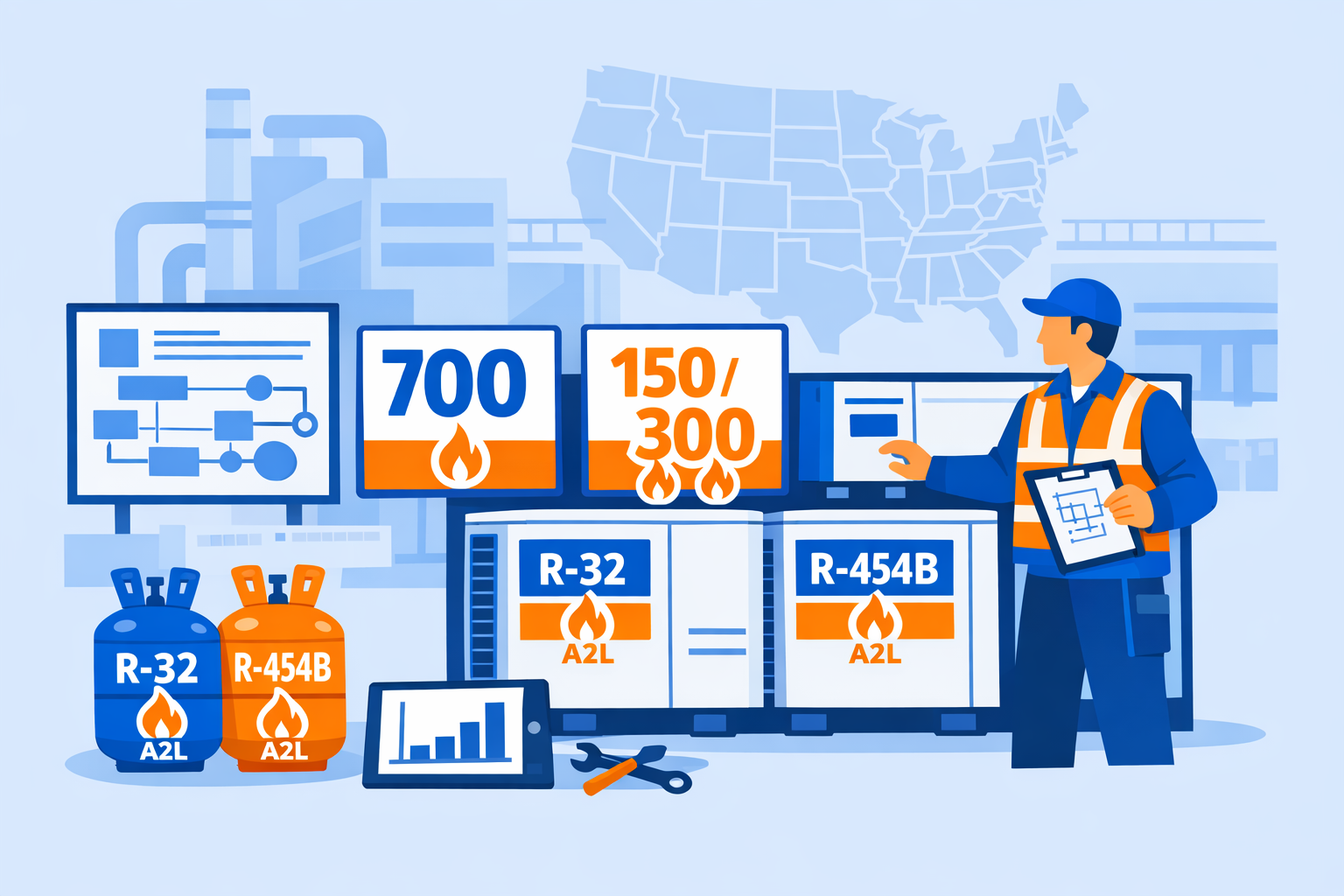
For much of the comfort-cooling market, the Technology Transitions rule establishes a 700-GWP ceiling for new equipment. R-410A has a global warming potential of about 2,088; R-32, about 675; and R-454B, about 466-placing the latter two alternatives below EPA's 700-GWP limit for most new stationary AC and heat-pump equipment[6].
Key points:
- R-32 and R-454B have become primary low-GWP replacements for R-410A in new residential and light-commercial systems.
- Both are A2L "mildly flammable" refrigerants, requiring updated installation practices, charge limitations, and sometimes leak-detection and ventilation under product standards and codes.
- Manufacturers are aligning product portfolios to meet the 700-GWP limit while balancing performance, safety, and global supply-chain factors.
For large refrigeration and cold-storage systems facing 150- or 300-GWP caps from 2026, ammonia, CO₂, and hydrocarbons are increasingly central to design-especially in jurisdictions with layered state requirements[5].
Segment-by-segment implications of the low-priority stance
HVACR contractors and service firms
For contractors, EPA's enforcement discretion primarily shifts short-term risk exposure, rather than long-term direction. Main implications:
Inventory and sell-through management
- Contractors can install R-410A residential/light-commercial inventory manufactured before January 1, 2025 through 2026 without likely federal enforcement, subject to state rules.
- Reduced risk of stranded inventory but increased importance of tracking manufacturing dates and proper documentation.
Training and tooling for A2L refrigerants
- Additional planning time allows for staged A2L training and phased tooling investment.
Mixed-fleet service complexity
- Service portfolios will include legacy high-GWP systems, new low-GWP units, and transition equipment for longer periods.
- Dispatch and parts logistics must coordinate by refrigerant type and flammability class.
Building owners, facility managers, and public agencies
For owners and facility managers, the shift affects capital timing, not outcomes.
Two-track capital planning
- Maintenance-heavy near-term strategies focus on reliability and leak reduction.
- Mid-term upgrades (2027-2032) align plant replacements with finalized regulatory dates and incentives.
Risk of future stranded assets
- Additional high-GWP installations in 2026 may carry future exposure to higher refrigerant prices and potential state or owner-driven decarbonization demands.
Portfolio-level leak and usage profiling
- Data-driven asset management-tracking plant charge size, leak history, run-hours, and refrigerant-guides retrofit sequencing and budgeting.
Manufacturers, OEMs, and distributors
OEMs and distributors must balance regulation against real-time market demand.
Product roadmap agility
- Manufacturers invest in modular platforms and shared components able to pivot between refrigerants or GWP targets.
Capacity and tooling investments
- Plants must assess timing for full transition to A2L-optimized lines; premature shifts risk idle low-GWP capacity, while delays risk non-compliance.
Channel guidance and documentation
- Distributors require clear labeling, cut-off dates, and installation guidance to aid contractor compliance during audits.
Layered compliance and risk management under regulatory uncertainty
With deadlines legally in effect but enforcement de-emphasized, organizations adopt layered risk-management instead of a binary compliance approach.
1. Maintain a compliance-ready documentation trail
- Map inventory and installations to manufacturing/import dates and applicable rules.
- Archive OEM compliance statements, labeling, and commissioning reports.
- For projects relying on enforcement discretion, preserve records of equipment dates and rationale for proceeding.
2. Monitor federal and state policy signals continuously
- Track EPA's Technology Transitions reconsideration for compliance date changes and new sector carve-outs.
- Monitor state refrigerant rules, especially in California, Washington, and New York[5].
3. Integrate leak-reduction with refrigerant transition strategy
- Rank systems by annualized leak losses and charge size.
- Pair high-leak, high-charge assets with early low-GWP retrofits or full plant replacement as justified.
- Align these steps with upcoming ER&R leak repair and reclaimed HFC requirements[5].
4. Use supplier collaboration to secure flexible options
- Focus on modular, field-adaptable platforms and ensure spare parts and training align with potential shifts in final compliance dates.
Incentives, financing structures, and retrofit economics
Federal enforcement discretion does not pause energy-efficiency and decarbonization incentives from states, utilities, or public programs. For many owners, these drive retrofit schedules more than federal compliance dates.
Current trends shaping economics:
- Utility incentives for high-efficiency and low-GWP systems.
- Programs specify minimum efficiency or refrigerant characteristics, discouraging high-GWP installations.
- Public-sector procurement rules.
- Many public entities require low-GWP and high-efficiency evaluations regardless of EPA enforcement stance.
- Performance-based contracting and shared-savings models.
- Energy performance contracts and "as-a-service" models can finance low-GWP upgrades over long terms.
Where enforcement is "low priority," these incentives and requirements drive refrigerant transitions for public and institutional portfolios.
Action plan: turning a soft federal deadline into a strategic transition
Resilient HVACR organizations treat January 2026 as a transition reference point, not a hard compliance cliff. Best practices include:
1. Build a two-track capital plan
Near-term (2026-2027): maintenance and risk control
- Prioritize reliability, leak repairs, and safety upgrades for existing high-GWP systems.
- Use enforcement discretion for necessary installations of pre-2025 inventory, limiting new high-GWP purchases.
Mid-term (2027-2032): strategic low-GWP conversion
- Replace high-leak, high-charge equipment, especially under state rules or decarbonization targets.
- Align large replacements with finalized federal dates and incentives.
2. Invest in data-driven asset management
- Maintain a consolidated register of cooling and refrigeration assets by refrigerant, age, leak record, and consumption.
- Use data to rank financial and compliance risk and justify upgrades where payback is strongest.
3. Strengthen supplier and OEM collaboration
- Plan with OEMs and distributors around refrigerant mix, A2L training, and SKU phaseouts.
- Favor modular platform choices to adapt to future regulatory tightening.
4. Coordinate with owners and funding programs
- Bundle refrigerant transition with efficiency projects and design financing to manage regulatory uncertainty while reducing emissions and costs.
Frequently Asked Questions
Does EPA's 'low enforcement priority' stance mean January 1, 2026 deadlines can be ignored?
No. The Technology Transitions rule and its deadlines remain in force until changed by a final reconsideration rule. EPA's statement signifies these deadlines are a low enforcement priority, but the agency reserves the right to act to protect health and the environment[1]. State, utility, and owner requirements may impose stricter expectations.
Which HVACR applications are most exposed around the 2026 dates?
Directly affected segments include:
- residential and light-commercial AC and heat pumps using R-410A equipment manufactured before January 1, 2025,
- industrial process refrigeration chillers and non-chiller systems with leaving temperatures at or above -30 °C,
- cold storage warehouses with large HFC charges, and
- self-contained commercial ice machines, which must switch to ≤150-GWP refrigerants from January 1, 2026[3].
Other subsectors, such as data-center cooling and retail food equipment, face later dates (2027-2028) but are already transitioning owing to state overlays and institutional climate commitments.
How should contractors handle R-410A installations during 2026?
Treat R-410A installations after January 1, 2026 as an exception, not a default. For equipment manufactured or imported before January 1, 2025, and within the interim install-by-2026 window, EPA's low-priority enforcement reduces immediate risk, but documentation is essential[1]. Project files should document manufacturing dates, rule provisions, and justification for any high-GWP choices over available low-GWP alternatives.
Do low-GWP refrigerants like R-32 and R-454B guarantee long-term compliance?
R-32 and R-454B currently meet the 700-GWP limit for most new comfort-cooling equipment. However, the ongoing HFC phasedown and possible future tightening of GWP caps mean long-term compliance will also depend on leak management, reclamation, and possible adoption of very-low-GWP or natural refrigerants in specific segments[2]. Evaluate total life-cycle risk, including local and corporate policies, for major projects.
How does the Technology Transitions reconsideration interact with leak-reduction rules?
The reconsideration primarily addresses sector-specific use restrictions and dates under Technology Transitions. EPA's separate Emissions Reduction and Reclamation (ER&R) rule establishes national requirements for leak repair, automatic detection, and reclaimed HFC use-beginning in 2029 for some equipment[5]. Organizations focusing solely on Technology Transitions dates may underprepare for these leak-management obligations, which will shape service requirements and refrigerant planning regardless of changes to 2026 deadlines.