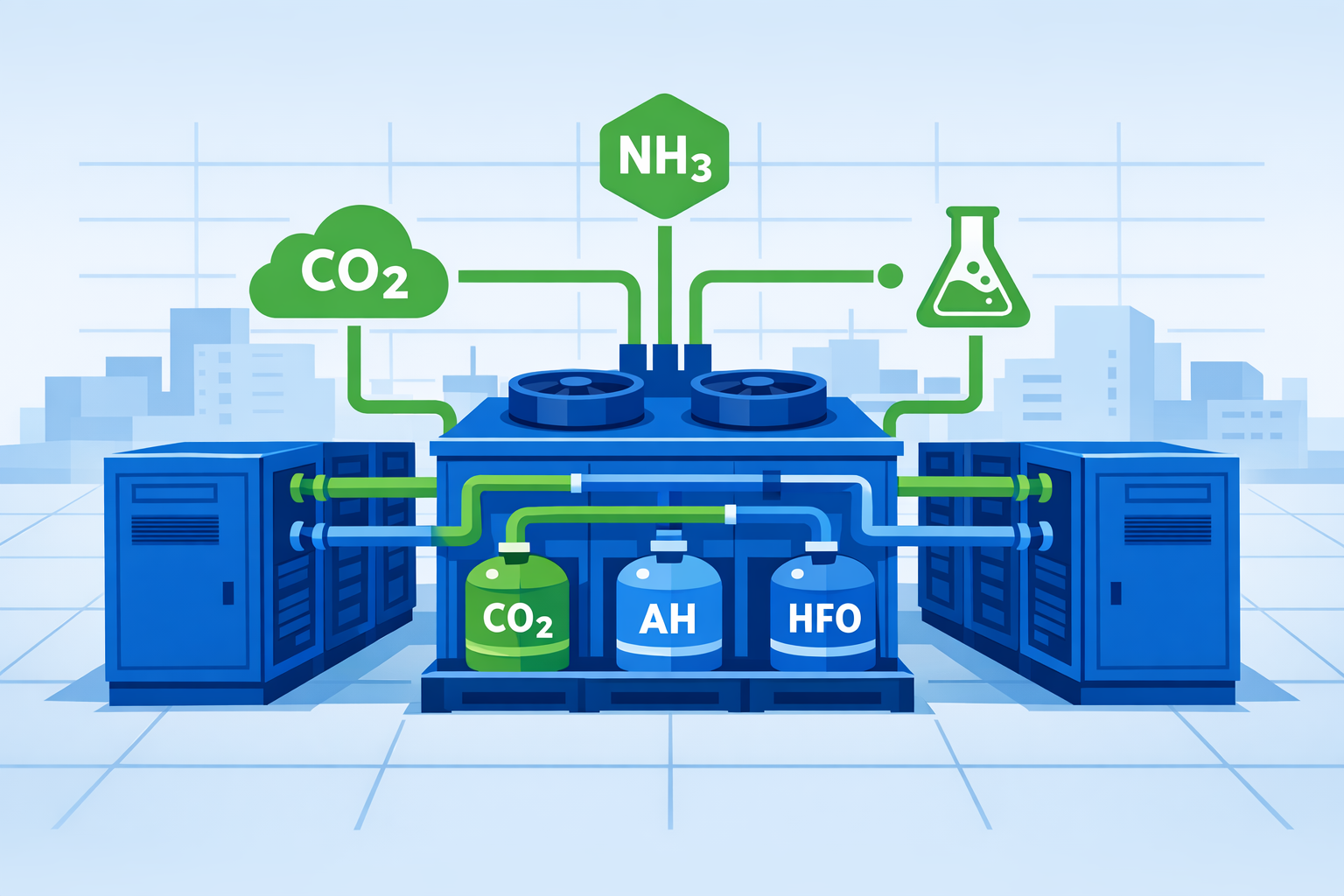
Data center operators across the United States are deploying hybrid cooling architectures - combining conventional air-based systems with CO₂ (R-744), ammonia (R-717), and hydrofluoroolefin (HFO) fluid circuits - as converging federal, state, and international refrigerant regulations compress planning timelines for facilities teams.
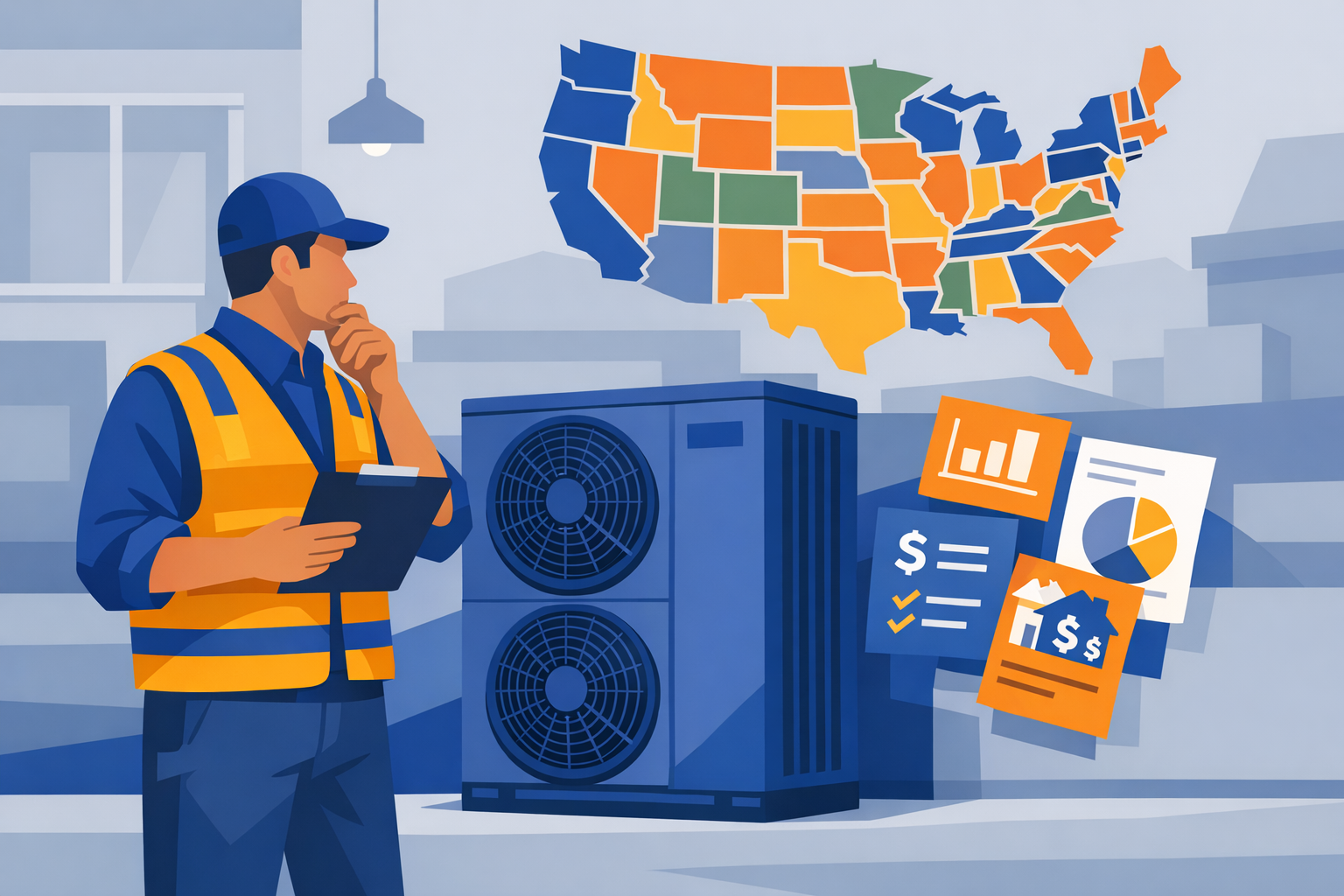
The shift is driven by hard compliance deadlines. Under the U.S. EPA's Technology Transitions Rule, enacted through the American Innovation and Manufacturing (AIM) Act, new data center cooling equipment must use refrigerants with a GWP below 700, effective January 1, 2027. The rule applies to newly manufactured or installed systems; existing equipment is not retroactively affected. However, tightening HFC supply caps under the AIM Act's phasedown schedule are expected to raise procurement costs for legacy refrigerants.
Regulatory Background
The federal deadline marks the final phase of a structured EPA rollout. Earlier restrictions under the Technology Transitions Rule took effect January 1, 2025, covering residential HVAC, heat pumps, and chillers. Data center cooling was designated a separate category with the 2027 deadline. Several states have moved faster: California requires new data center cooling equipment to use refrigerants with a GWP below 750, effective January 1, 2025, while Washington State has classified data center cooling as industrial process refrigeration (IPR) and is exercising enforcement discretion on new equipment until January 1, 2027.
Internationally, the EU's updated F-Gas Regulation 573/2024 bans fluorinated gases with a GWP of 750 or higher in new chillers above 12 kW from 2027. Unlike the U.S. approach, EU rules also restrict most A2L mildly flammable refrigerants, narrowing viable alternatives for operators with European footprints to natural refrigerants and specific HFO blends. The AIM Act mandates an 85% reduction in HFC production from historic baseline levels by 2036.
The confluence of state, federal, and supranational timelines has accelerated procurement decisions in a sector where cooling accounts for 30-40% of a data center's total electricity consumption.
Refrigerant Options and Pilot Deployments
Three categories of low-GWP alternatives are under active evaluation or deployment in data center applications. HFOs such as R-1234yf and R-1234ze carry GWP ratings below 10 but introduce mild flammability risks classified under ASHRAE's A2L designation. HFO/HFC blends such as R-454B and R-513A offer transitional solutions with more familiar handling characteristics; R-454B carries a GWP of 466, a reduction of more than 77% versus R-410A. Natural refrigerants - CO₂ and ammonia - offer the most favorable environmental profiles.
CO₂ (R-744) systems carry a GWP of just 1, compared to over 2,000 for common synthetic refrigerants. Research comparing CO₂ thermosyphon loops against R-134a and R-410A for data center applications found that CO₂ systems exhibit lower thermal resistance and higher heat transfer coefficients, with optimal refrigerant filling ratios of 45% for CO₂ versus 35% for R-134a/R-410A.
Ammonia is being tested in secondary cooling loops for industrial data centers, where its thermodynamic efficiency advantages are well established from decades of food processing and cold storage applications. Equipment manufacturer Zudek has supplied ammonia chillers to five data centers across South Africa and Germany, including a 6 MW (1,706 TR) installation in Germany. According to the ATMOsphere report Clean Cooling for Data Centers 2025, CO₂ (R-744), propane (R-290), and ammonia (R-717) chillers are being deployed in both Europe and North America, occupying a small but growing niche supported by regulatory and sustainability pressures.
Hybrid configurations - pairing air- or water-cooled chillers using A2L or HFO refrigerants with dedicated natural refrigerant circuits for high-density zones - allow operators to limit per-zone refrigerant charge. Under updated safety standards, indoor refrigerant mass limits per zone constrain system layout, requiring operators to segregate cooling systems and reduce charge volumes per equipment room. Controls platforms in compliant facilities must now incorporate real-time gas detection, automated isolation logic, and leak-threshold responses integrated directly into building management systems. Schneider Electric reported that it has been operating cooling units with low-GWP refrigerants in live data centers in North America since 2023 and in Europe since 2024.
On the demand side, AI server chips currently operate at 800 W to 2,000 W per chip, with rising rack densities that exceed the effective range of conventional air cooling. Global data center capacity is expected to nearly double from 103 GW to 200 GW by 2030.
Vendor Ecosystem and Procurement Outlook
Major equipment suppliers are redesigning product lines ahead of the 2027 deadline. Vertiv has redesigned its product lines to be available with low-GWP refrigerants to meet state-level timelines beginning with California. According to Vertiv, retrofitting existing equipment with new refrigerants is generally impractical, as it requires compressor changes, shut-off valve replacements, and recertification under safety agency listings. Companies including Daikin, Carrier, Trane, and Honeywell have released low-GWP refrigerant product lines optimized for data center cooling. Copeland has optimized its major compressor platforms for A2L refrigerants, including an oil-free centrifugal compressor designed for R-515B, R-1234ze, and R-513A.
For facilities teams, procurement lead times have emerged as a critical constraint. Contractors should factor manufacturing and installation timelines into equipment orders well ahead of the January 2027 federal deadline. The EPA estimates that the Technology Transitions Rule will result in emissions reductions equivalent to up to 876 million metric tons of CO₂ from 2025 through 2050, with climate benefits valued at up to $50.4 billion in 2020 dollars.
Operators budgeting infrastructure upgrades over the next 24 to 36 months face a layered compliance calendar: state-level rules already in effect in California and pending finalization in other jurisdictions, the 2027 federal deadline for new data center equipment, and EU F-Gas restrictions affecting any operator with European colocation or cloud infrastructure. Facilities teams that align capital expenditure planning with refrigerant transition schedules - and engage service providers certified in natural refrigerant systems - are positioned to avoid supply disruptions as legacy HFC availability contracts under the AIM Act phasedown.