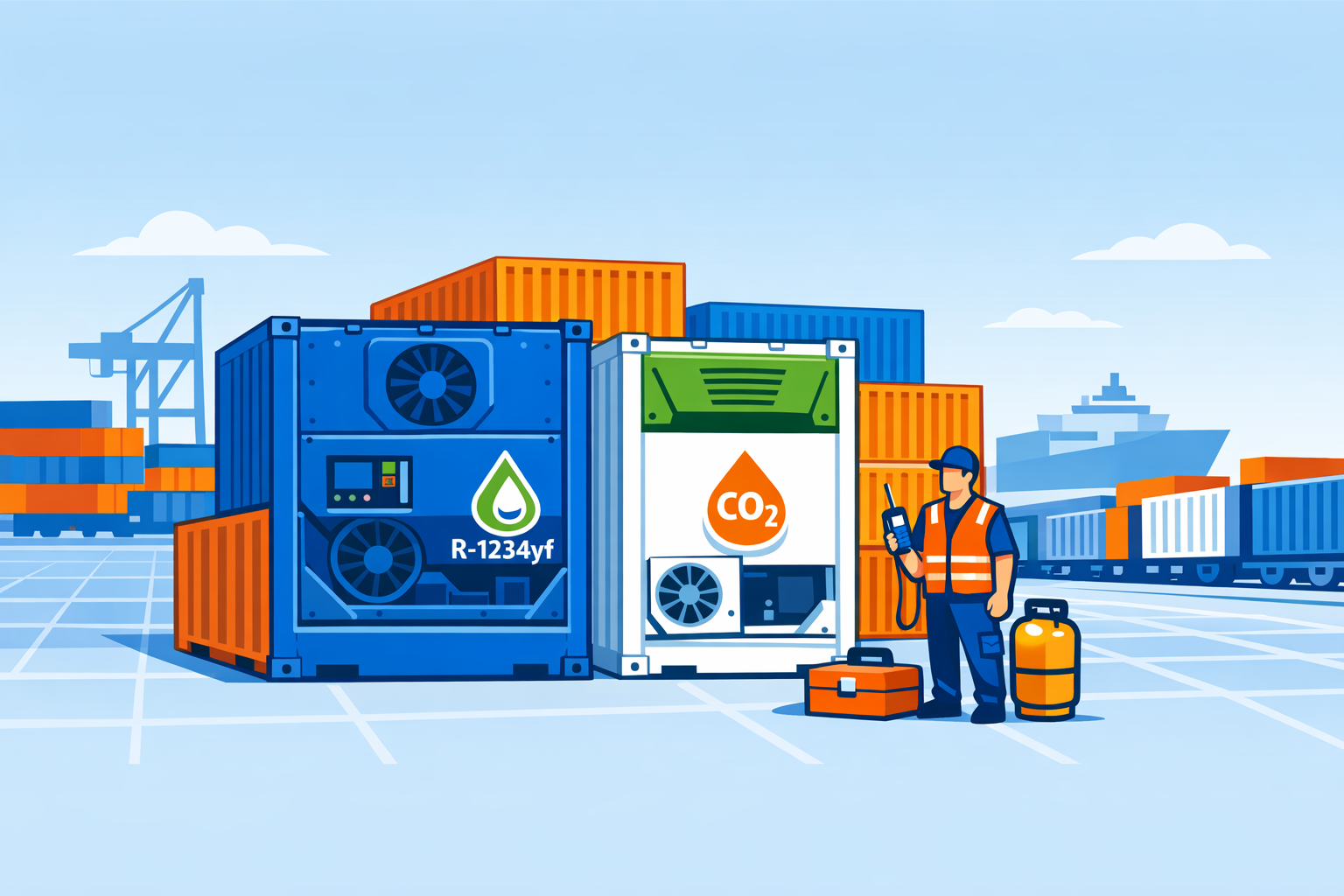
Executive summary: Carrier Global, through Carrier Transicold, and TITAN Containers have commenced a major low-GWP refrigerant deployment in intermodal container refrigeration, combining OptimaLINE units with R-1234yf and NaturaLINE CO₂ (R-744) technology.On 10 March 2026, Carrier Transicold announced TITAN's order of OptimaLINE units certified for R-1234yf and NaturaLINE units utilizing CO₂, supported by comprehensive multi-country training on these refrigerants. Amid tightening EU F-Gas regulations, emerging PFAS restrictions, and regional TRU standards, these field deployments will demonstrate if low-GWP refrigerants meet fleet performance, safety, and total cost requirements.
Key context: why transport refrigeration is pivoting to low-GWP
Intermodal reefers face several regulatory and market drivers:
- HFC phase-downs in Europe and North America
- Increased scrutiny of Scope 3 emissions by shippers and cargo owners
- Volatile pricing for legacy refrigerants
- Broader adoption of low-GWP HFO and natural refrigerant systems
According to the Container Owners Association, R-134a represents about 96% of the in-use reefer container fleet, with R-404A comprising most of the rest.[1] This mix is increasingly misaligned with emerging policies.
Regulatory drivers
EU F-Gas Regulation 2024/573:
- Reduces HFC market quotas.
- Aims for a 98% HFC phase-down by 2050 from 2015 levels.[2]
- Expands equipment bans and enforcement.
Transport refrigeration in EU scope:
- Updated F-Gas rules directly address transport refrigeration, including vans, ships, and land-based reefers, with phased enforcement by equipment type.[2]
California TRU regulation:
- Requires new truck, trailer, and certain facility TRUs in California to use refrigerants with GWP ≤ 2,200 from 31 December 2022.[3]
- While focused on road units, it signals broader expectations for low-GWP mobile cold-chain assets.
Maritime climate policy:
- The IMO Net-Zero Framework and related initiatives seek shipping decarbonization, where refrigerant leakage and unit energy use are relevant emissions sources.[4]
High-GWP refrigerants now pose regulatory and commercial risks alongside their environmental impacts.
Climate impact of legacy vs low-GWP refrigerants
Carrier-TITAN's adoption of low-GWP refrigerants is substantiated by direct GWP comparisons:
R-134a's 100-year GWP is about 1,430; R-1234yf is in the single digits, while CO₂ (R-744) is 1.[5]
The Greener Reefers initiative has observed sharp price increases in high-GWP HFCs as quotas limit supply. Project partners cite price jumps of up to 1,000% for some high-GWP refrigerants, underpinning the business case for alternatives.[6]
Inside the Carrier Global-TITAN Containers low-GWP deployment
Scope of the current program
Carrier Transicold's March 2026 communication outlines TITAN's phased fleet transition:
- OptimaLINE units certified for A2L R-1234yf
- NaturaLINE units using CO₂ (R-744)
- Factory delivery from Singapore, fully charged, minimizing on-site handling and expediting commissioning[7]
TITAN operates over 50,000 units globally, mainly for rental and temporary cold storage, reflecting wide climatic and regulatory coverage. The 2024 sustainability report confirms a fleet exceeding 50,000 containers across more than 90 countries.[8]
Core technologies: OptimaLINE with R-1234yf and NaturaLINE with CO₂
OptimaLINE and R-1234yf
- OptimaLINE is Carrier's triple-refrigerant-ready platform, enabling R-1234yf adoption.[7]
- A 2025 service bulletin specifies OptimaLINE units with R-1234yf-ready compressors and pressure relief valves, shipped with R-134a, convertible via model-specific kits.[9]
- Conversion kits integrate:
- R-1234yf leak sensors in-container
- Audible alarm buzzers
- Controller updates for A2L safety supervision[9]
These features address R-1234yf's A2L (mildly flammable) classification, complying with ISO 20854:2019 standards for OEM-certified systems.
NaturaLINE and CO₂ (R-744)
- NaturaLINE is Carrier's CO₂-based refrigeration unit for containers, promoted as the first marine natural-refrigerant solution.
- NaturaLINE employs CO₂ (R-744) with GWP 1, delivering up to 9.4 kW at 2°C and 4.4 kW at -29°C under 38°C conditions, at power draws similar to top synthetic units.[10]
- The design features a multi-stage compressor, variable-speed drive, and specialized gas cooler coils for high-pressure, transcritical CO₂ cycles.[10]
Fielding both R-1234yf and CO₂ enables TITAN and Carrier to compare HFO and natural refrigerants directly in service.
Alignment with TITAN's broader green refrigeration portfolio
TITAN's ArcticStore Horizon series exemplifies its adoption of low-impact stationary cold storage:
- Product materials cite about 55% average energy savings versus conventional reefers, using vacuum insulation and rooftop solar, and GWP reductions from 2,140 to 0.5.[11]
- ArcticStore Horizon operates from -30°C to +30°C, matching perishable logistics needs.
The partnership with Carrier extends this low-GWP strategy into intermodal and maritime transport, demanding consistent performance through varied pull-down and transit conditions.
Training and service capability as integral deliverables
Carrier emphasizes training and lifecycle support:
- Multi-country technical training on:
- Safe operation and service of R-1234yf OptimaLINE units
- Maintenance practices for NaturaLINE CO₂ systems[7]
- A2L-specific procedures-including leak detection, sensor servicing, and pre-trip validation-incorporated in Carrier's bulletins for R-1234yf units.[9]
Workforce readiness is integral to successful low-GWP transitions.
Refrigerant comparison: legacy vs low-GWP options in intermodal reefers
| Refrigerant | Typical role | Approx. 100-year GWP (AR4) | ASHRAE safety class | Notes for intermodal refrigeration |
|---|---|---|---|---|
| R-134a | Standard in legacy reefers | ~1,430 | A1 (non-flammable) | Simple single-stage; high GWP; subject to phase-down and volatile pricing[5] |
| R-404A | Used for low-temp, older reefers | ~3,922 | A1 | Extremely high GWP; phased out in EU/national measures; uneconomic for new builds[12] |
| R-1234yf | HFO, mobile/container use | <1-4 | A2L (mildly flammable) | Strong GWP reduction; needs sensors, alarms, A2L-certified components[13] |
| R-744 (CO₂) | NaturaLINE/natref units | 1 | A1 | Minimal climate impact; high pressures, transcritical cycles; requires specialized training[10] |
Mixed HFO and CO₂ portfolios are currently practicable as the sector evaluates adoption of alternatives like R-290 (propane).[14]
Technical questions these deployments need to answer
Carrier-TITAN's collaboration serves as a large-scale operational test of low-GWP intermodal refrigeration. Critical technical issues include:
1. Cooling performance and temperature stability
Operators will monitor:
- Pull-down rates across load conditions
- Temperature stability during frequent access and partial loading
- Recovery after power loss or genset changeovers
- Control precision for sensitive goods
Key metrics include capacity and COP of R-1234yf vs R-134a under high ambient loads, and NaturaLINE CO₂'s performance in hot climates during transcritical operation.
Recommended fleet monitoring:
- kWh/TEU-day or TEU-kilometer relative to R-134a/R-404A units
- Incidence of temperature excursions
- Compressor alarm frequencies
- Impact of advanced controls on part-load efficiency
2. Energy efficiency and power consumption
Energy use is a primary ROI element, especially where fuel or grid costs are high.
- Carrier indicates NaturaLINE matches the best synthetic units for power draw, while delivering climate gains via ultra-low GWP.[10]
- TITAN's ArcticStore Horizon experience suggests envelope improvements plus low-GWP refrigerants can cut energy consumption by over half.[11]
Container fleets must validate these gains under varied power conditions and transport cycles.
3. Reliability, component life and service intervals
Essential reliability concerns:
- Compressor durability with R-1234yf vs R-134a under variable loading
- Seal and valve compatibility for HFOs, CO₂ systems
- Electronics and sensor reliability amid marine and depot electrical stress
- Effects of added complexity (sensors, PRVs, drives) on mean time between failures
R-1234yf conversion kits add sensors and filter cartridges with specified service intervals, expanding maintenance requirements.[9]
4. Safety, leak detection and A2L handling
R-1234yf introduces mild flammability risks:
- Carrier units include:
- On-box sensors
- Audible leak and fault alarms
- Pre-trip checks for sensors and buzzers[9]
- Technicians require A2L-focused training, with no tolerance for recurring leaks.
CO₂ requires:
- Correct PRV selection for high pressures and system limits
- Procedures to prevent oxygen displacement in confined spaces during releases
Coordination with local codes, port regulations, and insurance policies is essential as low-GWP units proliferate.
Retrofit vs newbuild: what changes at system and service level?
Certified conversion paths vs non-convertible legacy units
Manufacturer documentation limits conversion eligibility:
- Only OEM-certified PrimeLINE, PrimeLINE EDGE, and OptimaLINE units with designated compressor/PRV specs may use R-1234yf.[9]
- ISO 20854 and manufacturer rules bar use of R-1234yf in uncertified units.
Fleets must:
- Upgrade newer units via approved kits, reducing operational GWP and capital expenditure
- Retire, resell, or redeploy older R-134a/R-404A units rather than convert
Tooling, leak detection and recovery equipment
Service infrastructure needs include:
- A2L-rated recovery/charging gear
- Leak detectors calibrated for R-1234yf at relevant concentrations
- Revised procedures meeting OEM and regulatory demands
Many operators are adapting similar practices in building HVAC as the sector shifts to A2L blends.[15] The container segment is converging on these standards, highlighting the need for consistent training across facility and fleet domains.
Digital controls and data
OptimaLINE and NaturaLINE platforms incorporate advanced digital management (e.g., Micro-Link controllers).[10] Fleets should:
- Log all leak alarms, refrigerant charge events, and sensor data
- Track energy performance across voyages and depot stays
- Correlate performance/faults with conditions and usage modes
Structured data is vital for building investment cases founded on demonstrable results.
Economics and ROI: where value is likely to accrue
Though detailed Carrier-TITAN cost data remain undisclosed, various ROI levers are evident:
1. Refrigerant cost and availability
- HFC quotas and PFAS scrutiny restrict high-GWP refrigerant access and elevate prices
- 10-fold EU HFC price increases heighten the risk of dependence on phased-down gases[6]
- R-1234yf and CO₂, while not exempt from costs, align with policy, reducing future price risks
2. Energy savings and carbon pricing
- TITAN's stationary ArcticStore Horizon fleet demonstrates combined envelope and refrigerant improvements can yield double-digit energy reductions[11]
- As carbon pricing expands to maritime/logistics (EU ETS, IMO levies), both improved energy and GWP drive lifecycle economics and carbon disclosures[4]
3. Asset future-proofing and residual values
- R-1234yf and CO₂ units reduce stranding risks from new bans and restrictions
- Low-GWP units may command higher residuals and broader secondary market appeal
4. Brand and customer requirements
- Major clients increasingly require refrigerated assets with minimized emissions
- Providers offering low-GWP units with verifiable performance are competitively favored for contracts with climate or Scope 3 reporting criteria[16]
What HVAC and cold-chain professionals should monitor as the program matures
Priorities for installers, technicians, and fleet operators:
Performance data
- Track and publish kWh/TEU-day, pull-down times, and temperature-excursion rates for R-1234yf and CO₂ units versus legacy standards
Service records
- Document failure types unique to A2L and CO₂, including sensor and pressure-fault incidents
Training assessment
- Audit technician competencies on A2L and CO₂ handling; address gaps in recovery, charging, and emergency procedures
Compliance mapping
- Align fleets with changing EU F-Gas, TRU, and port rules to sustain service eligibility
TCO modeling
- Integrate refrigerant costs, training, tooling investments, energy use, downtime, carbon penalties, and green-premium opportunities
Frequently Asked Questions
How are Carrier Global and TITAN Containers actually using low-GWP refrigerants today?
Carrier Transicold has shipped an initial batch of OptimaLINE units certified for R-1234yf and NaturaLINE units using CO₂ (R-744) to TITAN Containers.Units are factory-charged in Singapore and backed with dedicated, multi-country training for TITAN teams.[7] The precise deployment routes remain unspecified, but TITAN's global coverage suggests broad geographic application.
What are the main technical differences between R-1234yf and CO₂ in container refrigeration?
R-1234yf is a low-GWP HFO with A2L classification (mildly flammable), requiring built-in leak detection, alarms, and certified system components.[17] CO₂ (R-744), a natural refrigerant with GWP 1 and A1 non-flammability, operates at much higher pressures-demanding specialized compressors, valves, and controls.[10]
What changes for service technicians working on A2L R-1234yf reefers?
Technicians must:
- Use A2L-rated recovery and charging hardware
- Follow OEM-authorized conversion and servicing protocols
- Replace and calibrate sensor filters; verify alarm circuits with pre-trip tests
- Use proper ventilation and safety procedures for leak incidents, per Carrier bulletins[9]
These changes represent a procedural evolution, requiring formal training and meticulous documentation.
Are low-GWP container reefers ready for widespread fleet deployment?
Commercially available solutions, including NaturaLINE CO₂ and R-1234yf-ready OptimaLINE units, are operational in the field.[10] Broader operational datasets on efficiency, reliability, and safety are still being accumulated. The Carrier-TITAN rollout represents significant progress, but aims to inform wider adoption that also includes R-290 and other emerging natural-refrigerant pilots.[14]
How should fleet operators and facility managers evaluate ROI on low-GWP intermodal refrigeration?
Effective ROI evaluation should cover:
- Refrigerant acquisition and servicing costs as HFC regulation tightens
- Energy use across typical profiles
- Investments in training and tooling for A2L/CO₂ support
- Asset life and secondary value under evolving policy
- Revenue or contract premiums linked to lower Scope 3 emissions and customer climate requirements
Comprehensive telematics and standardized KPI tracking will enable informed, evidence-based investment decisions.
Conclusions and next steps for the HVAC and refrigeration community
The Carrier Global-TITAN Containers deployment marks a significant transition for intermodal refrigeration. The integration of R-1234yf and CO₂ proves whether low-GWP refrigerants can meet performance, safety, and cost demands across global cold chains.
Key action points for professionals:
- Assess fleets: Identify R-134a/R-404A units in service and their eligibility for OEM low-GWP conversion
- Standardize metrics: Track energy, reliability, and leak rates for legacy and low-GWP units
- Expand competency: Implement A2L/CO₂ training and verify that tools and recovery processes are compliant
- Engage OEMs: Coordinate on conversion criteria, warranty coverage, and remote monitoring
- Align with stakeholders: Position low-GWP refrigeration within broader sustainability and Scope 3 strategies
As real-world data accumulates from Carrier-TITAN and comparable projects, SHK professionals can advance from pilots to the widespread adoption of low-GWP container refrigeration as a new industry benchmark.