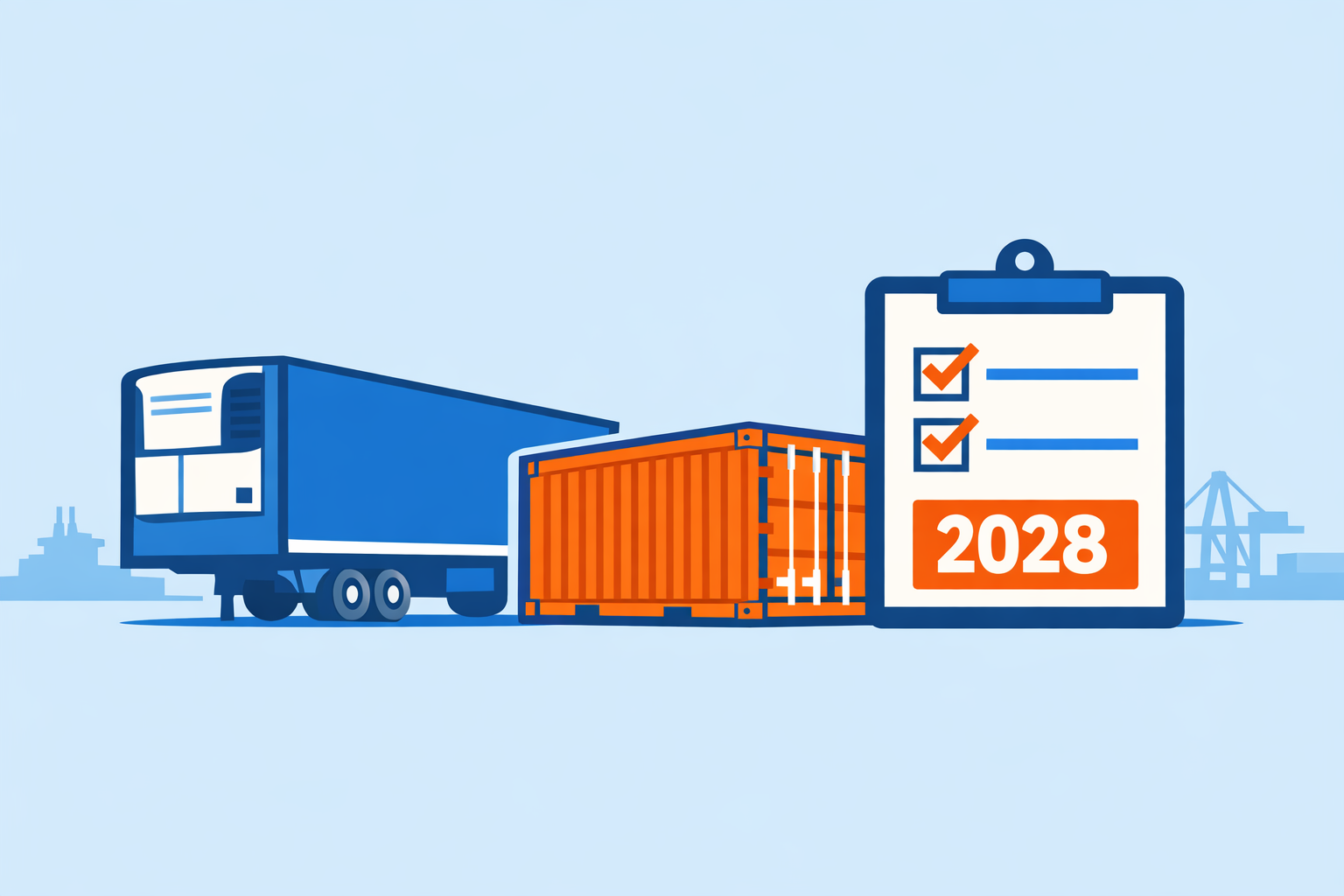
The U.S. refrigerant phase down is entering a stage where deadlines, enforcement priorities, and rulemakings no longer progress uniformly. For transport refrigeration, this dynamic is effectively extending planning horizons from the original 2025-2026 transitions toward the late 2020s. This shift significantly influences cold chain logistics, capital allocation, and workforce training.
Regulatory text for many transport applications maintains 2025 compliance dates. However, EPA's Technology Transitions reconsideration, enforcement memoranda, and No Action Assurance (NAA) for specific intermodal equipment indicate a more flexible schedule. The primary question for operators lies not in the inevitability of low-GWP refrigerants, but in how to sequence fleet turnover and adjust service practices through at least 2028 while maintaining reliability.
Regulatory context: How EPA refrigerant regulations affect the cold chain
The American Innovation and Manufacturing (AIM) Act mandates an 85% phasedown in U.S. HFC production and consumption from baseline levels by 2036[1]. EPA advances this through three coordinated programs:
- Allowance Allocation (HFC phasedown): Regulates bulk HFC production and imports via scheduled caps to 2036.
- Technology Transitions Program: Imposes sector-specific HFC restrictions in new equipment, including transport refrigeration.
- Emissions Reduction and Reclamation (ER&R) Program: Enacts leak management, refrigerant recovery, and reclaimed-refrigerant use for existing equipment.
Cold chain operators-including refrigerated trucks and trailers, marine and rail reefers, intermodal containers, warehouses, and supermarket systems-must address overlapping obligations under all three pillars. Decisions regarding transport refrigeration units (TRUs) must now consider impacts across warehouse racks or retail systems, as all draw from the same constrained HFC supply and regulatory structure.
Market analyses estimate the global cold chain logistics sector at US$393.2 billion in 2025, with projections exceeding US$1.6 trillion by 2035 at a CAGR of about 15.3%[2]. Regulatory misalignment with fleet renewal could constrain growth or increase product delivery costs.
Where transport refrigeration stands today under EPA refrigerant regulations
Original Technology Transitions deadlines for transport subsectors
The 2023 Technology Transitions final rule designates refrigerated transport in both "products" and "systems" tables, with distinct provisions for intermodal, road, and marine applications.EPA restricts for new refrigerated transport systems:
- Intermodal containers operating at or above -50 °C to refrigerants with less than 700 GWP from January 1, 2025.
- Road and marine self-contained systems from using specific high-GWP HFC blends, such as R-404A, R-507A, and several retrofit blends in new equipment from January 1, 2025[3].
These measures apply only to new systems; existing equipment may continue with allowed refrigerants under separate ER&R provisions.
Key transport-related Technology Transitions provisions
| Subsector / System | Core refrigerant restriction | Nominal installation / manufacture compliance date* |
|---|---|---|
| Intermodal containers (≥ -50 °C entering evaporator / exiting chiller) | GWP limit of 700 for HFCs and HFC blends | Jan 1, 2025[3] |
| Intermodal containers (< -50 °C) | Not covered by Technology Transitions GWP limit | Not covered |
| Road TRUs - self-contained | Prohibition on listed high-GWP blends (e.g., R-404A, R-507A, several retrofit blends) in new systems | Jan 1, 2025[3] |
| Marine TRUs - self-contained | Same prohibited blends list as road systems | Jan 1, 2025[3] |
| Cold storage warehouses (≥200 lb charge) | 150 GWP limit for new systems | Jan 1, 2026[3] |
| Supermarkets (≥200 lb charge) | 150 GWP limit for new systems | Jan 1, 2027[3] |
*Manufacture and import restrictions for "products" usually precede these system installation dates.
ER&R rule: Leak management and reclaimed-HFC use
The ER&R program adds requirements for installed refrigeration and HVAC assets. From January 1, 2026, refrigeration systems with 15 lb or more of an HFC-containing refrigerant or substitute with GWP above 53 must follow leak detection, repair, and documentation rules, including retrofit or retirement plans if leaks remain unresolved within designated periods[4].
Critically, beginning January 1, 2029, service and repair of appliances in the supermarket systems, refrigerated transport, and automatic commercial ice maker subsectors must utilize reclaimed HFCs[5]. This creates a definitive cutoff for high-GWP service practices, independent of changes to Technology Transitions dates.
Signals of an extended transition horizon toward 2028
Technology Transitions reconsideration and "low enforcement priority"
In March 2025, EPA initiated reconsideration of parts of the 2023 Technology Transitions Rule following multiple petitions. The October 3, 2025 proposed reconsideration explicitly identifies refrigerated transport-intermodal containers as a focus, with EPA stating intent to extend compliance dates for affected categories, while current deadlines formally remain until amended[6].
EPA reinforced this by designating enforcement of original dates as a "low enforcement priority" and signaling that resources will shift to new compliance dates established by the coming rulemaking[6]. Thus, the January 1, 2025 restrictions on new intermodal equipment, though still present in regulation, carry reduced enforcement risk during rule development.
No Action Assurance for deep-frozen intermodal containers
EPA's Office of Enforcement and Compliance Assurance has issued and extended No Action Assurance (NAA) for new refrigerated transport-intermodal containers operating between -35 °C and -50 °C using HFC refrigerants up to a 2,140 GWP (notably R-452A), through September 1, 2026 or finalization of rule reconsideration, whichever comes first[7].
This NAA acknowledges the lack of a suitable refrigerant meeting the 700 GWP target for specific deep-frozen applications-including hazardous chemical cargo and critical life-science loads. The NAA:
- Permits ongoing manufacture, import, and installation of niche high-performance intermodal units with R-452A.
- Minimizes disruption risk for pharmaceutical and specialty chemical cold chains.
- Offers a grace period for OEMs and operators to trial low-GWP options.
Interaction with other 2027-2028 refrigerant milestones
Although refrigerated transport has no formal compliance extensions into the 2030s, related deadlines reinforce a late-decade transition:
- VRF systems with higher-GWP HFCs made or imported before January 1, 2026, may be installed until January 1, 2028, per VRF-specific regulations[6].
- Technology Transitions covers compliance dates up to January 1, 2028, for certain industrial process refrigeration systems operating between -50 °C and -30 °C[3].
- Allowance caps tighten post-2028, with 2029-2033 bulk HFC supply roughly halved relative to 2026-2028[5].
These signals suggest that the 2027-2030 period will see peak compliance pressures. Many organizations are aligning refrigerant and equipment planning through at least 2028, pending final sector-specific dates.
Industry structure: Why transport refrigeration cannot be planned in isolation
The global refrigerated transport fleet's size and composition magnify regulatory shifts. Land-based transport represents about 64% of TRUs-approximately 2.7 million refrigerated trucks and trailers globally-while seaborne represents 24% with over 800,000 containers in service[8].
Only around 18% of TRUs are hybrid or electric; about 82% are diesel-powered, with refrigerated transport contributing nearly 12% of total logistics sector emissions[8]. This structure requires:
- Coordinated redesign of TRUs with propulsion system decarbonization.
- Fleet size and long lifespans mean compliance date changes significantly affect asset replacement and value calculations.
- While road TRUs dominate in numbers, intermodal and marine reefers are critical to international logistics and pharmaceuticals.
Strategic implications of a stretched transition window
Capital planning and fleet turnover
Integrated 2025 Technology Transitions, 2026 ER&R requirements, the 2029 reclaimed-HFC mandate, and soft enforcement for select intermodal assets reshape replacement and retrofit timelines.
Key planning issues:
- HFC-based TRU procurement longevity: With bans in effect for select high-GWP blends, fleets must specify new units with low-GWP or natural refrigerants.
- Accelerating pre-2025 TRU replacement: The 2029 reclaimed-HFC mandate introduces a clear breakpoint for units dependent on virgin HFCs.
- Aligning asset investments: Compliance dates for cold storage and supermarkets (2026-2027) and possible 2032 extensions will determine preferences for incremental or comprehensive upgrades.
A planning horizon extending through at least 2028 has become practical, as equipment platforms and refrigerant supply chains are expected to stabilize in that timeframe under the AIM Act.
Risk management and compliance posture
Designation of Technology Transitions obligations as low enforcement priority reduces, but does not remove, compliance risk. Industry participants distinguish between:
- Legal deadlines (CFR dates), such as January 1, 2025, for new high-GWP road TRUs.
- Enforcement and reputational risk intervals, shaped by EPA guidance, litigation, and client expectations.
Major retailers and pharmaceutical shippers often treat original compliance dates as operationally binding, leveraging EPA signaled flexibility to enable smoother implementation instead of postponing action.
Technology choices: Low-GWP refrigerants in transport refrigeration
Lower-GWP HFC/HFO blends
For road and marine TRUs, low-GWP blends like R-452A provide transitional reductions in GWP compared to legacy R-404A and remain compatible with existing components. However, R-452A's GWP (around 2,140) exceeds the 700-GWP thresholds applied in other subsectors, thus serving as a bridge solution.
EPA's NAA for deep-frozen intermodal equipment recognizes these transitional blends where lower-GWP options are not technically feasible. Over time, OEMs are expected to migrate toward ultra-low-GWP blends or natural refrigerants as standards evolve.
Natural refrigerants (CO₂ and others)
CO₂ (R-744) is increasingly adopted in transport refrigeration due to near-zero GWP and expanding component availability. A 2024 study in the International Journal of Refrigeration reported that an R-744 unit outperformed an R-134a reference by about 27.5% in annual coefficient of performance, and offered a 31.9% reduction in lifetime CO₂-equivalent emissions, despite heavier unit weight and minor fuel-related emission increases[9].
Key technical considerations:
- Higher-pressure operation and specialized components for CO₂ systems.
- Distinct sensitivity to ambient conditions compared to HFC/HFO systems.
- Lower total climate impact even if energy consumption is marginally higher.
Ammonia and hydrocarbon refrigerants gain interest for marine and warehouse applications, though toxicity and flammability currently limit their use in most road vehicles.
Workforce and service readiness: Training demands through 2028
Regardless of ultimate transport sector compliance dates, the ER&R program and the shift to low-GWP refrigerants create significant training requirements:
- Leak detection and documentation: ER&R mandates consistent leak-rate tracking, documentation, and required planning for unrepaired units.
- A2L refrigerant handling: With growing use of mildly flammable blends in stationary and some mobile systems, updated charging, leak testing, and safety procedures are essential.
- Natural-refrigerant safety: CO₂ systems require expertise in high-pressure operation, safe venting, and diagnostics.
- Reclaimed-HFC logistics: By 2029, servicing must incorporate reclaimed HFC supply chains, including tracking, quality control, and cost analysis.
Early investment in updated certifications, OEM-specific instruction, and fleet-wide procedural standards is vital for reliable uptime during the refrigerant transition.
Actionable conclusions and next steps for cold chain operators
In light of current EPA regulations and evolving timelines, emerging best practices include:
- Map refrigerant assets to regulatory schedules. Inventory all TRUs, containers, warehouses, and retail systems, aligning each with applicable milestones through at least 2030.
- Separate near-term and late-decade actions. Treat 2025-2026 requirements as immediate priorities; use 2028-2029 rules as medium-term anchors for planning.
- Standardize refrigerant selection. Limit refrigerant types across assets to simplify training, inventory, and reclaimed-gas management while aligning with low-GWP endpoints.
- Pilot low-GWP and natural-refrigerant TRUs. Leverage current flexibility to run structured pilots, gathering operational data before large-scale adoption.
- Integrate regulatory monitoring into procurement. Ensure new equipment specifications capture refrigerant management, compliance pathways, and future AIM Act assumptions.
These steps enable operators to turn transition flexibility into deliberate, data-driven modernization of cold chain infrastructure.
Frequently Asked Questions
Does EPA's recent activity mean the transport refrigeration deadline has officially moved to 2028?
No. As of April 2026, the Code of Federal Regulations still lists January 1, 2025, as the compliance date for new refrigerated transport systems using high-GWP refrigerants-including intermodal containers above the 700 GWP threshold, and road/marine units with listed blends such as R-404A and R-507A[3].
EPA has indicated intent to extend compliance dates for certain subsectors, has issued an NAA for part of the intermodal fleet through 2026, and labeled requirements under reconsideration as low enforcement priority. These combined actions extend operators' practical planning timelines toward the late 2020s, but do not alter the rule text.
Which parts of the cold chain are directly covered by the Technology Transitions versus ER&R rules?
Technology Transitions applies to new equipment, covering several cold chain subsectors-including refrigerated transport (intermodal, road, marine), retail refrigeration, cold storage warehouses, and select industrial process refrigeration systems.[3]
ER&R applies to installed equipment, mandating leak detection, repair, recovery, and reclaimed-refrigerant use in HFC-containing appliances. For operators, a key milestone is the rule requiring reclaimed HFC use in supermarket, refrigerated transport, and automatic commercial ice maker servicing after January 1, 2029[5].
How will the reclaimed-HFC requirement in 2029 affect refrigerated transport maintenance budgets?
The 2029 transition to reclaimed HFCs is projected to:
- Raise per-pound refrigerant costs relative to current virgin pricing, due to reclamation and logistics requirements.
- Encourage stricter leak prevention and repair, as all losses draw from a limited reclaimed pool.
- Strengthen the rationale for adopting low-GWP or natural refrigerants in new TRUs, minimizing future reliance on reclaimed HFCs.
Budget planning increasingly treats 2029 as a turning point, with higher operational expenditures for legacy HFC-based TRUs and accelerated retirement schedules for the most leak-prone assets.
What low-GWP refrigerants are technically viable for road and intermodal systems today?
For road TRUs, R-452A and other lower-GWP blends are in widespread use, providing meaningful climate impact reductions from legacy HFCs without major hardware changes. Although these blends exceed GWP levels now set for other subsectors, their long-term regulatory status remains unsettled.
For intermodal and some trailers, CO₂ (R-744) systems are commercially available and supported by field experience, notably in Europe. Recent research shows CO₂-based transport units deliver about one-third lower lifetime CO₂-equivalent emissions than comparable R-134a units, with design and operational adjustments required[9].
How should HVAC and refrigeration technicians prepare for evolving transport refrigeration requirements?
Technicians must build proficiency in:
- AIM Act compliance timelines and cross-border considerations
- ER&R-compliant leak detection, documentation, and refrigerant recovery
- Safe servicing of high-pressure CO₂ units and, where relevant, mildly flammable A2L refrigerants
- Handling reclaimed HFC logistics, quality verification, and regulatory documentation
Structured training developed with OEMs, distributors, and trade associations will be crucial to keeping workforce capabilities aligned with the refrigerant phase down and regulatory requirements through 2028 and beyond.