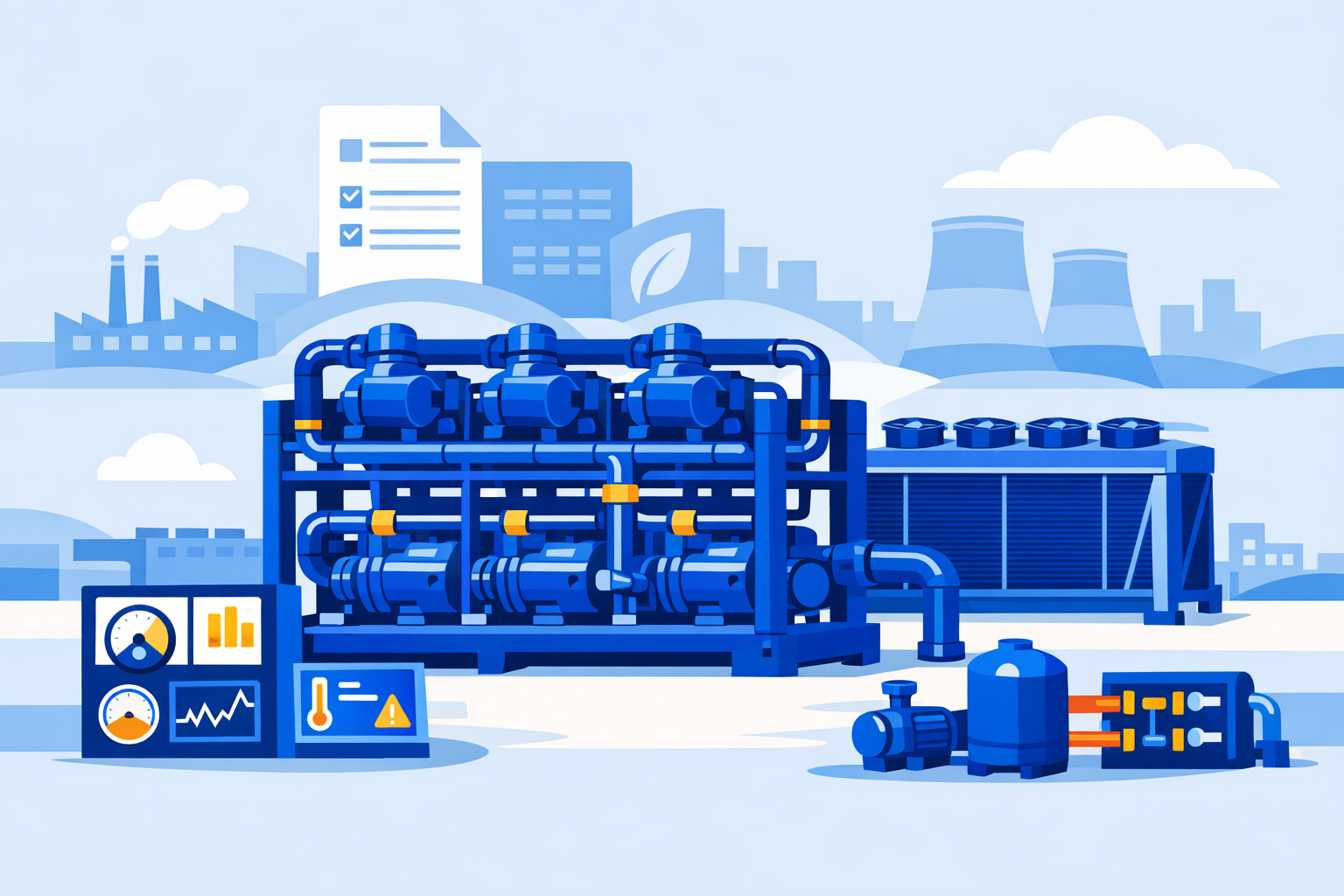
Advansor's new high-capacity CO₂ (R-744) heat pump platform for industrial and district heating projects demonstrates the rapid scaling of natural refrigerant technology into megawatt-class process heating. The modular SteelXL CO₂ heat pumps now achieve up to 4.8 MW of heating capacity per unit and can be paralleled to approximately 50 MW for large networks and plants.[1]
The launch coincides with tightening F-gas regulations and a sharp industry shift from high-GWP HFCs and some HFO blends in industrial heating. For HVAC and process engineers, the central question is now how and where CO₂ industrial heat pumps can deliver the required efficiency, lifecycle cost, and decarbonization benefits.
Advansor's SteelXL: A New Scale for CO₂ Industrial Heat Pumps
Advansor positions SteelXL as a configurable industrial heat pump line for process heating, district heating, and large commercial loads.
The company's CO₂ heat pump range offers capacities from about 600 kW up to 4.8 MW per unit, with water outlet temperatures up to roughly 95 °C.[2] This places the systems firmly in the heavy commercial and industrial heating segment, beyond typical building-scale units.
Key technical characteristics (Advansor CO₂ heat pump range)
| Parameter | Typical SteelXL / CO₂ range* | Implications for industrial heating |
|---|---|---|
| Refrigerant | CO₂ (R-744), GWP = 1 | Minimizes F-gas exposure; eases long-term compliance |
| Single-unit heating capacity | ~0.6-4.8 MW | Suitable for large plants, district heating substations |
| Parallel system capacity | Up to ~50 MW | Enables full network or site-level industrial heating |
| Max. supply temperature | Up to ~95 °C | Covers space heating, DHW, low/medium-temp process heat |
| Typical applications | District heating, food processing, industrial process heating, large buildings | Broad process and utility coverage |
*Ranges compiled from manufacturer and trade-press information.
Operating with CO₂, the system is classified as safety class A1 (non-flammable, low toxicity) but requires significantly higher pressures than conventional HFC industrial heat pumps. This is beneficial for sites where flammability (R290, R600) or toxicity (R717) pose challenges. Design teams must address transcritical pressures in the 80-130 bar range on the high side. Transcritical CO₂ heat pumps typically operate at pressures five to ten times higher than comparable HFC systems, with gas cooler pressures between approximately 80 and 130 bar.[3]
Regulatory Drivers: Why Low-GWP Industrial Heat Pumps Are Moving First
F-gas 2024/573: From Phase-Down to Phase-Out
The revised EU F-gas Regulation 2024/573 fundamentally shifts refrigerant options for industrial heat pumps, chillers, and process cooling.
The updated HFC quota drops to about 5.2% of the historical baseline by 2030 and zero by 2050, effectively turning the prior phase-down into a near-complete phase-out over two decades.[4]
Key clauses impact industrial heating:
- An export ban from 2025 covers stationary refrigeration, air conditioning equipment, and stationary heat pumps with fluorinated greenhouse gases (GWP > 1000) when bans apply.[4]
- Bans between 2027 and 2032 restrict new chillers and self-contained AC/HP equipment above GWP thresholds of 750 and 150, pushing markets to low-GWP and natural refrigerants. From 2027, new chillers >12 kW with F-gases GWP ≥ 750, and units ≤12 kW with F-gases GWP ≥ 150, face placement bans, with further tightening by 2032.[5]
- Certification and training for alternative refrigerants are mandated, including natural media such as CO₂, ammonia, and hydrocarbons.[4]
Therefore, industrial heat pump projects specified today must consider current and future bans, refrigerant availability, serviceability, and export limitations over a 20-30-year asset life. High-capacity CO₂ heat pumps like SteelXL increasingly serve as compliance-ready solutions for large sites and utility networks.
Why CO₂ Fits the Policy Direction
CO₂ offers several strategic advantages under these rules:
- GWP of 1 (baseline for GWP scale) and no PFAS concerns.[5]
- A1 safety classification (non-flammable, low toxicity), reducing some siting and insurance constraints compared to A3 hydrocarbons or B2L ammonia.[5]
- Broad applicability in district heating, commercial refrigeration, and now industrial heating and process cooling, enabling standardization in training and component ecosystems.
These features help OEMs and installers reduce regulatory and reputational risk while allowing portfolio consolidation around a natural refrigerant with strong policy support.
Industrial Heat and the Role of High-Temperature Heat Pumps
Process Heat Dominates Industrial Energy Use
Industrial decarbonization solutions increasingly target process heating.
Industry accounts for roughly 37% of global final energy use, with about two-thirds of its demand for process heat, much of it currently reliant on fossil fuels.[6]
A large share of heat demand resides below 150-200 °C, where high-temperature industrial heat pumps can replace steam and hot-water boilers.
Performance Envelope of CO₂ and Other High-Temperature Heat Pumps
High-temperature industrial heat pumps using natural refrigerants (CO₂, ammonia, hydrocarbons, water) or low-GWP synthetics (such as R1233zd(E), R1234ze(E)) now cover broad temperature and capacity ranges:
- Research and commercial projects report high-temperature industrial heat pumps (100-200 °C) can achieve COP values of 3-5, depending on lift and source temperature.[7]
- Transcritical CO₂ systems delivering 85-95 °C to district heating typically achieve COPs around 2-3 at high outlet temperatures, outperforming direct electric or gas boilers. Field data and simulations for CO₂ district heating heat pumps show COPs in the 2-3 range at ~90 °C supply temperatures.[8]
This efficiency profile makes CO₂ heat pumps effective for:
- District heating networks with flow temperatures of 75-95 °C.
- Low/medium-temperature process heating (e.g., pasteurization, cleaning, drying) up to ~90-95 °C.
- Combined heating/cooling where process cooling waste heat can be upgraded.
How CO₂ Compares with Other Low-GWP Refrigerants
A comparison of common low-GWP options for industrial heat pumps:
| Refrigerant | Typical GWP (AR4/AR6) | Safety class (ISO 817 / EN 378) | Practical industrial temp range* | Key advantages | Main constraints |
|---|---|---|---|---|---|
| CO₂ (R744) | ≈1 | A1 (non-flammable) | Up to ~90-95 °C (commercially); higher in some cases | Very low GWP; compact equipment; strong heat recovery | Very high pressures; efficiency depends on climate |
| R290 | ≈3 | A3 (flammable) | Up to ~80-90 °C | Excellent efficiency; very low GWP | Flammability limits charge and siting |
| R717 | 0 | B2L (toxic, mildly flammable) | >100 °C achievable | High efficiency; mature for large industrial | Toxicity and materials constraints |
| HFOs (e.g., R1234ze(E)) | <1-~2 | A2L (mildly flammable) | Up to ~120 °C (system-dependent) | Good efficiency; lower pressure than CO₂ | Flammability; PFAS/regulatory scrutiny |
*Indicative; actual limits depend on system design and compressor technology.[5]
Advansor's approach places CO₂ as a primary working fluid for high-capacity process heating, complementing rather than replacing ammonia and R290. Selection remains application- and site-specific.
Climate and Load Profile: Heat Pump Efficiency in Real Projects
Sensitivity to Ambient and Source Temperatures
Heat pump efficiency depends on the temperature lift from source to sink. This is especially significant for CO₂, which operates transcritical cycles.
Key insights from current research:
- Raising supply temperature from ~65 °C to 90-120 °C reduces both capacity and COP for CO₂ heat pumps.[9]
- High ambient temperatures (air-source units above ~35 °C) can reduce cooling performance and stress high-pressure components, prompting use of ejectors, parallel compression, or two-stage designs.[10]
For industrial designers considering SteelXL or similar CO₂ heat pumps, consider:
- Optimal efficiency is achieved by keeping process return temperatures as low as possible (such as with effective heat exchangers, low district return temperature).
- Water-source or waste-heat-source configurations are preferable to harsh air-source conditions, especially for year-round process heating.
Lifecycle Cost Versus Boilers and HFO/HFC Heat Pumps
Lifecycle analysis for industrial heating typically weighs:
- High-efficiency gas/oil boilers
- HFO/HFC-based high-temperature heat pumps
- Natural refrigerant heat pumps (CO₂, R717, R290)
Critical total cost of ownership (TCO) factors:
- Annual operating hours and load factor (base-load vs. peak usage)
- Electricity vs. gas pricing and carbon costs
- Use of waste heat as an input to the heat pump
- Regulatory risks (F-gas quotas, leak penalties, export bans, PFAS rules)
SteelXL-class CO₂ heat pumps are often most competitive as base-load equipment in heavily utilized networks or plants with steady year-round heat demand and accessible low-grade heat sources, with boilers used for peaks or backup.
Integration Challenges in Existing Industrial Plants
Deploying a megawatt-class CO₂ industrial heat pump requires substantial integration engineering.
Hydraulic and Process Integration
Design teams must address:
Temperature levels and pinch points
- Are process or heat networks designed for 80-95 °C, or can temperatures be reduced to improve COP?
- Can some processes shift to lower temperature tiers?
Heat sources and sinks
- Are waste heat streams (condensers, compressors, exhaust, wastewater) available?
- Is there a need for intermediate heat exchangers to manage water quality and corrosion?
Hydraulic separation
- Using buffer tanks, hydraulic separators, or plate heat exchangers to decouple the CO₂ heat pump from legacy boiler loops.
- Designing pumping and flow control to maintain stable return temperatures and prevent short-cycling.
Controls, Automation, and Plant Uptime
Integration into control architectures can present challenges:
- Sequencing logic between heat pumps and boilers (or CHP) to prioritize lowest marginal cost and emissions source.
- Supervisory control for transcritical CO₂, such as dynamic gas cooler pressure, ejector utilization, and parallel compression.
- Cybersecurity and remote monitoring, particularly when OEM cloud platforms are used.
On brownfield sites, maintaining uptime during retrofit is critical. Phased commissioning (e.g., installing one SteelXL train alongside existing boilers before full expansion) minimizes shutdowns but increases initial hydraulic and control complexity.
Safety, Training, and Maintenance in High-Pressure CO₂ Systems
CO₂ is non-flammable and non-toxic at typical concentrations, but its high operating pressures require careful engineering and operational discipline.
Pressure, Venting, and Standards
Technical literature shows CO₂ heat pumps and refrigeration operate at 20-40 bar (low side) and 80-130 bar (gas coolers). Relief devices and components must be engineered under EN 378 and pressure equipment directives.[3]
Plant design and maintenance should ensure:
- Reliable pressure relief and venting systems routed to safe discharge points
- Selection of components rated for CO₂ high-side pressures with proper safety margins[11]
- Established procedures for lock-out/tag-out, pressure testing, and proper evacuation
Workforce Skills and OEM Training
The revised F-gas Regulation requires certification and training for alternative refrigerants, including CO₂.[4]
Key skill sets include:
- Understanding transcritical cycle behavior and high-pressure control (ejectors, parallel compression, flash gas management)
- Leak and emergency response for high-pressure releases
- Correct charge and start procedures to avoid hydraulic shock and stress
Advansor and other OEMs provide structured training. Advansor offers online CO₂ courses covering start-up, installation, servicing, and specialized options such as heat recovery, supported by webinars on integrating CO₂ heat pumps in high-return-temperature networks.[12]
For service providers and operators, early investment in CO₂ capabilities is essential to minimize reliability risks and comply with emerging certification standards.
Supply Chain and Aftermarket: A Rapidly Scaling CO₂ Market
The industrial CO₂ heat pump and chiller market is expanding rapidly, driven by regulations and growing demand.
Market analyses estimate the global R744 CO₂ heat pump segment at over USD 1.2 billion annually, with nearly 15% yearly growth through 2030. Europe represents around 48% of demand, mainly due to strict F-gas policies.[13]
Trends for HVAC and process industries:
Component availability
- Increasing range of CO₂-rated compressors, gas coolers, valves, and heat exchangers
- Intensifying competition among OEMs in the MW-scale CO₂ heat pump class
Service networks
- Refrigeration contractors with supermarket CO₂ experience are branching into district heating and industrial applications[14]
- Standardized rack platforms (such as SteelXL) simplify spare parts and training
Standards and codes
- EN 378 and related codes evolve to address high-pressure, low-GWP refrigerants, shaping design and inspection practices[15]
Advansor's high-capacity CO₂ launch signals both product availability and supply chain readiness for large-scale natural refrigerant adoption beyond commercial refrigeration.
What Advansor's Launch Signals for the Wider Market
This development highlights several shifts:
Natural refrigerants move into high-capacity industrial heating SteelXL-class units show CO₂'s ability to address multi-MW industrial and district heating loads previously dominated by fossil-fuel boilers and ammonia plants.
Convergence around shared platforms CO₂ rack and control technologies now support multiple sectors including food processing, district energy, and large commercial buildings, fostering cross-industry standardization.
Increased R&D in transcritical efficiency As warm-climate limitations become more important, R&D focuses on ejector cycles, two-stage compression, and hybrid systems to stabilize COP.[10]
Need for robust field performance data Despite promising prototypes, comprehensive long-term data on seasonal performance, maintenance, and reliability remains limited. Industry operators will closely monitor real-world efficiency and costs at scale.
Overall, high-capacity CO₂ heat pumps are moving from demonstration to mainstream in low-GWP industrial heating strategies.
Actionable Conclusions and Next Steps for Industry Stakeholders
For plant owners and facility managers
- Conduct process heat mapping (temperature levels, load curves, waste heat streams) to identify opportunities for CO₂ heat pumps.
- Prioritize applications with continuous or high-load operations and return temperatures ≤50 °C to optimize COP.
- Incorporate regulatory risk, carbon pricing, and F-gas quota scenarios into lifecycle cost assessments.
For HVAC and process designers
- Assess CO₂, ammonia, and R290 for each temperature and safety context using standard criteria (GWP, safety class, achievable COP, pressure, integration complexity).
- Design loops to minimize return temperatures and allow for staged decarbonization.
- Specify control systems that optimize transcritical CO₂ operation (gas cooler pressure, ejector use) and enable remote monitoring.
For contractors and service organizations
- Invest in CO₂ training and certification to prepare for growth in industrial heat pump projects.
- Develop standard commissioning, maintenance, and emergency response procedures for high-pressure CO₂ systems, in line with EN 378 and regulations.
- Partner with OEMs and suppliers to ensure access to CO₂-rated parts and technical support.
For OEMs and component manufacturers
- Align products with the 2027-2035 F-gas milestones to avoid stranded high-GWP lines.[4]
- Expand reference designs and measured performance data for SteelXL-class installations in diverse climates and applications.
- Support training initiatives (online modules, academies, simulators) to ease contractor transitions to natural refrigerants.
Frequently Asked Questions
How does a CO₂ industrial heat pump compare in efficiency to a gas boiler?
Modern gas boilers are 90-95% efficient (COP ≈ 1). High-temperature industrial heat pumps typically reach COPs of 2-3 at ~90 °C supply and can exceed 3-4 at lower supply temperatures or with favorable waste heat. Studies on high-temperature industrial heat pumps consistently report COPs in the 3-5 range for suitable lifts, enabling 40-70% primary energy savings over direct electric or boiler heating.[7] Actual performance depends on temperature lift, annual hours, and energy pricing.
In which industrial applications are CO₂ heat pumps most attractive today?
CO₂ industrial heat pumps are well-suited where required temperatures are ≤95 °C and consistent low-grade or waste heat sources are available. Key sectors include food and beverage (pasteurization, CIP, hot water), paper drying, district heating, and chemical or pharmaceutical processes with moderate temperature needs.[9]
What are the main risks associated with CO₂ as a natural refrigerant in industrial systems?
The main technical risk is high pressure, calling for properly rated components, rigorous pressure relief and venting, and strict commissioning and maintenance. CO₂ is non-flammable and has low toxicity, but accumulation in confined spaces can pose asphyxiation risks. Compliance with EN 378, correct procedures, and staff training with gas detection address most hazards.[3]
How do F-gas regulations impact investment decisions for industrial heat pumps?
The revised EU F-gas regime imposes both quantitative HFC quotas and specific bans by GWP limit, increasing the risk of obsolescence for high-GWP technologies. Many industrial operators see natural refrigerants and ultra-low-GWP HFOs/A2Ls as default choices for new assets to minimize regulatory and long-term cost risk.[4]
Will CO₂ replace ammonia and hydrocarbons in industrial heating?
CO₂ is unlikely to fully replace ammonia (R717) or propane (R290), but serves as a strong complement when non-flammability and low toxicity are key, network temperatures suit CO₂ operation, and high-pressure design is manageable. Ammonia remains preferred for very large, centralized plants, while hydrocarbons continue to expand in smaller systems and where A3 safety measures are feasible. Selection remains application-specific, but the SteelXL launch signals an expanded future role for R744 in industrial heating.