The U.S. HVAC industry's court-ordered pivot to A2L refrigerants is accelerating, compressing service workflows and driving cost increases across the supply chain as manufacturers, distributors, and installers adapt to one of the sector's most consequential regulatory transitions in decades.
Background
The American Innovation and Manufacturing (AIM) Act, signed in December 2020, granted the EPA authority to phase down hydrofluorocarbons (HFCs) by 85% over 15 years. The legislation's first hard equipment deadline arrived on January 1, 2025, when the EPA prohibited the manufacture and import of new residential and light commercial air conditioning and heat pump systems using refrigerants with a GWP above 700 - a threshold that effectively ended R-410A production. R-410A, the prior industry standard, carries a Global Warming Potential of 2,088, meaning one pound released into the atmosphere has the same warming effect as 2,088 pounds of CO₂.
After the initial 2025 manufacturing transition, the next major HFC consumption thresholds under the AIM Act arrive in 2029 and 2034. Existing HVAC systems cannot be retrofitted to use A2L refrigerants; the new standards apply only to newly manufactured equipment. Older systems are grandfathered and may continue operating on legacy refrigerants until full replacement.
Supply Disruptions and Rising Costs
R-454B, the dominant A2L replacement refrigerant for U.S. residential ducted systems, has faced severe supply constraints since the transition began. Jorge Alvarez, co-founder of iGasUSA, stated in a commentary in ACHR News that industry professionals are "struggling to find even a single 20-pound cylinder" of R-454B, and that the cost had "surged to $60 per pound, compared to $17 per pound in previous years," adding that "in 2025, the average cost of a system has risen by $3,000 compared to 2024, and by $5,000 compared to 2017."
A shortage of cylinders equipped with pressure relief valves featuring the left-handed threads required for A2L refrigerants compounded the problem, alongside raw material shortages and limited production capacity. Honeywell, a major R-454B manufacturer, announced in April 2025 a price increase of $4/lb on all new orders, combined with a 42% surcharge on the new price, citing unprecedented demand.
Major U.S. air conditioning manufacturers, including Carrier and Trane, have taken steps to alleviate supply shortages, while some industry participants are pivoting to R-32 as an alternative. R-32 is currently priced between $250 and $300 per 20-lb cylinder, while R-454B, when available, reportedly sells for $700 to $800 or more per cylinder. R-454B shortages are expected to persist through at least Q3 2025, prompting contractors and analysts to recommend R-32 or other alternatives for near-term installations.
Service Workflow and Safety Training Requirements
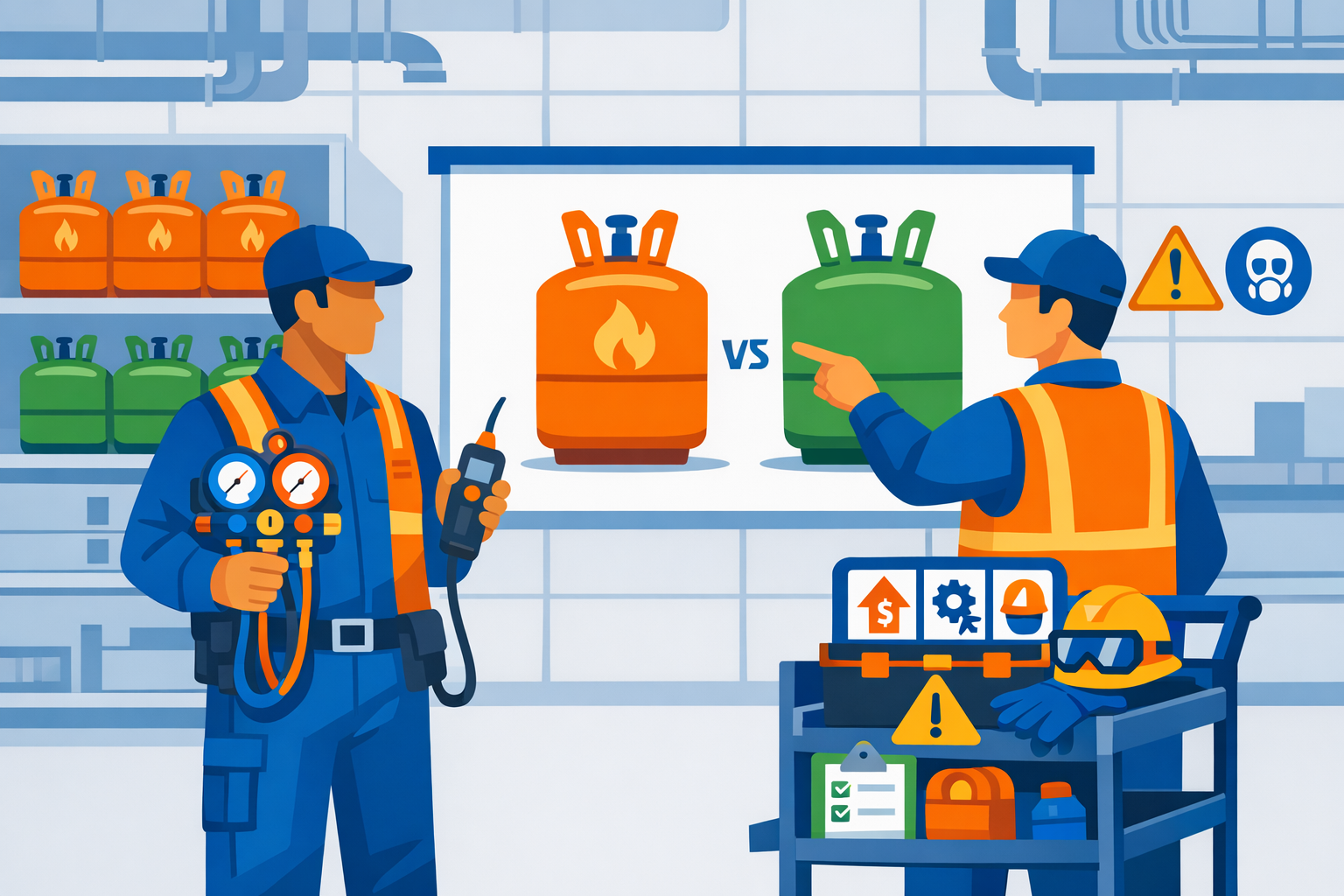
The mild flammability of A2L refrigerants - classified as such under ASHRAE Standard 34 - materially changes field service procedures. R-454B's A2L classification means technicians require A2L-rated gauges, recovery machines, and leak detectors, as standard R-410A tools may not be compatible. Systems must include leak mitigation strategies such as automatic leak detection, shutdown mechanisms, and blower fans to dissipate refrigerant. A2L line sets require "Risk of Fire" labeling in compliance with local building codes.
Updates to the International Mechanical Code (IMC), International Building Code (IBC), and International Fire Code (IFC) now permit wider use of A2L refrigerants but impose new installation obligations. The latest ASHRAE standards introduce stricter requirements for refrigerant classification, charge limits, ventilation, and labeling, affecting both new construction and retrofit projects. Engineers must design systems that safely accommodate mildly flammable refrigerants, incorporating ventilation thresholds, room size considerations, and leak detection placement.
New EPA 608 certification is not currently mandated federally for A2L-specific work, but many states are adding individual requirements. Technicians are advised to confirm requirements with their state board before working on R-454B systems. A2L systems cost 10-15% more than previous-generation equipment due to additional safety features, and contractors must invest in new recovery equipment, leak detectors, and updated training certifications.
Outlook
Analysts predict that by 2028, R-454B pricing may fall to levels comparable to what R-410A once commanded as large-scale production improves economies of scale. Existing R-410A systems continue operating normally and can be serviced with R-410A refrigerant, but parts availability and refrigerant costs will gradually increase as production shifts entirely to next-generation alternatives. For contractors navigating the transition, the dual-refrigerant inventory environment - legacy R-410A for service work alongside A2L refrigerants for new installations - is expected to define the market through the remainder of the decade.