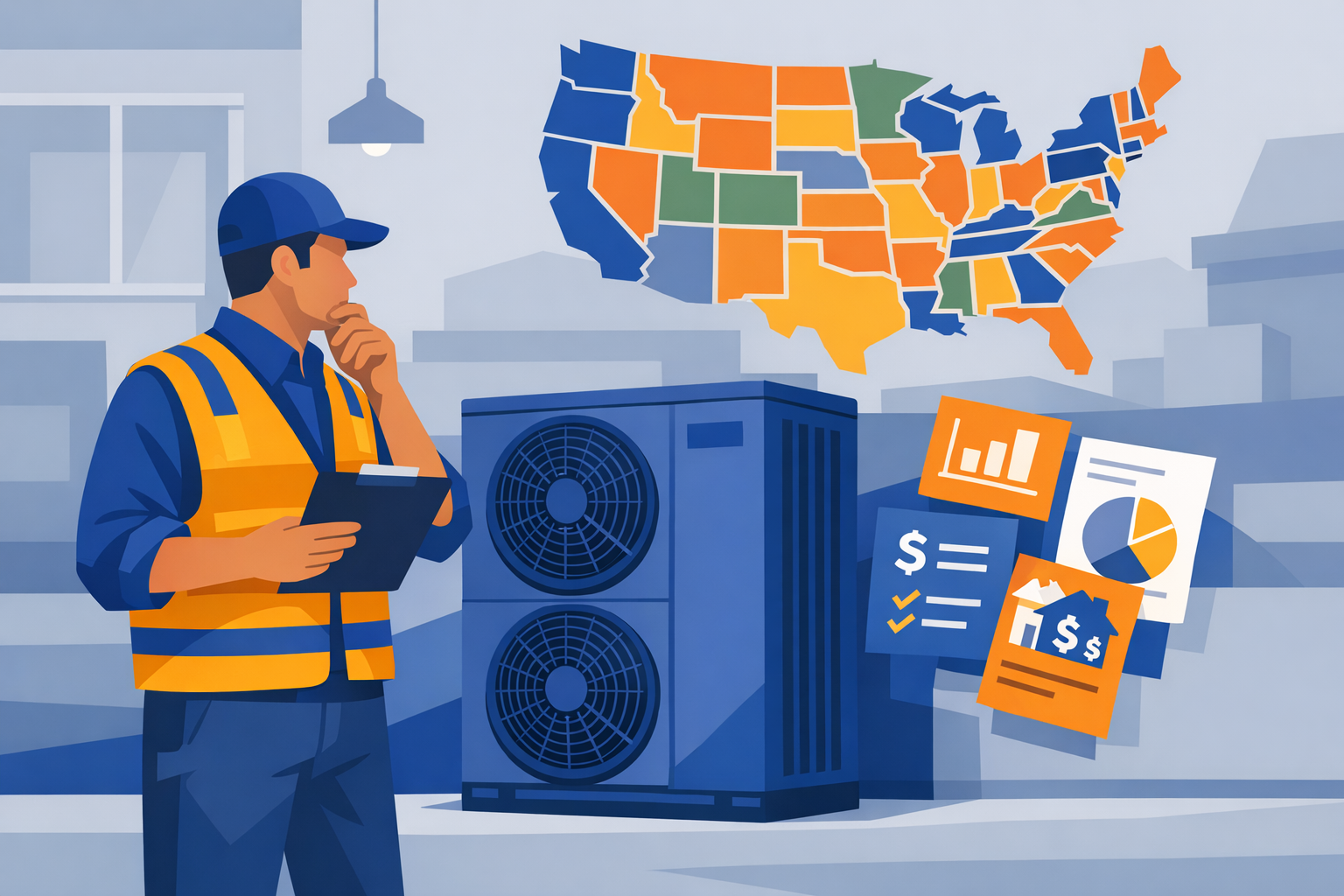
The U.S. HVAC sector is navigating a mandatory transition to mildly flammable A2L refrigerants, reshaping retrofit strategies, safety obligations, and technician upskilling requirements across residential and commercial service chains. Manufacturing of new R-410A residential split systems and heat pumps became legally prohibited as of January 1, 2025. With new equipment already deploying A2L blends industry-wide, these refrigerants are now the baseline rather than the exception - transforming installation practices, service workflows, equipment pricing, and long-term ownership economics.
Regulatory Background
The transition is driven by two overlapping federal programs. The HFC Phasedown Program gradually reduces hydrofluorocarbon refrigerant use over 15 years, while the Technology Transitions Program supports that phasedown by requiring a shift to next-generation equipment free of HFC refrigerants in residential and light commercial construction.
Residential and light commercial air conditioners and heat pumps manufactured after January 1, 2025, must use A2L refrigerants. Pre-transition equipment carries a one-year grace period for installation through January 1, 2026. R-410A has a global warming potential (GWP) of 2,088 - far exceeding the new regulatory ceiling of 700.
On the code side, the 2024 editions of ASHRAE Standards 15 and 34 introduce updated safety, classification, and installation requirements. Standard 15 addresses leak detection, ventilation, and equipment placement for flammable refrigerants, while Standard 34 defines refrigerant categories by toxicity and flammability. Updates to the International Mechanical Code, International Building Code, and International Fire Code also permit wider use of A2L refrigerants under these new standards.[1]
Supply constraints have further complicated the timeline. In some regions, concerns over A2L refrigerant availability have contributed to hoarding and, in certain cases, higher installation costs and extended lead times. In response, the EPA issued a proposed rule reconsidering certain Technology Transitions requirements, including removal of language that would have prohibited installing systems with GWPs above 700 on or after January 1, 2026.
Retrofit Challenges and Safety Requirements
Legacy R-410A systems cannot be directly retrofitted to use A2L refrigerants due to incompatible system design. A1-classified refrigeration systems lack the safety architecture required for A2L operation, meaning businesses may need to invest in entirely new equipment designed for A2L compliance. Every component in an A2L system - fans, compressors, and electrical connections - must be specifically rated and certified for mildly flammable refrigerants, requiring manufacturers to redesign and recertify virtually their entire product lines.
Where partial upgrades are under consideration, the economics frequently favor full replacement. Retrofitting may keep upfront costs low and downtime minimal, but efficiency rarely exceeds 90 percent of a new unit. For small systems under five tons, payback analysis often favors replacement: new units can exceed 15 SEER2, while retrofits yield minimal efficiency gains.
Installation requirements for A2L systems often include enhanced ventilation in mechanical rooms to ensure that, even during a significant leak, refrigerant concentrations remain well below flammability thresholds. Leak detection requirements grow increasingly stringent based on the A2L refrigerant charge, codified under M1, M2, and M3 charge classifications. Systems exceeding the M1 charge limit of 62.6 oz of refrigerant require a factory-installed or provided refrigerant detection system (RDS), according to Enertech Global.
Workforce Upskilling and Certification
The refrigerant phasedown represents a fundamental transformation of the HVACR workforce. As high-GWP refrigerants give way to mildly flammable A2L alternatives, updated technician training and certification have become critical - untrained workforces place operational safety and long-term compliance at significant risk.
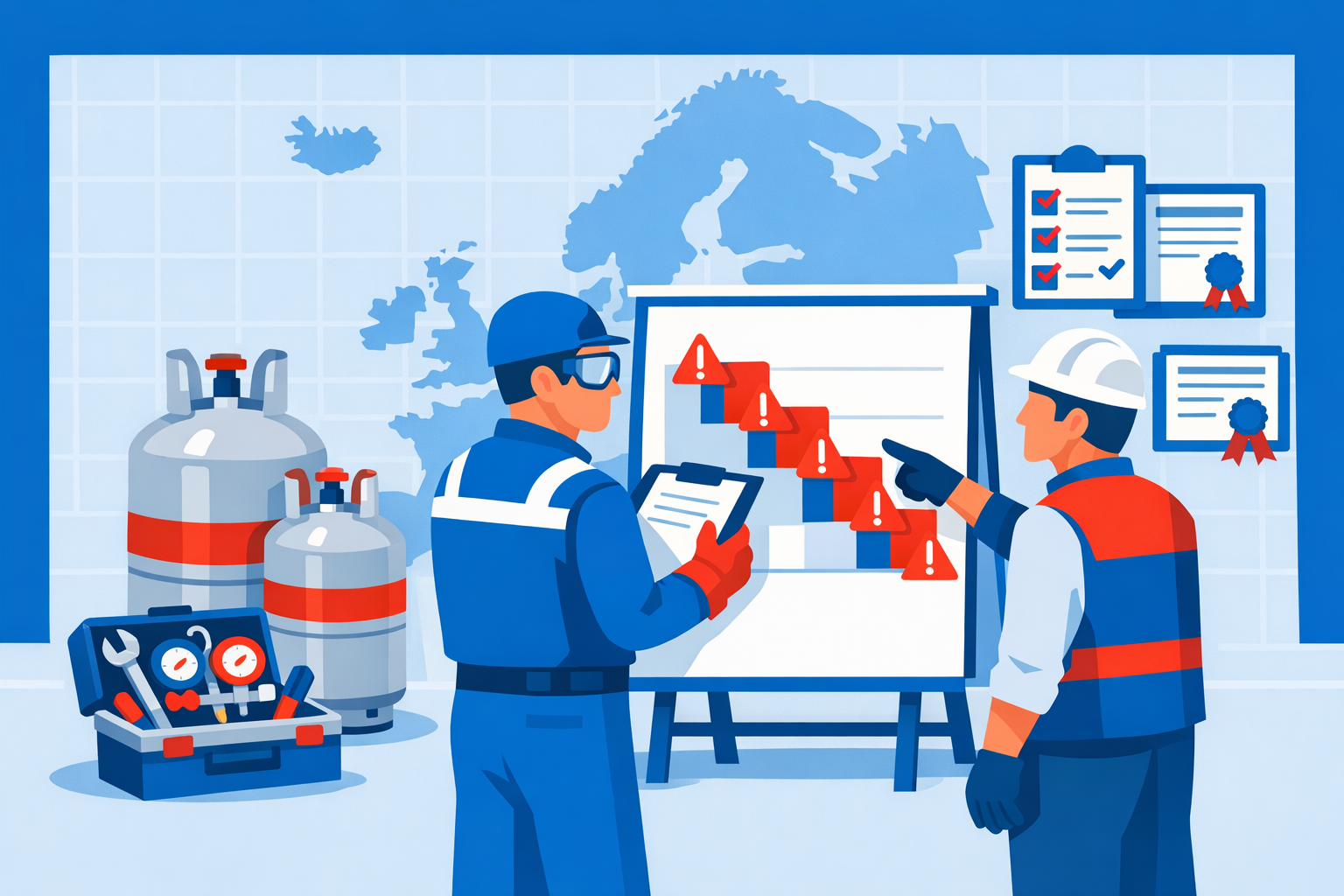
The mild flammability of A2L refrigerants introduces safety considerations that demand specialized tools, updated installation practices, and rigorous handling protocols. Leak detectors must identify even low-level leaks in enclosed spaces, and vacuum pumps and refrigerant handling tools must be spark-proof and rated for flammable blends.
Industry bodies and manufacturers have expanded formal training pathways in response. North American Technician Excellence (NATE) offers a Low-GWP certification exam specifically covering A2L refrigerants and safe handling procedures. NATE's Low-GWP certification ensures technicians possess the skills and knowledge to handle these refrigerants safely, with a strong emphasis on proper procedures. In New York City, effective July 1, 2025, all Q-01/Q-99 license holders applying for renewal must submit evidence of completing an A2L Refrigerant, Safety, and Flammable Refrigerant Training Course compliant with FDNY fire and building code requirements, delivered through seven hours of live instruction.
Training demand is especially acute for newer service technicians. Industry trainers note that foundational skills - including soldering, brazing, and torch use around flammable refrigerants - require deliberate instruction that cannot be assumed from existing certifications.
Financial Impact and Outlook
Cost pressures are unevenly distributed across service firms. New A2L-compatible HVAC systems are expected to cost $2,000 to $3,000 more than prior-generation R-410A models, according to SSI Services. Higher quotes reflect the combination of new safety features, component re-engineering, technician training, and A2L parts supply constraints, with total project pricing increases of 15-50 percent reported in some markets.
Over the long term, economics improve with operational performance gains. Energy savings in well-optimized A2L systems can reduce operating costs by 10-30 percent, with less strain on components resulting in longer service life and fewer breakdowns. A2L refrigerants such as R-32 and R-454B operate more efficiently than R-410A, with a projected 5-10 percent reduction in energy consumption over time.
Adoption of updated local standards - including UL 60335-2-40 - remains uneven. Early adopters of A2L technology sometimes operate in regulatory gray zones where inspectors, installers, and code officials interpret requirements differently. Analysts expect more jurisdictions to formally adopt updated standards in the years ahead, reducing ambiguity and increasing enforcement consistency. Contractors that invest early in proper installation practices, documentation, and training are expected to be better positioned as inspections grow more rigorous.