Executive summary. Climate-driven heat waves are pushing commercial, healthcare, and educational HVAC systems to their design limits, increasing the risk of cooling failures when uptime is critical. This analysis explains how data-driven HVAC maintenance, predictive monitoring, and modular upgrade strategies can reduce unplanned downtime, stabilize indoor environments, and improve energy performance during extreme heat events.
Extreme Heat Has Become a Core Reliability Risk for Commercial HVAC
Global building operations account for roughly 40% of energy use and a significant share of CO₂ emissions, with HVAC systems responsible for much of that demand. This baseline load is increasingly subject to higher outdoor temperatures, extended peak periods, and more frequent heat waves.
Recent data highlights the changing landscape:
- 2023 was the hottest year on record globally, consistent with IPCC findings that human-driven climate change has raised the frequency, intensity, and duration of heat waves.
- Over a recent 12-month period, an estimated 6.3 billion people-about 78% of the global population-experienced at least 31 days of extreme heat conditions made at least twice as likely by climate change.
- Europe is currently the fastest-warming continent, with average temperatures about 2.3°C above pre-industrial levels-roughly double the global average increase.
For HVAC and plumbing professionals, this results in:
- Higher peak cooling loads and more frequent operation at full capacity
- Increased risk of simultaneous failures (e.g., multiple chillers or air-handling units under stress)
- Tighter comfort and indoor air quality (IAQ) tolerances in critical facilities such as hospitals, senior care, and schools
Traditional design margins and standard maintenance schedules are increasingly inadequate. System resilience now depends on how assets are maintained, monitored, and upgraded over time.
Why Traditional HVAC Maintenance Underperforms in Heat Waves
Many commercial and institutional facilities still rely on reactive or fixed-interval preventive maintenance. During extreme heat, these methods provide minimal margin between a stressed system and total cooling failure.
Common maintenance modes in existing facilities
| Maintenance strategy | Typical trigger | Strengths | Weaknesses under extreme heat |
|---|---|---|---|
| Run-to-failure (reactive) | Component stops or alarms | Low upfront cost; minimal planning | High downtime, emergency callouts, collateral damage |
| Time-based preventive (PM) | Fixed calendar or hour intervals | Familiar, easy to schedule | Does not reflect actual asset condition or heat stress |
| Condition-based | Simple thresholds (e.g., ΔT, amps) | Links to operating conditions | Limited diagnostics; too coarse to avoid sudden failures |
| Predictive (data-driven) | Analytics on continuous sensor data | Anticipates failures; supports planning | Requires sensors, connectivity, data skills, and process change |
Under heat-wave conditions, the limitations of reactive and time-based PM are intensified:
- Components already degraded (e.g., fouled coils, low refrigerant, failing pumps) may pass spring checks but fail rapidly when temperatures spike.
- Time-based PM misses rapidly developing problems like condenser water scaling, valve degradation, or short-cycling caused by control faults.
- During regional heat events, repair resources and replacement parts may be scarce, extending outage durations.
This leads to a reliability gap: systems appear maintained but lack the resilience to withstand prolonged high-load conditions.
Predictive Monitoring and Fault Detection: Stabilizing Cooling Before It Fails
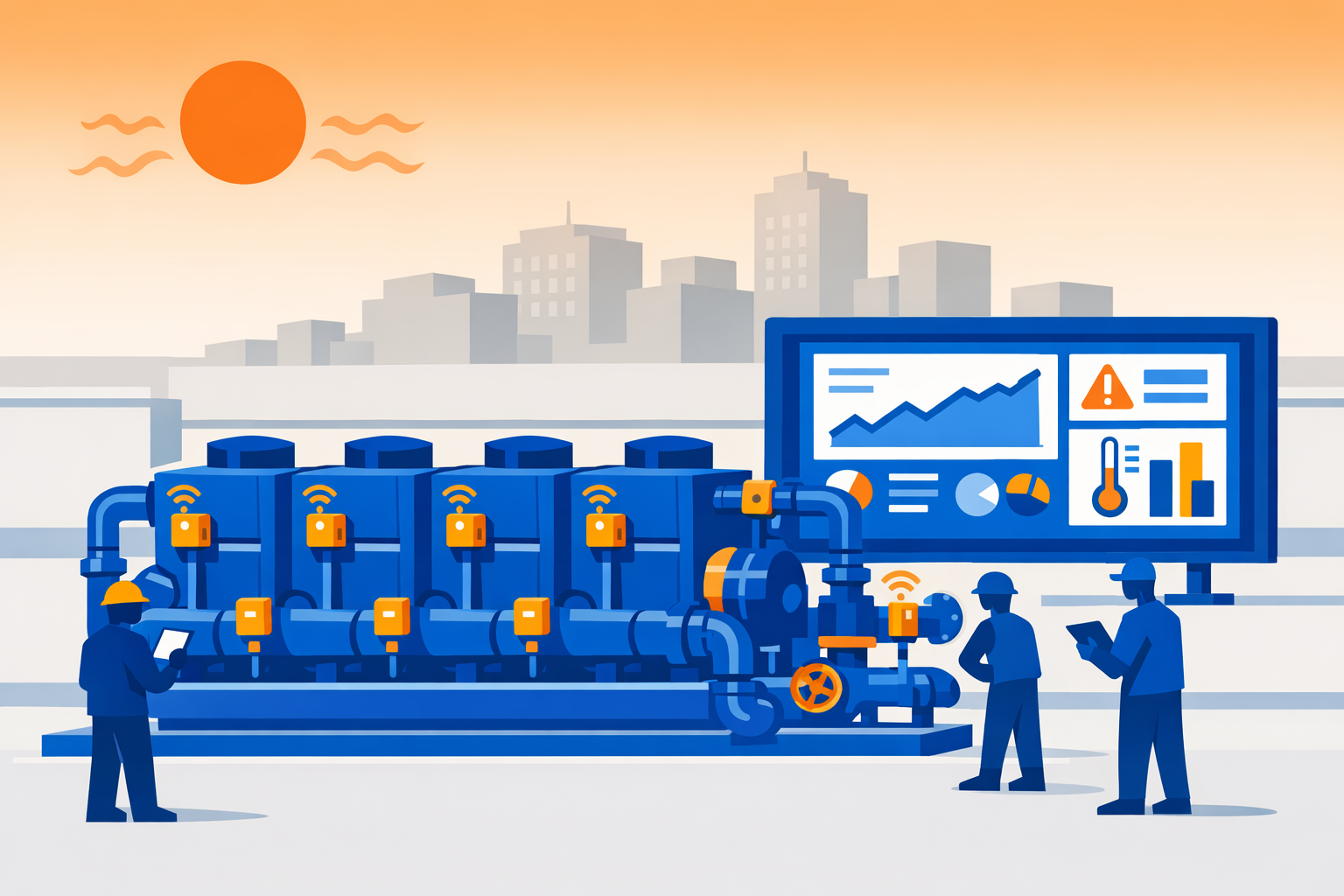
Data-driven maintenance and predictive monitoring address this reliability gap. Sensors, connectivity, and analytics enable early detection of failures and prioritization of interventions before service loss.
Quantified benefits of predictive maintenance
Industry studies reveal similar performance improvements:
- Predictive maintenance reduces unplanned downtime by approximately 20-50% versus reactive or time-based approaches.
- Analytics-driven maintenance strategies lower maintenance costs by 10-30% and improve asset availability.
- Energy-focused predictive maintenance programs report 10-15% energy cost reductions in industrial settings by correcting inefficiencies early.
Building-specific research supports these findings. A recent commercial study using digital twin-enabled predictive HVAC maintenance showed:
- Fault detection accuracy above 96%, a 32.7% reduction in maintenance costs, a 45.3% increase in mean time between failures, and a drop in annual HVAC energy intensity from about 152 to 139 kWh/m².
Under extreme heat, longer mean time between failures and earlier detection directly reduce cooling outages and help maintain stable indoor conditions.
Key building blocks of predictive HVAC monitoring
Predictive monitoring typically integrates:
- Sensor infrastructure:
- Continuous measurements (temperatures, humidity, pressures, flow rates, valve positions, fan speeds, energy use, vibration).
- Coverage across chillers, pumps, cooling towers, boilers, AHUs, FCUs, VRF systems, terminal devices.
- Fault Detection and Diagnostics (FDD):
- Algorithms identify conditions such as simultaneous heating/cooling, abnormal coil ∆T, or heat rejection degradation.
- Remote FDD reduces diagnostic labor, prevents energy waste, and flags failures before comfort complaints.
- Remote monitoring and analytics platforms:
- Systems aggregate BAS data, meter readings, and field sensor inputs.
- Dashboards rank issues by energy, comfort risk, and operational impact, guiding maintenance priorities.
- Integration with work management:
- Automatically generated work orders assign detected faults to specific tasks (e.g., clean coils, rebalance loops, recalibrate sensors).
- Ongoing feedback improves fault models and reduces false positives over time.
Heat-wave-specific use cases
In the context of extreme heat, predictive monitoring particularly aids in:
- Condenser performance and water quality monitoring: Early warnings of scaling, fouling, or biofilm protect heat rejection capacity.
- Refrigerant charge and compressor health: Condition monitoring enables preemptive action before compressor failure during peak loads.
- Demand-spike forecasting: Weather and occupancy integration allows pre-cooling or staged ramp-up, preventing sudden load spikes.
- IAQ and comfort assurance: Monitoring in line with ASHRAE 55 and similar standards helps maintain safe conditions during severe weather.
Preventive HVAC Upgrades That Enhance Heat Resilience
While predictive monitoring mitigates downtime risk, it cannot overcome undersized or obsolete systems. Targeted HVAC upgrades-especially modular, phased interventions-increase both resilience and efficiency.
Modular chiller plants and staged capacity
Modular chiller concepts distribute capacity across several smaller units, providing:
- N+1 or N+2 redundancy, so single failures do not cause total cooling loss
- Sequenced operation based on real-time load and electricity pricing
- Simplified phased replacement, allowing upgrades without full plant shutdowns
In retrofits, modular chillers with upgraded towers and variable-speed drives enhance energy savings, particularly when paired with:
- Optimized condenser-water temperature strategies
- Night pre-cooling or thermal storage to reduce daytime peaks
- Free-cooling or waterside economizer modes, climate permitting
Fan-coil and terminal unit retrofits
Fan-coil and terminal units represent frequent failure points in hospitals, hotels, dormitories, and offices. Studies show fan energy can contribute up to a quarter of a building's HVAC electricity use.
Resilient upgrade measures include:
- Replacing aging FCUs with electronically commutated (EC) fan units and superior coils
- Adding smart valves and room controllers for demand-driven operation and remote diagnostics
- Applying retrofit kits to convert air handlers or FCU circuits to low-temperature hydronic heat pumps, enabling staged electrification with existing piping
These support phased refurbishment, prevent full-building outages, and enable progressive improvement.
Smart, demand-responsive controls
Controls enhancements often deliver the fastest resilience gains per investment:
- Advanced BAS/BEMS:
- Coordinate chiller, pump, AHU, and terminal device control
- Enable grid demand-response and automated setpoint optimization by occupancy, IAQ, and external conditions
- Model-predictive and AI control:
- Use forecasts to proactively adjust operation
- Lower energy and peak loads while maintaining comfort
- Zone-level enhancements:
- Reduce non-critical cooling during heat events; maintain capacity for essential areas like operating theaters, data rooms, or pharmacies
Energy and emissions impact of resilience-focused upgrades
Beyond reliability, such retrofits offer significant energy and emissions impacts:
- HVAC accounts for roughly 40-50% of energy consumption in many commercial and institutional buildings.
- Sustainable refurbishment data shows HVAC retrofits provide 40-70% of total building energy savings in deep projects.
Upgrades primarily justified for resilience and uptime also advance corporate climate and energy goals.
Cost and Planning: Balancing Capital, Risk, and Operating Savings
Facilities must balance resilience investments against budget constraints. A structured approach enables comparison based on both energy use and reliability.
Illustrative comparison of resilience measures
The following table summarizes typical characteristics. Actual values vary by building type and region.
| Measure | Capex level | Energy savings impact | Downtime reduction impact | Implementation complexity |
|---|---|---|---|---|
| BAS software upgrade with FDD | Low-Medium | Medium | High (fewer surprise failures) | Medium (integration, tuning) |
| Additional sensors on existing plant | Low | Low-Medium | Medium-High | Low-Medium |
| Modular chiller plant reconfiguration | High | High | High | High (major plant works) |
| FCU / terminal unit replacement program | Medium-High | Medium | Medium-High (fewer local outages) | Medium-High (phased works) |
| Variable-speed drives on pumps and fans | Medium | Medium-High | Medium | Medium |
| Thermal storage or pre-cooling integration | Medium-High | Medium-High | Medium-High (peak shaving, redundancy) | High (design, controls) |
While modular plant upgrades may require substantial capital, predictive monitoring and FDD often have lower costs and utilize existing infrastructure. This allows early reliability and energy benefits while planning more extensive retrofits.
A Practical Roadmap for Heat-Resilient Commercial HVAC
Successful resilience initiatives follow clear, staged actions. The following roadmap reflects emerging patterns across healthcare, education, and commercial portfolios.
1. Map critical cooling loads and resilience priorities
- Classify spaces by criticality (e.g., operating rooms, ICUs, pharmacies, server rooms, classrooms, offices)
- Quantify outage impacts (patient safety, compliance, business continuity, reputation)
- Identify single points of failure in HVAC serving critical zones
2. Establish a tiered maintenance strategy
- Define maintenance and monitoring tiers by criticality:
- Tier 1 - Mission-critical: Continuous monitoring, predictive analytics, short inspection intervals, formal redundancy
- Tier 2 - High-importance: FDD coverage, condition scheduling, seasonal reviews
- Tier 3 - Standard: Targeted time-based PM with selected sensors
- Align contracts and procedures, including response commitments during heat events
3. Deploy predictive monitoring in phases
- Start with central plant (chillers, boilers, towers, major pumps) and main AHUs for large loads
- Add sensors and FDD to representative terminal units in priority zones
- Leverage analytics to:
- Catalog common faults and root causes
- Quantify avoided downtime and energy savings to inform investments
4. Plan modular and no-downtime upgrades
- Use condition data to target replacement of highest-risk chillers, AHUs, or terminals
- Design upgrades for:
- Temporary bypass or rental plant during works
- Phased cutovers by wing, floor, or zone
- Future electrification and low-carbon integration
5. Integrate with standards and emergency planning
- Reference ASHRAE and national guidance for:
- Thermal comfort and IAQ thresholds (ASHRAE 55)
- Specialized HVAC requirements for critical spaces
- Align HVAC management with extreme heat plans, including:
- Pre-event system checks and redundancy sweeps
- Load-shedding strategies to prioritize critical spaces
- Coordination with clinical, educational, or tenant stakeholders
6. Strengthen supplier and contractor partnerships
- Use framework agreements covering:
- Priority response during regional heat events
- Remote diagnostic and support capability
- Rapid deployment of temporary cooling if needed
- Share aggregated monitoring data with service partners to improve diagnostics
Conclusions and Next Steps for Heat-Resilient HVAC
Extreme heat has become a fundamental consideration for HVAC design and operation. Cooling systems suitable for historical weather patterns may no longer meet the reliability standards required for critical and commercial facilities.
Preventive upgrades and predictive monitoring offer a comprehensive approach:
- Predictive maintenance and FDD lessen both frequency and severity of unplanned outages, especially during stress periods
- Modular plants, upgraded terminals, and advanced controls provide flexibility and redundancy essential for managing prolonged heat waves
- Energy and emissions reductions bolster climate targets and financial cases for resilience improvements
Priority next steps include:
- Completing a critical-load mapping and resilience assessment
- Implementing baseline monitoring and FDD on central plant assets
- Developing phased upgrade plans targeting high-risk components with modular, low-impact strategies
Proactive action reduces outage risk, stabilizes indoor environments, and limits emergency retrofits during crises.
Frequently Asked Questions
How should facilities prioritize where to deploy predictive HVAC monitoring first?
Portfolios generally achieve the most benefit by instrumenting central plant assets (chillers, boilers, cooling towers, pumps) and primary AHUs serving high-priority zones. These systems are major single points of failure and top energy consumers. Once central plant analytics are in place, monitoring representative terminal units in critical zones follows.
What key performance indicators (KPIs) signal elevated HVAC risk during heat waves?
Effective early-warning KPIs include:
- Rising chiller or condenser approach temperatures under similar loads and ambient conditions
- Increasing pump or fan power at equal flow or airflow rates
- High frequency of simultaneous heating and cooling or recurrent reheat in AHUs
- Frequent IAQ or comfort breaches relative to setpoints in vital spaces
- Growing deferred maintenance backlogs on cooling equipment
Combined with weather forecasts, these KPIs support advanced warning of capacity shortfalls.
Are predictive monitoring and FDD feasible for smaller commercial buildings and schools?
Yes. Full-scale BEMS installation is not always required. Options include:
- Using smart thermostats or packaged-unit controllers supporting open protocols
- Adding a minimal sensor suite (power, temperature, outdoor data) routed to cloud analytics
- Leveraging standard rule-based FDD libraries for common rooftop or split systems
These methods deliver much of the benefit with reduced complexity and cost.
How often should predictive maintenance models and rules be updated?
Update frequency depends on system changes and data quality. Common practices include:
- Annual review of rule-based FDD libraries and after major plant or controls changes
- Retrain data-driven models when building use or equipment changes significantly
- Perform regular checks comparing predicted to actual failures for tuning thresholds and logic
Timely updates ensure analytics reflect real asset performance as systems evolve.
How can facilities quantify the financial value of resilience-focused HVAC initiatives?
Quantification combines several factors:
- Historical records of HVAC downtime and associated disruptions
- Avoided emergency and overtime costs compared to prior years
- Measured reductions in energy and demand charges post-upgrade
- Risk-based estimates of avoided major failures (e.g., chiller outage likelihood and impact during heat waves)
Tracking these metrics before and after upgrades supports a solid business case that includes both reliability and efficiency gains.