The European Union's revised F-Gas Regulation (EU 2024/573), effective since March 11, 2024, imposes an accelerated phase-down of high-GWP hydrofluorocarbons targeting commercial refrigeration. The regulation mandates an 80% reduction in HFCs by 2030 and a full phase-out by 2050. Retailers, supermarket operators, hospitality companies, and cold-storage facilities face binding milestones restricting both new equipment purchases and servicing of existing systems, requiring capital expenditure planning and workforce adjustments across the HVACR supply chain.
Background
The F-Gas Regulation (EU) 2024/573 was adopted on 7 February 2024 and took effect on 11 March 2024.[1] It replaces the 2014 regulation that first introduced the HFC quota system. The updated framework aligns with the EU's Green Deal and Fit for 55 package to achieve climate neutrality by 2050 and contribute to 55% emission reductions by 2030. The HFC phase-out process had already reduced F-gas emissions by roughly 33% by 2023, from a 2014 peak.[2] However, the European Commission determined that the prior schedule would not deliver sufficient reductions by 2030, prompting the steeper trajectory now in force.
Commercial refrigeration is a primary target. Since January 2022, multipack centralised refrigeration systems for commercial use with a rated capacity of 40 kW or more containing F-gases with a GWP of 150 or more have been prohibited, except in the primary refrigerant circuit of cascade systems where F-gases with a GWP below 1,500 may be used. The new regulation extends restrictions to a broader range of equipment and tightens servicing rules.
Details
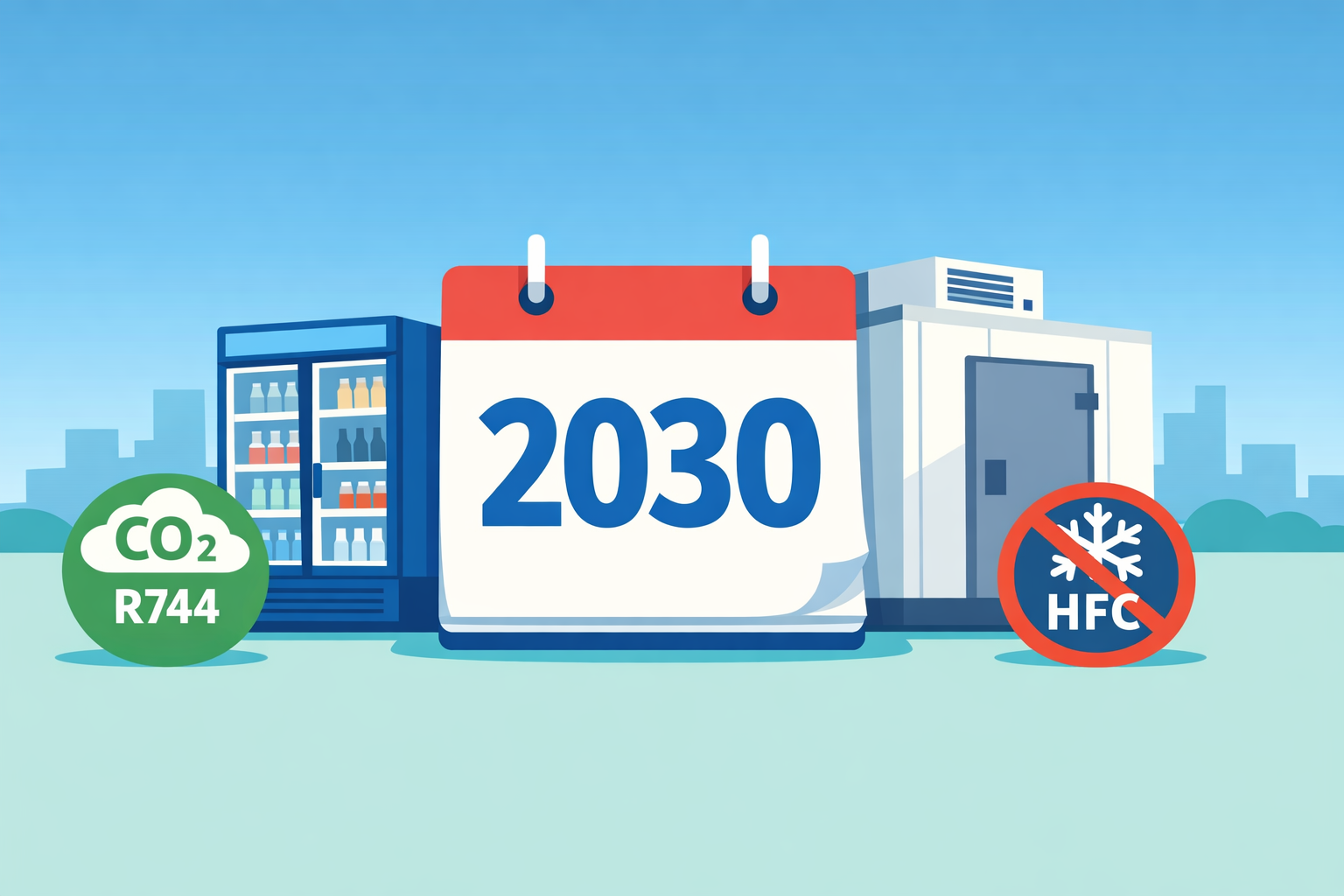
The revised regulation introduces a phased series of market bans and servicing restrictions. From January 1, 2025, self-contained commercial refrigerators and freezers containing F-gases with a GWP of 150 or more are banned from the EU market, according to the regulation's Annex IV. From January 2030, F-gases with a GWP of 150 or more are prohibited for non-self-contained refrigeration equipment. This 2030 deadline affects centralized supermarket systems, walk-in cold rooms, and large-scale cold storage - the backbone of food retail and distribution.
Servicing restrictions compound the equipment bans. From January 2025, the use of virgin HFCs with a GWP of 2,500 or more is prohibited for the maintenance or servicing of any refrigeration equipment, as specified in the regulation text. A further limit on using virgin HFCs with a GWP above 750 to service stationary refrigeration equipment takes effect in 2032. Reclaimed or recycled refrigerants remain permitted under temporary derogations, but availability is expected to tighten as overall quotas decline.
The quota system itself is accelerating. HFC quotas for the EU market dropped to 42.9 million tonnes CO₂ equivalent for 2025-2026, representing a 48% reduction compared to the 2023 value of 82.3 million tonnes CO₂ equivalent, according to data published by General Gas. For 2027-2029, the total quota will be further halved to approximately 21.7 million tonnes CO₂ equivalent, then fall to about 9 million tonnes for 2030-2032.
Workforce requirements are also shifting. The European Commission will establish training and certification programme requirements by March 2026, and member states must establish or adapt certification programs by March 2027. Companies must ensure that any employee handling F-gases completes mandatory refresher training at least every seven years. The Commission has also released a proposed regulation establishing minimum certification requirements for engineers working with natural refrigerants - specifically CO₂ (R744), hydrocarbons, and ammonia (R717).
On the technology side, R744 (CO₂) systems can reduce energy consumption by up to 37% in commercial refrigeration units compared to R134a systems, according to research published in ScienceDirect. CO₂-based transcritical and cascade systems, along with hydrocarbon-based (R290) units, are emerging as the primary low-GWP alternatives for the commercial sector.
Outlook
With the 2030 GWP-150 limit for non-self-contained refrigeration approaching, supermarket chains and cold-storage operators face capital investment decisions within the next two to four years. Contractors and system designers in these sectors should evaluate retrofit and replacement pathways now, as equipment lead times, technician certification requirements, and tightening refrigerant supply are expected to create procurement bottlenecks. Related coverage on refrigerant market dynamics and EU transport refrigeration compliance provides additional context for HVACR professionals navigating this transition.