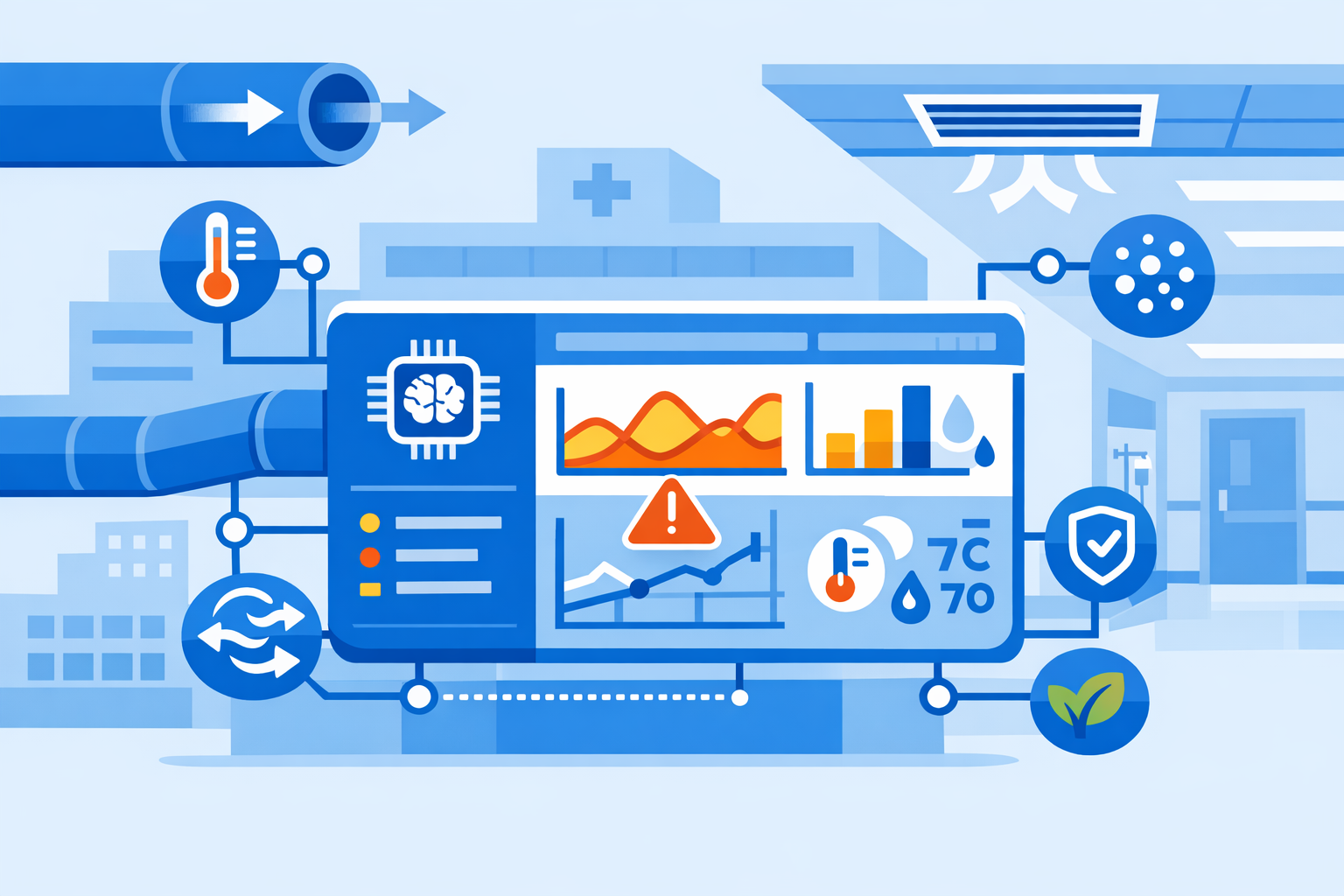
Healthcare facilities across the United States are accelerating deployment of AI-powered HVAC controls and indoor air quality (IAQ) sensor networks as overlapping federal refrigerant mandates raise compliance stakes in clinical environments. The convergence of environmental regulation and patient safety requirements is reshaping how hospital facility teams procure, monitor, and maintain mechanical systems - and creating urgent demand for integrated monitoring infrastructure.
Regulatory Background
The compliance pressure stems from the EPA's Technology Transitions Rule, enacted under the 2020 American Innovation and Manufacturing (AIM) Act. The AIM Act tasked the EPA with overseeing the phasedown of hydrofluorocarbons (HFCs) in the United States, mandating an 85% reduction by 2036. The rule's first wave took effect on January 1, 2025, when the EPA required new residential and light commercial HVAC systems to use refrigerants with a GWP of 700 or less - effectively barring high-GWP refrigerants like R-410A from newly manufactured comfort cooling equipment.
Subsequent phases extend the mandate's reach. As of January 1, 2026, requirements cover Variable Refrigerant Flow (VRF) and Variable Refrigerant Volume (VRV) systems - advanced air conditioning configurations widely used in healthcare construction. Simultaneously, the EPA is lowering the refrigerant charge threshold from 50 pounds to 15 pounds for systems containing high-GWP refrigerants starting January 1, 2026. This change brings many previously exempt systems under stringent federal leak detection, repair, and reporting requirements. Healthcare facilities rank among the most heavily affected sectors.
The primary replacement refrigerants under the new regime carry their own compliance obligations. R-454B - an A2L refrigerant with a GWP around 466 - has emerged as the leading substitute for R-410A in new systems. A2L refrigerants are classified as mildly flammable under ASHRAE Standard 34 due to their low burning velocity, introducing new ventilation, labeling, and leak detection requirements that hospitals must address during system replacement or retrofit.
AI Monitoring as a Compliance and Safety Tool
Hospitals are responding to these regulatory layers by deploying AI-enabled fault detection and IAQ sensor networks that go beyond conventional building automation. Automated fault detection and diagnostics (AFDD) systems have shifted from an optional analytics layer to an operational standard at tier-one building operators in 2025-26. The economic case is clear: chiller and AHU fault detection with 3-8 weeks of lead time replaces emergency repair events that carry 3-4x planned cost premiums.
In clinical settings, the stakes extend beyond cost. Hospital isolation rooms and operating suites depend on precise airflow control through VAV systems. AI can now detect actuator degradation, damper positioning errors, and pressure-independent control valve drift that could compromise room pressurization requirements. Slow refrigerant loss - a growing concern as facilities transition to new refrigerant types - reduces cooling capacity and increases energy consumption. AI correlates superheat and subcooling data with compressor performance to identify leaks before they affect temperature control.
IAQ monitoring is a parallel priority. HVAC, cooling, and heating systems account for 52% of hospitals' total energy use, with inefficient systems carrying the highest costs. Affordable new sensors and AI-powered platforms can continuously monitor environmental data and adjust airflow based on real-time conditions, enabling dynamic response that static occupancy-based systems cannot provide. The American Council for an Energy-Efficient Economy (ACEEE) found that hospitals can save 14% of annual building energy consumption by integrating smart technology systems.
Market data reflects the acceleration. The global smart hospital HVAC market is projected to expand from $6.19 billion in 2025 to $7.18 billion in 2026, at a CAGR of 15.9%. Looking further ahead, the market is anticipated to reach $12.81 billion by 2030, with heightened emphasis on indoor air quality, infection control, and patient comfort identified as primary drivers.
Outlook
The compliance timeline continues to tighten. Beginning January 1, 2026, the EPA's HFC Leak Repair and Management Rule places mandatory leak detection and repair requirements on owners or operators of HFC-containing appliances with a refrigerant charge of 15 pounds or greater. As the industry transitions to A2L refrigerants, leak detection and environmental monitoring become even more critical. A2L refrigerants have different safety profiles than legacy refrigerants, and facilities need reliable detection systems integrated with building automation systems (BAS). For hospital facility managers and HVAC contractors, the pressure to align refrigerant compliance with continuous IAQ performance monitoring is no longer theoretical - it is an active project requirement across new construction and existing infrastructure alike.