Amazon and Transaera announced a multi-year commercial agreement on May 5, 2026, to integrate next-generation heat pump technology across Amazon's HVAC infrastructure - a deal that signals accelerating large-scale electrification in the commercial building sector. The partnership follows a six-month field trial of Transaera's rooftop-based cooling system at an Amazon logistics facility, with results validated through independent third-party analysis, according to a joint press release from Somerville, Massachusetts.
Background
The agreement comes as the commercial HVAC sector faces mounting pressure to cut energy consumption in large-footprint buildings. HVAC systems account for over one-third of energy use in commercial buildings, according to Sorin Grama, CEO and co-founder of Transaera. Heat pump installations have outsold gas furnaces consistently since 2021, a trend expected to continue as manufacturers capitalize on improved efficiency, according to the Rocky Mountain Institute. Despite this momentum, adoption has not grown fast enough to meet decarbonization targets - fewer than one in five U.S. households currently have heat pumps, according to Canary Media.
Transaera, founded by MIT engineers and materials scientists, developed a Dedicated Outdoor Air System (DOAS) based on Metal Organic Frameworks (MOFs) - crystalline solid desiccant materials that selectively remove moisture from incoming air before cooling begins. This approach eliminates energy-intensive overcooling and subsequent natural gas reheat, a standard process in conventional rooftop systems. Transaera's DOAS has demonstrated more than double the current federal minimum efficiency standard for moisture removal, the company stated.
Deal Details
Under the expanded collaboration, Transaera will dedicate a portion of its U.S.-based manufacturing output to support Amazon's HVAC deployment needs, with the agreement structured to integrate Transaera's system into Amazon's broader HVAC design solutions. The company is simultaneously building a U.S.-based supply chain for advanced HVAC systems, a move it says supports domestic skilled manufacturing.
The core technology delivers expected energy savings of 40% compared to conventional packaged direct expansion (DX) only systems, in a form factor engineered to match the footprint and weight of legacy rooftop units - enabling drop-in replacement without structural modification. The extended trial demonstrated consistent performance in hot and humid conditions, according to the joint statement.
"This announcement signals that high-performance HVAC is no longer a niche innovation - it's becoming the new standard," Grama stated in the release.
For HVAC professionals and service networks, the agreement carries practical implications. Transaera's systems function as full heat pumps capable of cooling, heating, and dehumidifying without natural gas reheat - directly aligning with electrification mandates taking shape across multiple U.S. states.
Outlook
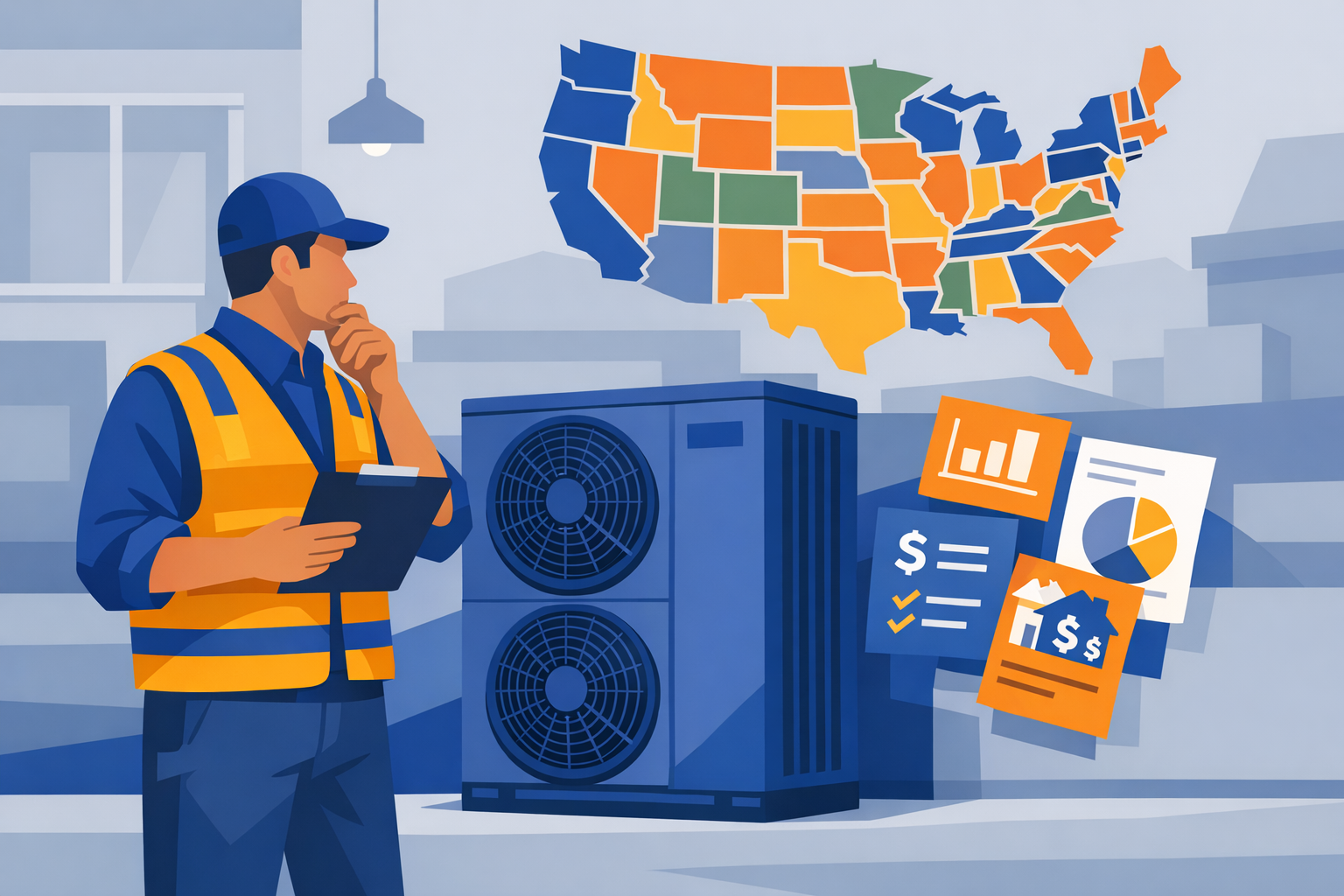
The Amazon-Transaera deal enters a policy environment where state-level action is filling a gap left by reduced federal incentives. Eleven U.S. states including California, Colorado, Massachusetts, and New York have committed to heat pumps making up 65% of residential heating, air conditioning, and water heating equipment sales by 2030, with targets rising to 90% by 2040, according to a NESCAUM action plan published in September 2025. Meanwhile, the global heat pump market is projected to grow from USD 96.36 billion in 2025 to USD 174.56 billion by 2032, according to MMR Statistics. For HVAC installers, system designers, and procurement managers, the Amazon-Transaera scale-up points to near-term demand for technicians trained in all-electric DOAS commissioning, servicing, and integration with existing rooftop unit configurations - a workforce gap that industry groups and state programs are already working to address.